The Psychology of the Superfluous Apology
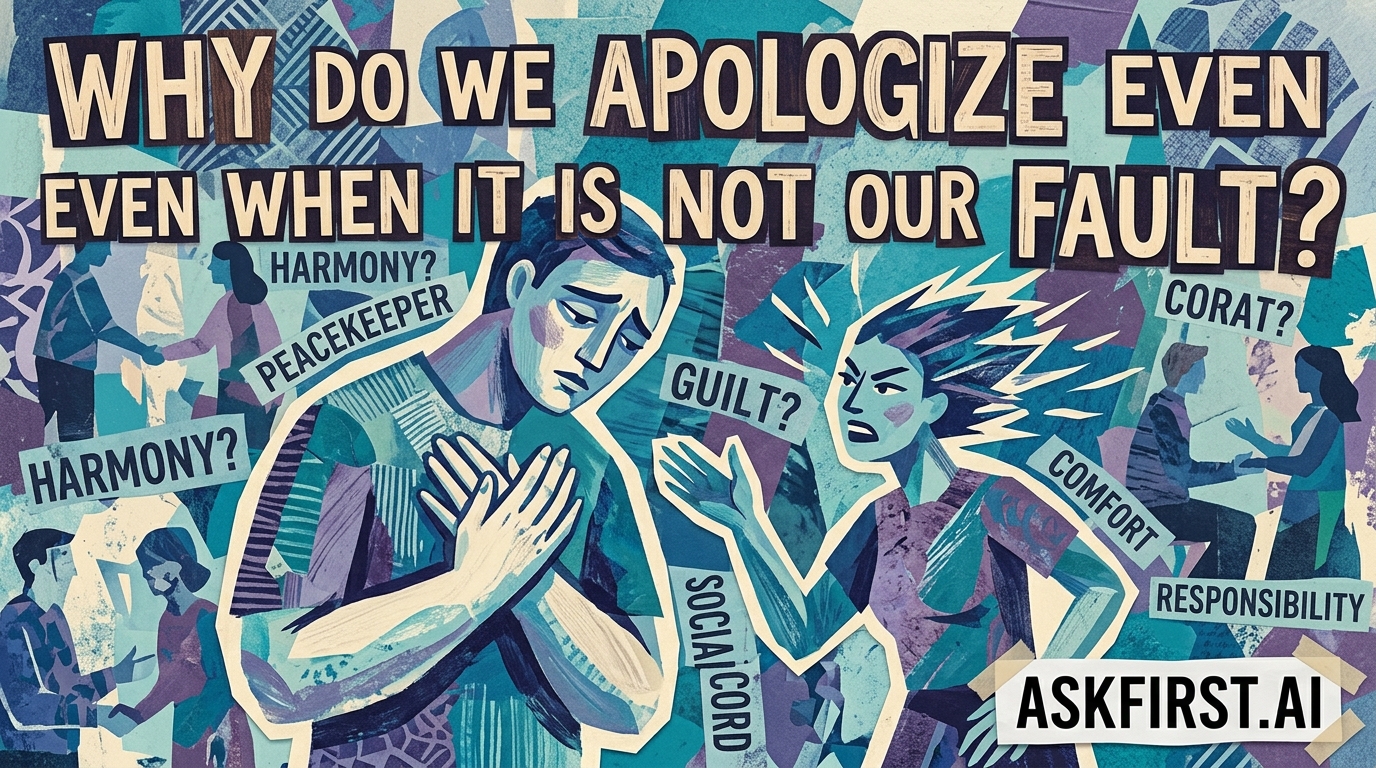
Human interaction is governed by an intricate web of social lubrication, and the act of apologizing—even when no objective wrongdoing exists—is a primary mechanism for maintaining relational stability. This phenomenon is often labeled as the 'superfluous apology.' While it may seem illogical from a perspective of personal accountability, the behavior is deeply rooted in evolutionary psychology and the pursuit of social harmony.
1. The Prosocial Buffer
Apologies function as social glue. When individuals express regret for situations beyond their control, such as a missed train causing a colleague's late arrival, they are prioritizing the relationship over the literal truth. This behavior is considered prosocial because it acknowledges the other person's discomfort. By saying 'I am sorry you are stuck in traffic,' one is validating the other's emotional experience rather than claiming responsibility for the traffic jam. This creates a psychological buffer that reduces tension and prevents defensiveness.
2. The De-escalation Strategy
In high-stress environments, an apology acts as an immediate de-escalation tool. Research into conflict resolution suggests that the word 'sorry' can serve as a verbal peace treaty. When a person senses that an interlocutor is frustrated or agitated, offering an apology—regardless of fault—effectively lowers the status differential between the two parties. It signals to the other person, 'I am not your adversary; I am your ally.' This is highly effective in professional settings, such as customer service or collaborative project management, where the goal is to resolve an issue rather than win a debate.
3. Empathy Signaling
Another driving factor is the human need to signal empathy. Apologizing serves as a tangible metric of caring. It is a way of saying, 'I recognize your pain, and I wish you were not experiencing it.' This emotional intelligence is highly valued in human society. Those who offer unsolicited apologies are often perceived as more agreeable and conscientious. They are viewed as individuals who care about the collective emotional state of their environment, which strengthens bonds within families, friendships, and organizational cultures.
4. The Mitigation of Future Risk
From a sociological perspective, the superfluous apology is also a form of risk mitigation. In many cultures, standing one's ground during a minor friction can be interpreted as aggressive or stubborn. By taking a symbolic hit, one preempts the potential for conflict to spiral into a more damaging dispute. It is a strategic surrender that preserves political capital for more significant matters. The cost of a small, false apology is almost always lower than the cost of a long-standing, unproductive disagreement.
5. Linguistic Habit and Social Conditioning
It is important to acknowledge that sometimes these apologies are purely automatic, driven by ingrained social scripts. Many individuals are socialized from childhood to maintain politeness at all costs. This 'habitual apologizing' acts as a filler phrase, much like 'um' or 'ah,' intended to soften the impact of an interaction. While some experts argue that excessive apologizing can diminish personal authority, it remains an integral part of polite discourse across many global societies.
Practical Takeaways for Professional and Personal Growth
- Assess the Impact: If an apology validates a friend’s feelings without compromising your self-worth, it is a tool for empathy. Use it liberally.
- Balance Authority: In leadership roles, replace superfluous apologies with active appreciation. For example, instead of saying 'Sorry to keep you waiting,' try 'Thank you for your patience.' This maintains the positive sentiment while removing the implication of personal error.
- Understand Cultural Context: Recognize that cultural standards regarding apologies vary widely. In high-context cultures, expressions of remorse are often used as gestures of general concern rather than admissions of guilt.
In conclusion, the tendency to apologize when one is not at fault is far from a sign of weakness. It is a sophisticated, albeit subconscious, application of emotional intelligence designed to preserve social cohesion and foster cooperation. Whether it is an act of genuine empathy or a tactical social maneuver, the superfluous apology remains one of the most effective tools in the human social toolkit, ensuring that relationships remain resilient even in the face of inevitable, daily frustrations.