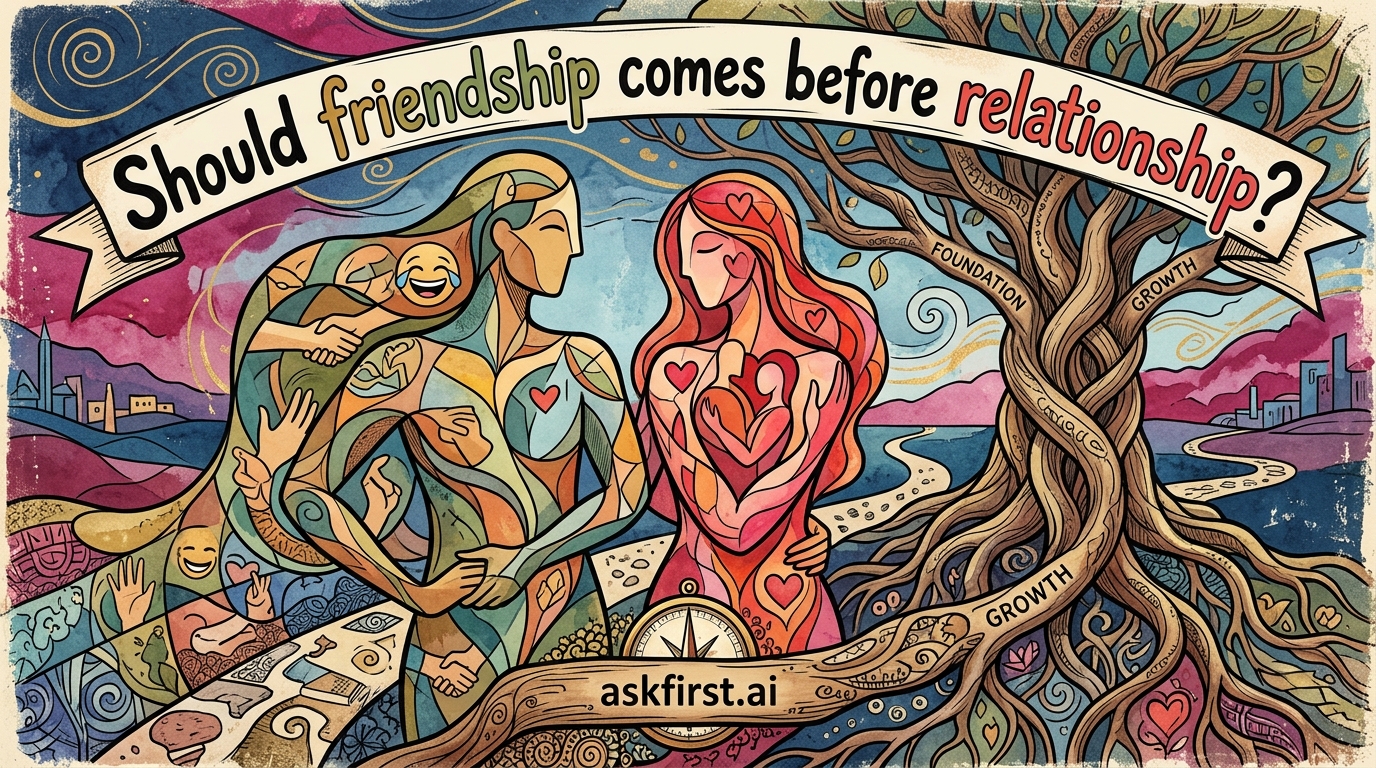
The debate over whether friendship should be the foundational bedrock of a romantic relationship is one of the most enduring inquiries in the sociology of human connection. While cultural narratives often emphasize the "spark" or "love at first sight," psychological research and historical relationship patterns suggest that building a romantic partnership on the soil of a pre-existing friendship offers a distinct competitive advantage for long-term stability.
The Psychological Foundation of Friend-First Relationships
When we examine the literature on interpersonal attraction, we find that the transition from friendship to romance—often termed "friends-to-lovers"—is a common yet under-researched phenomenon. In their extensive studies on relationship initiation, researchers like Danu Anthony Stinson and Joel R. Anderson have noted that many long-term partners cite friendship as the primary stage of their connection.
The core advantage here is information asymmetry reduction. In a traditional dating scenario, both parties are performing a curated version of themselves. They are navigating social scripts, trying to impress, and filtering their personality to appear more desirable. Conversely, in a friendship, the "mask" is rarely worn. You have already observed how the other person reacts to stress, failure, kindness, and trivial annoyances. By the time the romantic transition occurs, you are not gambling on an unknown personality; you are investing in a proven entity.
The Role of Shared Values and Cognitive Compatibility
A relationship built on friendship inherently prioritizes cognitive compatibility. According to Dr. John Gottman, a leading researcher on marital stability and author of The Seven Principles for Making Marriage Work, the "sound relationship house" is built on a foundation of "fondness and admiration." These elements are the natural byproducts of a healthy friendship.
When friendship comes first, the couple develops a shared language, inside jokes, and a collective history that acts as a buffer during future conflicts. Consider a concrete example: a couple who has been friends for years knows each other’s "triggers"—the specific topics or behaviors that lead to anxiety or anger. Because they have navigated these as friends without the added pressure of romantic stakes, they possess a pre-calibrated conflict-resolution mechanism. They are not learning how to communicate while simultaneously managing romantic expectations; they are simply applying an existing toolkit to a new context.
The Paradox of the "Spark" vs. Stability
Critics of the "friendship first" model often argue that it lacks the visceral intensity or "chemistry" required for romantic attraction. This is the "friend-zone" dilemma. However, this perspective often confuses limerence—the state of involuntary obsession and infatuation described by psychologist Dorothy Tennov in her seminal work Love and Limerence—with actual love.
Limerence is transient; it is a neurochemical explosion that inevitably fades. Friendship, by contrast, is rooted in companionate love. When a relationship begins with friendship, the couple is less likely to be blindsided by the "post-honeymoon" crash. They have already established a baseline of respect and mutual support that persists even when the initial romantic novelty wanes. In The Art of Loving, Erich Fromm argues that love is an action, not merely a feeling. Friendship requires the practice of that action—listening, caring, and sacrificing—long before the formal label of "partner" is applied.
Potential Pitfalls and Mitigation
While the benefits are significant, it is important to acknowledge that shifting from friendship to romance carries risks. The primary danger is the loss of the friendship itself if the romantic endeavor fails. To mitigate this, experts suggest:
- Explicit Communication: Do not assume the transition is mutual. Clearly articulate the desire to evolve the relationship.
- Defining Expectations: Discuss whether the romantic aspect changes the fundamental boundaries of the friendship.
- Maintaining Autonomy: Ensure that the romantic intensity does not erode the individual activities and social circles that sustained the friendship in the first place.
The Necessity of Emotional Safety
True intimacy is impossible without emotional safety. In a professional or social setting, we often see people who are guarded and defensive. Friendship acts as a trial period for vulnerability. As Brené Brown highlights in Daring Greatly, vulnerability is the birthplace of connection. If you have already dared to be vulnerable with a friend, the transition to romance is not a leap into the unknown, but a deepening of a path already walked.
Conclusion
Should friendship come first? The evidence overwhelmingly suggests that it should. While society often glamorizes the sudden, cinematic encounter, the data points to the profound durability of relationships born from companionship. By prioritizing friendship, you are essentially vetting your partner for character, reliability, and emotional intelligence before the stakes of romance are introduced. This sequence does not guarantee a lack of conflict, but it does guarantee that when the inevitable challenges of life arise, you are facing them alongside a person who has already proven themselves to be your most reliable ally. In the long arc of a human life, the ability to view one's romantic partner as their best friend is perhaps the most reliable indicator of enduring satisfaction.