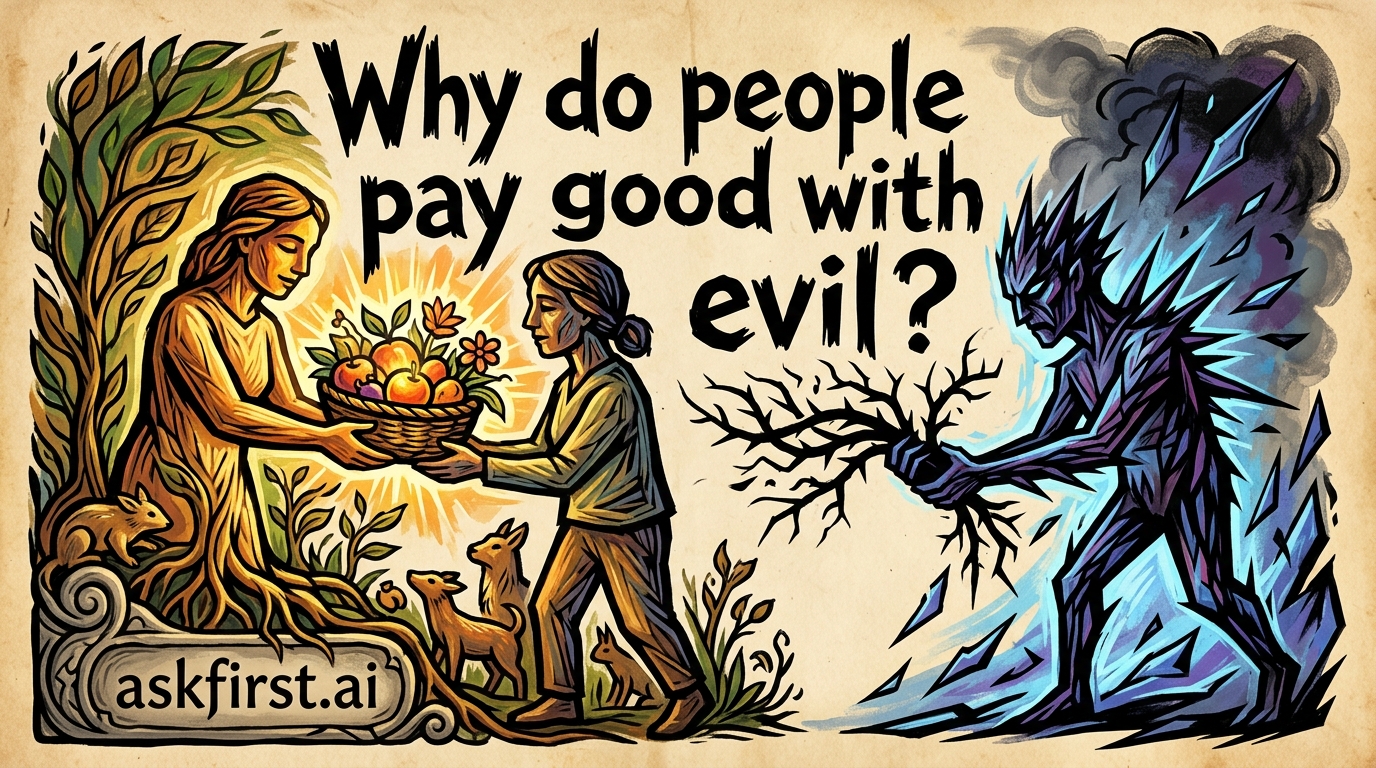
The phenomenon of responding to kindness with cruelty—often described as "paying good with evil"—has perplexed philosophers, psychologists, and sociologists for millennia. It is a fundamental paradox of the human condition: why would an organism, designed for social cooperation, actively undermine those who provide it with benefits? To understand this, we must move beyond simplistic notions of "malice" and examine the complex intersection of evolutionary biology, psychological defense mechanisms, and social power dynamics.
The Evolutionary Perspective: The "Free Rider" and Resource Competition
From an evolutionary standpoint, the drive for self-preservation sometimes overrides the drive for social cohesion. In his seminal work The Selfish Gene, evolutionary biologist Richard Dawkins posits that organisms are biological vehicles designed to propagate their own survival. When an individual receives a benefit (a "good"), they may perceive the benefactor as having an excess of resources. If the recipient lacks the capacity for gratitude or views the benefactor as a competitor, "paying with evil" becomes a brutal strategy to neutralize the benefactor’s influence or claim their territory.
This is often observed in the "Tragedy of the Commons," where individuals prioritize short-term gain over long-term stability. By harming the benefactor, the recipient may seek to eliminate the moral debt they feel, effectively "resetting" the power dynamic in their favor. This behavior is not necessarily a sign of inherent wickedness, but rather a maladaptive survival instinct that views gratitude as a form of submission.
Psychological Defense Mechanisms: The Burden of Indebtedness
Psychologically, the act of receiving kindness can be profoundly uncomfortable for individuals with low self-esteem or deep-seated feelings of inadequacy. In the psychoanalytic tradition, this is often discussed as the "intolerance of benevolence." When someone receives an unearned kindness, it creates a psychological state known as "cognitive dissonance." The recipient may feel a crushing sense of obligation or an implication that they are "lesser" than the person helping them.
As noted by psychiatrist Karen Horney in Our Inner Conflicts, individuals who struggle with power dynamics may view a benefactor’s kindness as a form of condescension. To regain a sense of autonomy, the recipient lashes out. By responding with evil, they reject the "gift" and the implied hierarchy it creates. They essentially say, "I do not need your help, and I will prove it by hurting you." This is an attempt to reclaim control, even if that control is destructive.
The Dynamics of Resentment and Envy
Friedrich Nietzsche explored the concept of ressentiment—a deep-seated, persistent feeling of resentment that arises when an individual feels powerless against those they perceive as superior. In On the Genealogy of Morals, Nietzsche argues that those who cannot achieve the excellence of the benefactor often seek to diminish the benefactor’s status.
When you provide someone with "good," you inadvertently hold up a mirror to their own perceived lack of success or virtue. If the recipient is not secure in their own identity, your kindness serves as a painful reminder of what they lack. This triggers a spiteful reaction. The evil act is not directed at the kindness itself, but at the discomfort that the kindness forces the recipient to confront. It is a defensive maneuver designed to drag the benefactor down to the recipient’s level, thereby alleviating the pain of comparison.
Sociological Factors: The Breakdown of Reciprocity
In a healthy society, the social contract relies on the norm of reciprocity—the expectation that people will respond to each other in kind. However, when social bonds are weakened, the incentive to maintain this reciprocity vanishes. Sociologist Robert Putnam, in his exploration of social capital in Bowling Alone, discusses how the erosion of community leads to a "zero-sum" mentality.
When individuals feel alienated from their community, they stop viewing others as potential partners and start viewing them as obstacles. In such a climate, "paying with evil" is a signal of social fragmentation. The perpetrator no longer cares about the long-term consequences of their actions because they no longer feel like part of a cohesive group. They prioritize immediate satisfaction—such as stealing, betrayal, or emotional abuse—over the preservation of a relationship that they deem expendable.
Conclusion: Navigating the Human Paradox
The inclination to repay good with evil is rarely about the kindness itself; it is almost always about the internal state of the recipient. Whether it is a product of evolutionary competition, the psychological burden of debt, or the corrosive nature of envy, this behavior reveals a profound lack of maturity and self-assurance.
Understanding this does not excuse the behavior, but it provides a framework for managing one’s expectations. As Marcus Aurelius noted in his Meditations, one should expect to encounter "ungrateful, violent, treacherous, envious, and uncharitable" people. He argued that the wise person understands that these individuals act out of ignorance of what is truly good and what is truly evil. By recognizing that this behavior is a reflection of the perpetrator's own internal struggles, we can maintain our own integrity without becoming cynical. We must continue to do good—not because others deserve it, but because it is the only way to remain human in a world that often struggles to understand the value of grace.