The Architecture of Deception: Why Human Psychology Falls Victim to Scams
The prevalence of scams in the digital and physical age is not merely a consequence of sophisticated criminal technology; it is a fundamental byproduct of how the human brain is wired. Despite our advancements in logic and analytical reasoning, we remain tethered to evolutionary heuristics—mental shortcuts—that scammers exploit with surgical precision. Understanding why we fall victim requires looking beyond the "gullibility" of the individual and examining the cognitive vulnerabilities inherent in the human condition.
The Evolutionary Trap: Heuristics and Cognitive Biases
At the core of human decision-making are heuristics, or "rules of thumb," that allow us to process information quickly. In a primitive environment, these shortcuts were essential for survival. However, in the complex landscape of modern commerce and internet communication, these same shortcuts become liabilities.
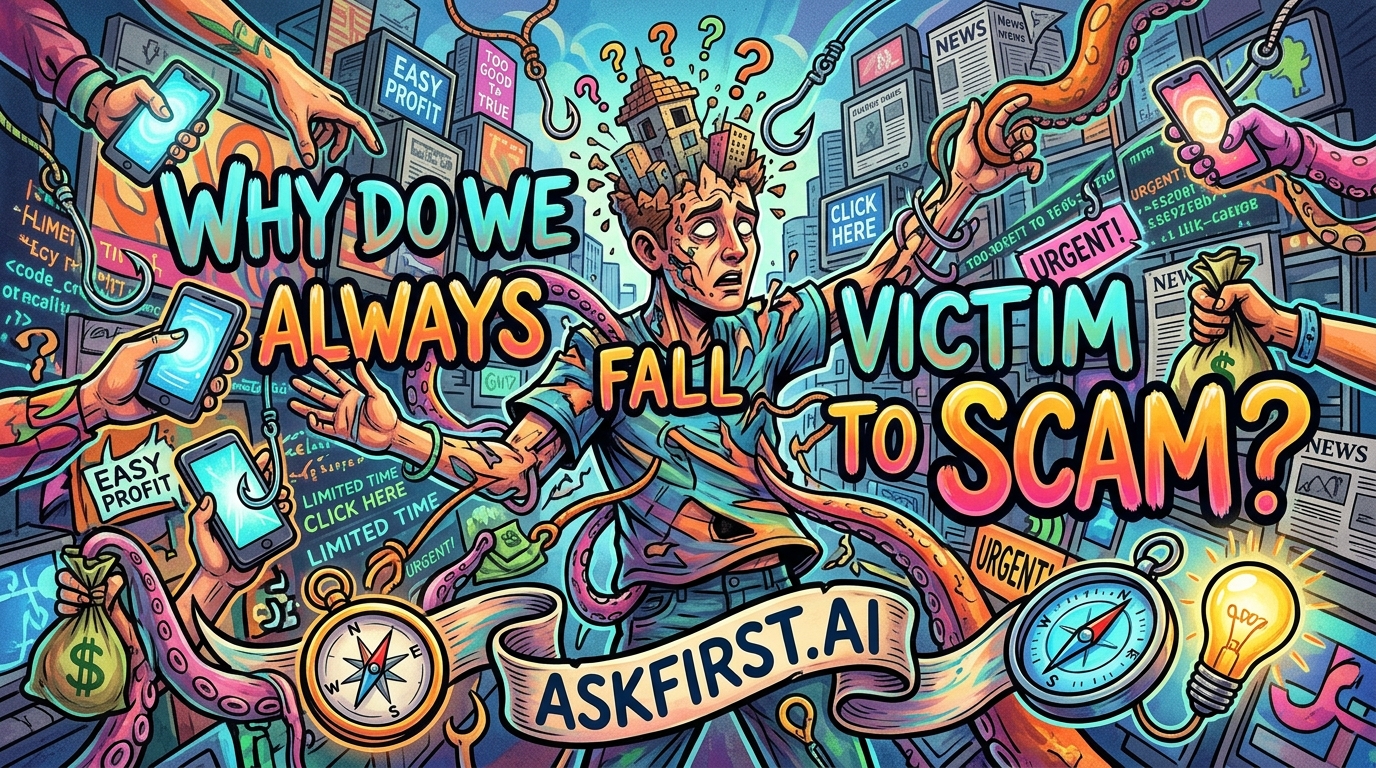
According to Daniel Kahneman, a Nobel laureate and author of Thinking, Fast and Slow, the human brain operates on two systems. System 1 is fast, intuitive, and emotional; System 2 is slow, deliberative, and logical. Scammers intentionally bypass System 2 by triggering System 1. They use high-pressure tactics, artificial scarcity, and emotional triggers to force a rapid, instinctual response before the victim has time to engage their critical thinking faculties. When a message arrives claiming "Your bank account has been compromised—click here immediately to secure your funds," the victim is thrust into a state of "fight or flight," which effectively suppresses the rational brain.
The Social Engineering Factor: Exploiting Trust
Scams are rarely about technical hacking; they are almost always about "hacking the human." This is known as social engineering. As Kevin Mitnick, one of the world’s most famous former hackers and author of The Art of Deception, frequently noted, it is significantly easier to trick a person into revealing a password than it is to brute-force a digital encryption key.
Humans are social creatures hardwired for reciprocity and cooperation. Scammers weaponize these social norms. A common tactic is the "foot-in-the-door" technique, where a fraudster builds rapport through a small, seemingly benign interaction before requesting sensitive information or money. Once a social bond—however artificial—is established, the victim feels a psychological pressure to maintain that trust, often ignoring the "red flags" that would otherwise be glaringly obvious.
Authority, Scarcity, and Social Proof
Robert Cialdini, in his seminal work Influence: The Psychology of Persuasion, identifies key principles that scammers consistently leverage to manipulate human behavior:
- Authority: Scammers often impersonate figures of authority, such as tax officials (e.g., IRS or HMRC scams), police officers, or technical support executives. We are culturally conditioned to obey authority, and when someone presents themselves with the trappings of officialdom, we are less likely to question their legitimacy.
- Scarcity: The "limited time offer" or the "final notice" warning creates a sense of urgency. By creating a deadline, the scammer forces the victim to act before they have the opportunity to verify the claim with a third party.
- Social Proof: Scams involving fake investment schemes or "get-rich-quick" testimonials rely on the herd mentality. If we see others—or fake accounts pretending to be others—profiting from a venture, we assume it is safe. This bias makes us ignore the mathematical reality of risk.
The Dunning-Kruger Effect and Overconfidence
One of the most profound reasons we fall for scams is the belief that "it won't happen to me." This is a manifestation of the Dunning-Kruger effect, where individuals with limited knowledge in a specific area (such as cybersecurity or financial fraud) overestimate their own competence.
Many people believe they are too smart to be deceived. This overconfidence acts as a cognitive blind spot. When we believe we are immune to manipulation, we lower our defenses. We stop verifying links, we reuse passwords, and we engage with strangers online under the assumption that our superior intellect will protect us. Ironically, the more confident a person is in their ability to detect a scam, the more likely they are to be targeted by sophisticated, long-con operations.
The Role of Emotional Vulnerability
Scams are not always about greed; often, they are about emotional needs. Romance scams, for instance, exploit the fundamental human desire for connection and intimacy. By creating a fabricated persona that perfectly mirrors the victim’s needs, scammers can manipulate victims for months or years. In these cases, the "victim" is not being tricked by a logic puzzle, but by their own hope. When emotional stakes are high, the brain’s capacity for objective analysis is significantly diminished.
Conclusion: Strengthening Our Defenses
We fall victim to scams not because we are unintelligent, but because we are human. Our brains are designed to trust, to respond to authority, and to seek efficiency through heuristics. To mitigate these risks, we must consciously adopt a policy of "productive skepticism."
This involves slowing down the decision-making process—forcing the transition from System 1 to System 2 thinking. Whenever an interaction involves money, urgency, or a request for personal data, we should treat it with extreme caution. By understanding the psychological levers that scammers pull, we can learn to recognize the mechanisms of manipulation and build a buffer against them. The most effective defense against deception is the awareness that our own biology is the first thing that needs to be defended.