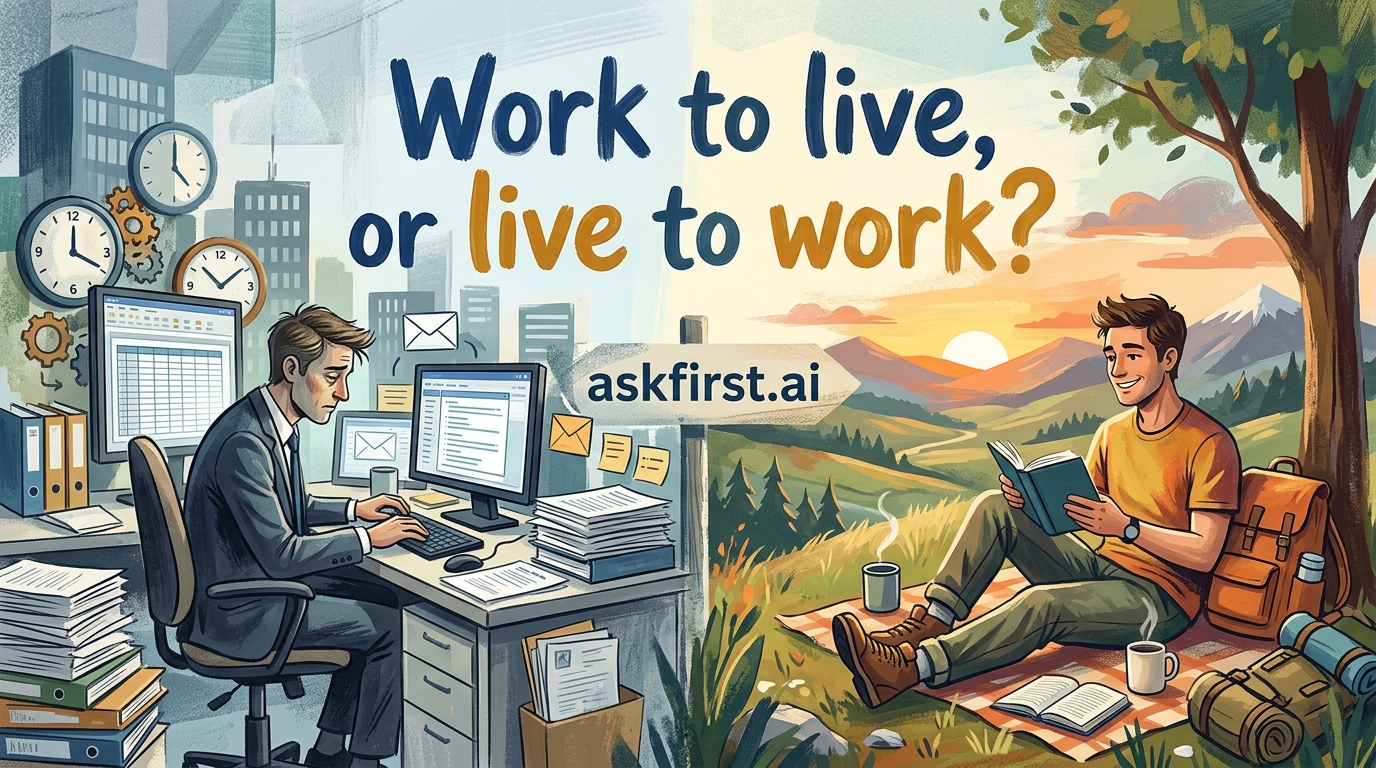
The dichotomy between "working to live" and "living to work" represents one of the most fundamental philosophical divides in modern professional life. This tension is not merely a matter of scheduling or career strategy; it touches upon the core of human identity, the meaning of contribution, and the psychological health of the individual within a capitalist framework. To navigate this debate, one must examine the historical evolution of labor, the psychological implications of career-centricity, and the practical necessity of maintaining equilibrium.
The Philosophy of "Working to Live"
The "work to live" paradigm posits that labor is a utilitarian necessity—a means to an end. In this view, employment provides the financial resources required to sustain one’s genuine life interests, such as family, travel, creative pursuits, or community service. This perspective is deeply rooted in the concept of instrumental value.
From a sociological standpoint, this approach is often championed by those who prioritize autonomy. As noted by Bertrand Russell in his classic essay In Praise of Idleness, the obsession with "work" as a virtue is a relatively modern construct that often distracts from the cultivation of wisdom and the arts. Russell argued that if labor were more efficiently distributed, humans could spend significantly less time working, thereby freeing themselves to engage in intellectual and creative endeavors that define the human spirit.
In practical terms, "working to live" manifests as strong boundary-setting. An individual operating under this framework excels at their job but views their professional title as a subset of their life, not the definition of it. For example, a software engineer who works exactly forty hours a week and spends their evenings volunteering at a local animal shelter is practicing this philosophy. They derive their self-worth from their contribution to their community, not their code output.
The Ethos of "Living to Work"
Conversely, the "live to work" mindset views professional labor as the primary vehicle for self-actualization. This is often associated with the "Protestant Ethic," a concept famously analyzed by Max Weber in his seminal work The Protestant Ethic and the Spirit of Capitalism. Weber argued that the development of modern capitalism was fueled by a religious belief that hard work and professional success were signs of moral rectitude and divine favor.
Today, this has evolved into the "hustle culture" prevalent in Silicon Valley and high-stakes corporate environments. Proponents of this view argue that because we spend the majority of our waking hours at work, it is only logical to seek deep meaning and purpose within that domain. For an entrepreneur or a dedicated scientist, the boundary between "life" and "work" is porous by design.
Consider the example of Marie Curie, whose dedication to her research was so absolute that it transcended personal comfort and safety. Her life was her work, and her work was her life. For individuals driven by such intense curiosity or a sense of mission, the dichotomy between working and living disappears. They do not work for money; they work because the work is their primary expression of existence.
The Dangers of Extremism
While both philosophies have their proponents, both extremes carry significant risks. The "work to live" approach, if taken to the point of apathy, can lead to a lack of professional fulfillment and a sense of "clock-watching" that drains the spirit. If one finds no intrinsic value in their labor, the 40-hour work week can feel like a prison sentence, leading to chronic disengagement.
On the other hand, the "live to work" approach is the primary driver of the modern burnout epidemic. According to Dr. Christina Maslach, a pioneer in the study of occupational burnout, the erosion of the boundary between personal life and work leads to "exhaustion, cynicism, and inefficacy." When one’s self-worth is entirely tied to professional KPIs (Key Performance Indicators) or status, any professional setback is experienced as a personal failure. In The Burnout Society by Byung-Chul Han, the author argues that we have moved from a society of prohibition to a society of achievement, where we exploit ourselves voluntarily, believing we are "realizing ourselves" while actually driving ourselves to psychological collapse.
Finding the Middle Path: Integration
The most sustainable approach for the majority of the population is likely a hybrid model: meaningful engagement. This involves finding a career that offers enough intrinsic interest to be engaging, while maintaining firm boundaries that protect one’s personal life.
To achieve this, one must cultivate what Cal Newport describes in his book Deep Work as "the craftsman mindset." Newport argues that rather than asking "what can the world offer me?" (which leads to entitlement) or "what can I offer the world?" (which can lead to overwork), one should focus on the quality of their craft. By becoming exceptionally good at something, one gains the "career capital" necessary to dictate the terms of their work, allowing for a healthy balance that respects both the need for professional achievement and the necessity of personal restoration.
Conclusion
Ultimately, the choice between "working to live" and "living to work" is a personal one, dictated by one’s temperament, life stage, and values. There is no moral superiority in either stance. However, the most successful individuals—in terms of both mental health and longevity—are those who treat their life as a holistic project. Whether you view your job as a tool or a calling, it is essential to ensure that your identity is multifaceted. By investing in relationships, hobbies, and personal growth outside of the office, you ensure that your life remains stable even when your professional circumstances shift. Work may be a significant part of the human experience, but it is rarely the whole of it.