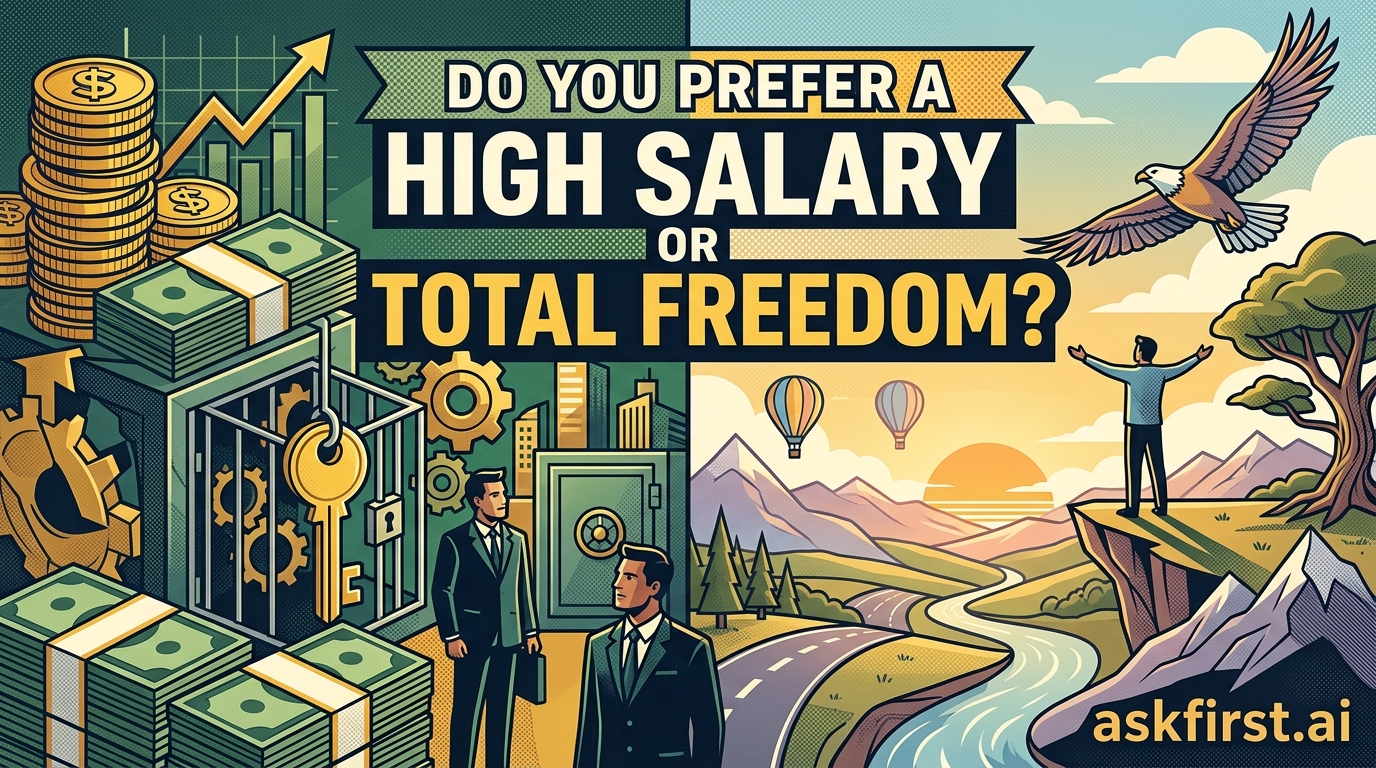
The Eternal Trade-off: High Salary Versus Total Autonomy
Determining whether to prioritize financial accumulation or professional liberty is a fundamental dilemma in human career development. This tension often defines the trajectory of an individual's life, influencing mental health, legacy, and long-term satisfaction. To navigate this effectively, one must understand the distinct psychological and economic frameworks surrounding both paths.
The Allure of the High Salary
Financial compensation functions as a primary driver for many professionals, primarily because it serves as a vehicle for security and status. The appeal of a high salary is deeply rooted in the concept of purchasing power. Higher income levels permit individuals to:
- Mitigate existential risk: Financial cushions provide a buffer against unforeseen emergencies.
- Access exclusive networks: Wealth often dictates proximity to influential power structures.
- Achieve early retirement: The principle of financial independence, retire early (FIRE) relies on aggressive saving strategies facilitated by substantial income.
However, high-income roles often come with significant "golden handcuffs." These are contractual or cultural obligations that require immense time commitment, high stress, and limited decision-making agency. Research in organizational behavior consistently indicates that as extrinsic rewards (like money) increase, intrinsic motivation—the internal drive to perform tasks for the sake of the activity itself—often declines.
The Power of Total Freedom
Total freedom, or autonomy, represents the ability to govern one's own schedule, environment, and professional focus. This model is often pursued by entrepreneurs and high-level specialists. Freedom is characterized by:
- Cognitive autonomy: The power to pursue creative solutions without corporate bureaucracy.
- Temporal flexibility: The ability to align work output with personal biological rhythms.
- Increased job satisfaction: Autonomy is frequently cited in psychological studies (such as Self-Determination Theory) as a top contributor to overall human happiness and well-being.
While freedom is often idealized, it entails substantial volatility. Without the stability of a steady paycheck, individuals must master self-discipline, financial planning, and risk management. The absence of a structured corporate environment requires a high degree of accountability; if the business fails, there is no organizational safety net.
Evaluating the Equilibrium
Modern career design suggests a hybrid approach. Many successful professionals choose to reach a "threshold of sufficiency"—an income level that covers all basic needs and future security requirements—before pivoting toward autonomy. This strategy allows the individual to transition from being an employee to an owner, essentially buying back their time once the financial base is secure.
Ultimately, the choice between money and freedom depends on one's tolerance for instability and the underlying values of the individual. While a high salary buys the comfort of the present, freedom provides the opportunity to shape the future. The most resilient professionals are those who master the art of negotiating their environment to minimize corporate constraints while maximizing professional output.