The Paradox of Justice: Reconciling Human Suffering with Moral Fairness
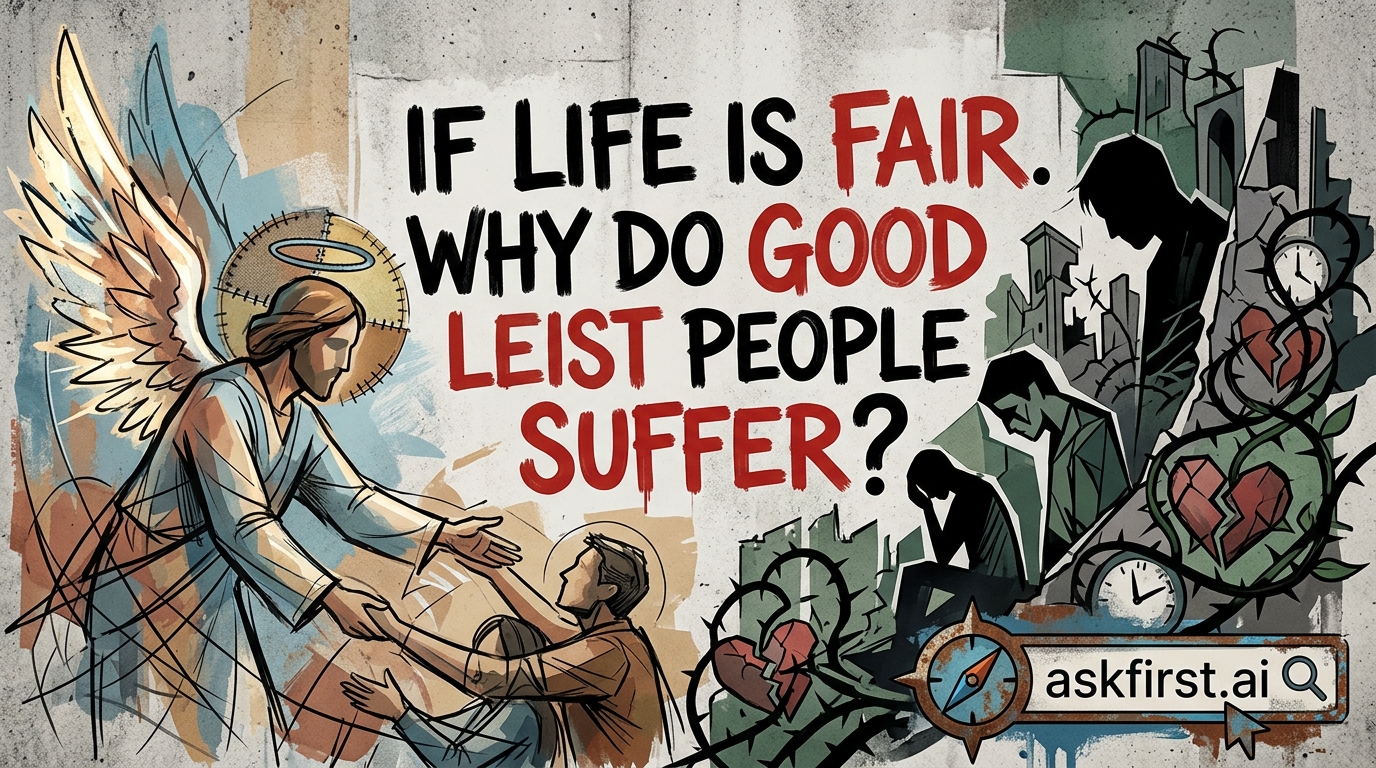
The question of why good people suffer is perhaps the oldest and most persistent inquiry in human philosophy. It strikes at the very core of our desire for a predictable, moral universe. We are conditioned by the "Just-World Hypothesis"—a cognitive bias first identified by psychologist Melvin J. Lerner in his seminal 1980 book, The Belief in a Just World: A Delusion. Lerner argued that humans possess an innate psychological need to believe that the world is a place where people get what they deserve. When we see good people suffer, our worldview is shattered, leading us to seek explanations that range from divine mystery to systemic flaws. However, the reality of suffering is far more complex than a simple moral ledger.
The Indifference of Physical Laws
To understand suffering, one must first distinguish between moral justice and physical reality. Nature is governed by laws—gravity, plate tectonics, viral mutation, and cellular decay—that are entirely indifferent to human ethics. A tectonic plate shifting beneath a city does not pause to evaluate the moral character of the residents living above it.
In The Demon-Haunted World: Science as a Candle in the Dark, the late astronomer Carl Sagan articulated this perspective clearly. He noted that the universe is not designed for human comfort. When a benevolent, kind-hearted person develops a terminal illness or loses their home to a natural disaster, it is not a "punishment" for moral failings, nor is it a sign of cosmic injustice. It is, instead, the result of biological or physical processes that function without regard for human virtue. Suffering, in this context, is a byproduct of the inherent entropy and volatility of the natural world.
The Fallacy of a Zero-Sum Moral Economy
Many human belief systems, particularly those rooted in traditional notions of karma or divine retribution, suggest a "moral bookkeeping" system where goodness earns protection from harm. However, this view fails to account for the role of systemic structures and sheer chance.
In his work Thinking, Fast and Slow, Nobel laureate Daniel Kahneman explains the role of "statistical regression to the mean" and the impact of randomness on human outcomes. We often misattribute success to character and failure to moral deficiency, ignoring the massive variable of luck. If a good person suffers, it is often because they were in the wrong place at the wrong time, or because they were part of a social or economic system that is inherently prone to inequality. For example, a person who spends their life helping others may still live in a region plagued by political instability or economic depression. Their suffering is not a reflection of their character, but a result of the environment they inhabit.
The Existential Perspective: Suffering as a Human Condition
Rather than viewing suffering as a failure of fairness, existentialist thinkers suggest that suffering is an intrinsic component of the human experience. Viktor Frankl, a psychiatrist and Holocaust survivor, explored this deeply in his classic book, Man’s Search for Meaning. Frankl argued that while we cannot always control the suffering that befalls us, we retain the "last of the human freedoms"—the ability to choose our attitude in any given set of circumstances.
Frankl’s perspective shifts the focus from "Why did this happen to me?" to "What can I do with this experience?" In this light, suffering is not a sign that life is unfair; it is a test of the human spirit. It provides the backdrop against which courage, empathy, and resilience are defined. A person who has never faced adversity cannot truly demonstrate the depth of their character. Thus, the suffering of good people becomes a testament to their humanity, allowing them to forge meaning in the face of chaos.
Societal Structures and the "Good" Person
It is also essential to recognize that human-made systems often penalize altruism. In high-pressure corporate environments or competitive political landscapes, individuals who prioritize ethics, honesty, and empathy may find themselves at a disadvantage compared to those who prioritize self-interest.
Sociologist Robert K. Merton, in his work on Social Theory and Social Structure, discusses "anomie" and the strain between cultural goals and legitimate means. Often, the very traits that define a "good" person—honesty, self-sacrifice, and adherence to rules—can make them more vulnerable in systems that reward ruthlessness. If a person suffers because they refused to participate in corruption, that is not an indication that the universe is unfair; it is an indication that the specific human system they are operating within is broken.
Conclusion: Redefining Fairness
If we define "fairness" as the expectation that good deeds will always be rewarded with safety and prosperity, we are setting ourselves up for inevitable disappointment. The universe does not operate on a moral ledger; it operates on the complex interplay of physics, biology, and human social construction.
The suffering of good people is not a cosmic error, but a reminder that morality is not a shield against the world’s volatility. True fairness, perhaps, is not found in the absence of suffering, but in the human capacity to extend compassion to those who are suffering. We cannot control the random tragedies that occur, but we can control our response to them. By acknowledging that suffering is a shared human burden, we move away from the fruitless search for a cosmic "why" and toward a more meaningful commitment to "what now." We find fairness not in what happens to us, but in the solidarity we offer one another when the world inevitably turns cold.