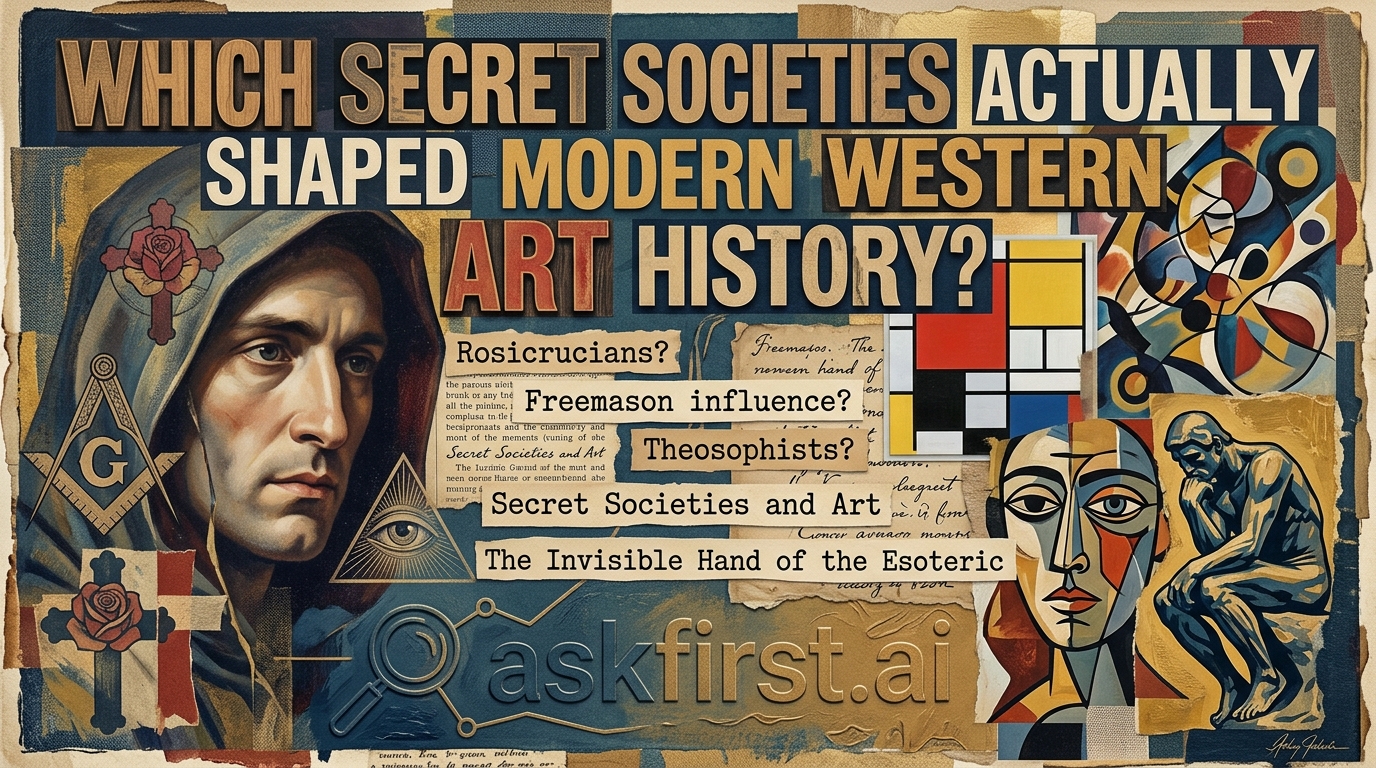
The Hidden Architects of Aesthetic Evolution
The narrative of Western art history is often presented as a straightforward progression of styles, from the Renaissance to Modernism. However, beneath the surface of official galleries and academic curricula lie the clandestine fingerprints of secret and semi-secret societies. These organizations provided the intellectual, occult, and logistical frameworks that propelled art into revolutionary new territories. By exploring the influence of these groups, one discovers that the evolution of beauty was rarely a solitary endeavor.
The Rosicrucian Influence on Geometric Symbolism
Tracing back to the 17th century, the Rosicrucian Order played a pivotal role in disseminating esoteric geometric knowledge. Their focus on the 'unity of nature' and the divine proportion deeply impacted European architects and painters. Artists like Albrecht Dürer and later, the symbolist painters, integrated Rosicrucian ideals regarding light, space, and the 'temple of the human soul' into their canvases. This was not merely an aesthetic choice; it was a ritualistic act intended to mirror the celestial order on earth. The geometry found in masterworks of this period often mimics the sigils and structural grids documented in clandestine Rosicrucian texts, serving as a silent language of initiation for those who knew how to decode it.
Freemasonry and the Neoclassical Paradigm
Perhaps no organization has influenced the physical landscape of Western art and architecture more profoundly than the Freemasons. During the 18th and 19th centuries, Masonic lodges acted as hubs for Enlightenment thought. The shift toward Neoclassicism, characterized by a return to architectural symmetry and civic virtue, was heavily supported by Masonic patronage. Notable figures such as Benjamin Franklin and various architects responsible for the layout of major Western capitals utilized Masonic motifs—such as the compass, the square, and the plumb line—to imbue public spaces with a sense of moral rectitude and timeless balance. The influence extended to the fine arts, where Masonic allegories regarding the 'Great Architect of the Universe' became foundational themes for history painting.
The Theosophical Society and the Birth of Abstraction
If one seeks the true catalyst for 20th-century Abstract Art, the Theosophical Society stands as the primary culprit. Founded by Helena Blavatsky, Theosophy synthesized Eastern and Western mysticism. Its influence on early modernists cannot be overstated. Wassily Kandinsky, the pioneer of abstract painting, was deeply influenced by the Theosophical belief that art could transcend physical reality to express the 'vibrations' of the spirit. His seminal text, 'Concerning the Spiritual in Art,' reads like an extended Theosophical manual. Similarly, Piet Mondrian, a lifelong member of the Theosophical Society, viewed his iconic grid paintings as a means to reach the 'absolute' reality—an essential, spiritual truth obscured by the clutter of the material world. Without the esoteric, anti-materialist push of the Theosophists, the radical break into abstraction might have been delayed by decades.
Surrealism and the Occult Tradition
Surrealism, often dismissed as a mere playground for dreamers, was rooted in the occult traditions of the Hermetic Order of the Golden Dawn. Figures like André Breton and Salvador Dalí were fascinated by the concept of 'the marvelous' and the manipulation of consciousness to access higher planes. Their obsession with tarot, alchemy, and ritual magic provided a structured framework for exploring the unconscious. Surrealism was not just about shock value; it was an attempt to reconstruct the 'Great Work' of alchemy within the realm of the subconscious, transforming the lead of human desire into the gold of aesthetic transcendence.
Why This Legacy Matters for Future Creators
- The Power of Intentionality: These societies demonstrated that art is not just a reflection of reality but a tool to shape perception.
- The Language of Symbols: They popularized a visual vocabulary that continues to influence contemporary branding and cultural iconography.
- Holistic Synthesis: By blurring the lines between art, science, and spirituality, they established a blueprint for the interdisciplinary creative works we see today.
The history of Western art is indeed the history of hidden hands. By recognizing these influences, one moves past the surface level of canvas and pigment to understand the deep, structural currents that have shaped the aesthetic soul of the modern world. These societies did not just commission art; they provided the philosophical impetus for the very concepts of 'originality' and 'sublime beauty' that remain central to our cultural identity today.