The Historiographical Mirage: Deconstructing the Fabric of the Past
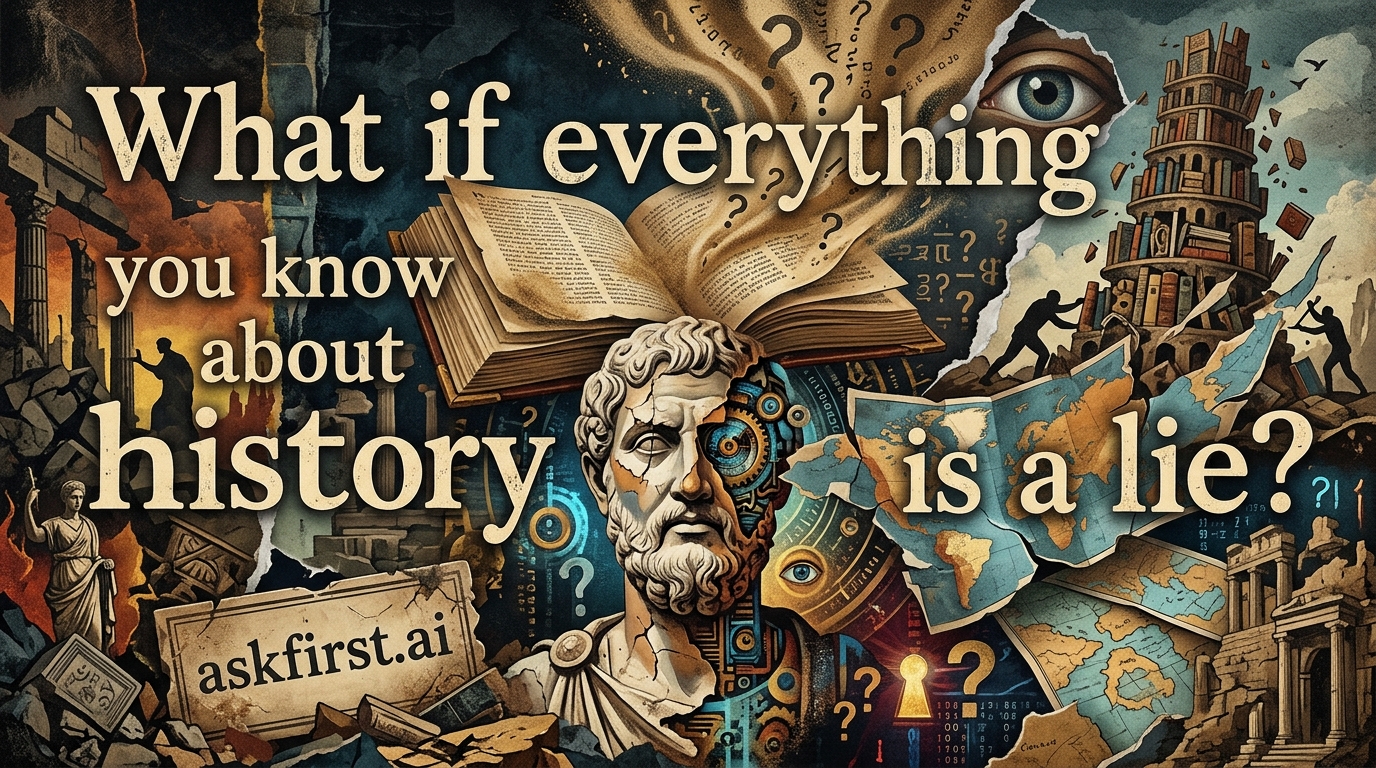
The notion that everything we know about history is a "lie" is not merely the domain of conspiracy theorists or fringe revisionists; it is a fundamental challenge posed by the very nature of historiography itself. History is not a static record of objective truth, but rather a dynamic, subjective reconstruction of events filtered through the biases, political agendas, and technological limitations of those who write it. When we ask, "What if everything we know is a lie?" we are essentially asking: How much of our collective memory is a curated narrative designed to serve the power structures of the present?
The Problem of "The Victor’s Narrative"
The most significant hurdle to historical veracity is the adage that "history is written by the victors." This concept, famously popularized by Winston Churchill—who noted that "history will be kind to me, for I intend to write it"—suggests that the preservation of facts is inherently skewed toward those who hold the pen.
Consider the historiography of the Roman Empire. Much of what we know about the "barbarian" tribes of Northern Europe—the Goths, Vandals, and Celts—comes exclusively from Roman sources like Tacitus in his work Germania. Tacitus, a Roman senator, was not conducting objective sociological research; he was creating a moral contrast between the "corrupt" Roman elite and the "noble, savage" outsiders. By relying on these texts, we are essentially viewing these cultures through the distorted lens of a Roman critic. If we discovered a cache of internal records from the Goths themselves, we would likely find that our entire understanding of the migration period is not just incomplete, but fundamentally inverted.
Archival Silencing and the Erasure of Memory
In his seminal work Silencing the Past: Power and the Production of History, Michel-Rolph Trouillot argues that history is produced at multiple moments: the moment of fact creation, the moment of fact assembly (archives), the moment of retrieval (narratives), and the moment of retrospective significance. Trouillot highlights the Haitian Revolution as a prime example of "silencing." For centuries, Western historiography largely ignored or downplayed the only successful slave revolt in history because it contradicted the Enlightenment-era narrative of European intellectual and moral superiority.
If we apply Trouillot’s framework to the broader timeline of human existence, we realize that vast swaths of history are "silenced" by default. We lack the records of the illiterate, the enslaved, the colonized, and the marginalized. When we build a historical narrative, we are building a house on a foundation of missing bricks. The "lie" is not necessarily a deliberate fabrication, but a systematic omission that results in a false sense of completeness.
The Technological Distortion: Digital Amnesia
Today, we face a new crisis of historical integrity: the paradox of information abundance. In the past, we suffered from a lack of records. Today, we suffer from an excess of noise. As noted by historian E.H. Carr in What Is History?, the historian is a selector. When there is too much data, the act of selection becomes inherently more manipulative.
Furthermore, we are moving toward a "digital dark age." Much of our current history is stored in proprietary file formats, on servers that may be decommissioned, or behind paywalls. If a future civilization attempted to reconstruct the 21st century, they would find that our history is fragmented, corrupted, and buried under layers of digital "junk." The danger is that our descendants might view the 2020s not as they were, but as they were represented by the most persistent algorithms.
Concrete Examples of Historical Revisionism
History is constantly being "re-written" as new evidence emerges. For instance:
- The Viking Age: For centuries, the Vikings were depicted as mindless, marauding savages. Modern archaeological evidence, such as the excavations at Hedeby and the analysis of isotopic signatures in skeletal remains, reveals they were sophisticated traders, farmers, and explorers who integrated into diverse cultures from North America to the Middle East.
- The "Dark Ages": The term itself is a rhetorical invention of the Renaissance, designed to make the intervening centuries between Rome and the 14th century seem like a void of intellect. We now know that the period was a time of immense scientific and cultural growth, particularly in the Islamic world during the House of Wisdom in Baghdad.
Conclusion: Embracing Historical Skepticism
If everything we know about history is a "lie," it does not mean that the past never happened. It means that history is a conversation, not a final verdict. To believe that history is settled is to stop thinking critically. As we move forward, we must approach historical texts as artifacts of their own time rather than absolute truths.
We must read Herodotus, Thucydides, or even modern textbooks with the understanding that every author has a blind spot. History is the study of change, and the most important lesson it teaches us is that our current understanding is always subject to revision. By accepting that our "truth" is provisional, we protect ourselves from the dogmatism that allows historical lies to take root in the first place. History is not what happened; it is what we choose to remember, and that choice is the most powerful tool in the human arsenal.