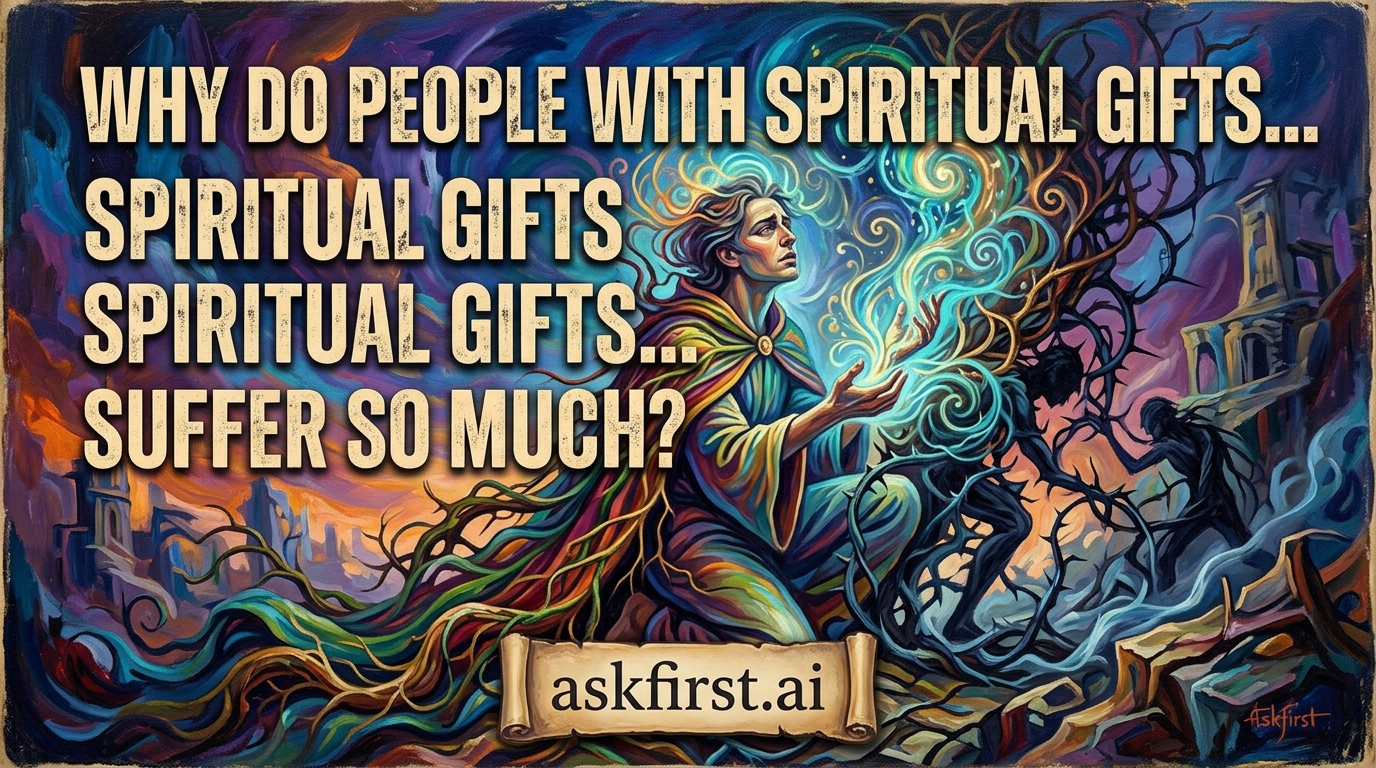
The experience of individuals possessing heightened spiritual sensitivity—often referred to in various traditions as "spiritual gifts," "clairsentience," or "spiritual awakening"—is frequently marked by an intense paradox. While these individuals may report profound connections to the divine, the collective unconscious, or the energetic fabric of reality, their daily lives are often characterized by significant emotional, physical, and existential suffering. Understanding why this occurs requires a multi-faceted exploration of psychology, sociology, and metaphysics.
The Burden of Hyper-Empathy and Energetic Permeability
The most immediate cause of suffering for those with heightened spiritual sensitivity is the lack of psychological and energetic boundaries. In the seminal work The Highly Sensitive Person by Dr. Elaine Aron, the author explains that a significant portion of the population processes sensory data more deeply than others. When this biological sensitivity is coupled with what many spiritual traditions call "empathy" or "clairsentience," the individual becomes a sponge for the emotional states of those around them.
Unlike the average person, who can effectively filter out the ambient stress or "noise" of a crowded room or a tense relationship, the spiritually sensitive individual often cannot distinguish between their own emotions and those of their environment. This phenomenon, which Judith Orloff, M.D., explores extensively in The Empath's Survival Guide, leads to chronic nervous system exhaustion. The suffering here is not a cosmic punishment; it is a physiological and energetic burnout resulting from an inability to "shut off" the reception of external stimuli.
The Isolation of the "Outlier" Experience
Sociologically, those who experience reality through a spiritual lens often find themselves alienated from mainstream culture. In the book The Hero with a Thousand Faces by Joseph Campbell, the "call to adventure" often begins with a sense of being different or misunderstood. In a society that prioritizes material success, logical positivism, and linear time, the person who experiences precognition, intense intuition, or mystical visions is often labeled as mentally unstable or eccentric.
This alienation is a profound source of psychological pain. Human beings are fundamentally social creatures; when a person’s internal reality cannot be validated by their immediate community, they experience what psychologists call "ontological insecurity." This is the feeling that one’s very perception of reality is fragile or wrong. The suffering arises from the constant pressure to "mask"—to hide one's true nature to fit into professional and social environments that are fundamentally incompatible with their spiritual depth.
The "Dark Night of the Soul" as a Developmental Stage
In the mystical traditions of St. John of the Cross, specifically in his treatise Dark Night of the Soul (La Noche Oscura del Alma), the period of intense suffering is not viewed as a failure, but as a necessary purification. From this perspective, the spiritual gift is a "chisel" that strips away the ego.
The suffering occurs because the ego—the structure of the self that identifies with titles, status, and physical form—resists the expansion of the soul. When an individual has a gift for seeing the "truth" behind societal facades, they can no longer participate in the "games" of the world with the same enthusiasm as others. This creates a state of purgation. The person suffers because they are stuck in the "in-between": they no longer belong to the world of mundane pursuits, but they have not yet mastered the art of living in the physical world while maintaining their spiritual awareness. This transition is inherently painful, as it involves the death of old identities.
The Responsibility of the "Wounded Healer"
The archetype of the "Wounded Healer," a concept deeply analyzed by Carl Jung in The Archetypes and the Collective Unconscious, provides perhaps the most profound explanation for this suffering. Jung posits that the physician or healer is effective only if they have suffered themselves. The spiritual gift is rarely a passive experience; it is an active, often heavy, burden.
Those who perceive the world’s suffering more acutely are often compelled to help, leading to "compassion fatigue." The suffering is the price of admission for the capacity to heal others. By experiencing the darkness, the spiritually gifted individual learns to navigate it, eventually becoming a guide for others. However, the process of transformation is rarely gentle. It is a process of friction—the friction between the infinite nature of the spirit and the finite, often painful limitations of the body and the ego.
Conclusion
The suffering of those with spiritual gifts is rarely meaningless. It is a combination of sensory overstimulation, the inevitable isolation of walking a non-conformist path, the ego-death required for spiritual evolution, and the heavy mantle of the wounded healer. As outlined in the works of mystics and modern psychologists alike, this suffering is the crucible of transformation. It is the mechanism by which the individual moves from a state of unconscious existence to one of profound, albeit often painful, conscious awareness. While the path is arduous, it is historically recognized as the prerequisite for the depth of wisdom and empathy that such individuals eventually offer to the world.