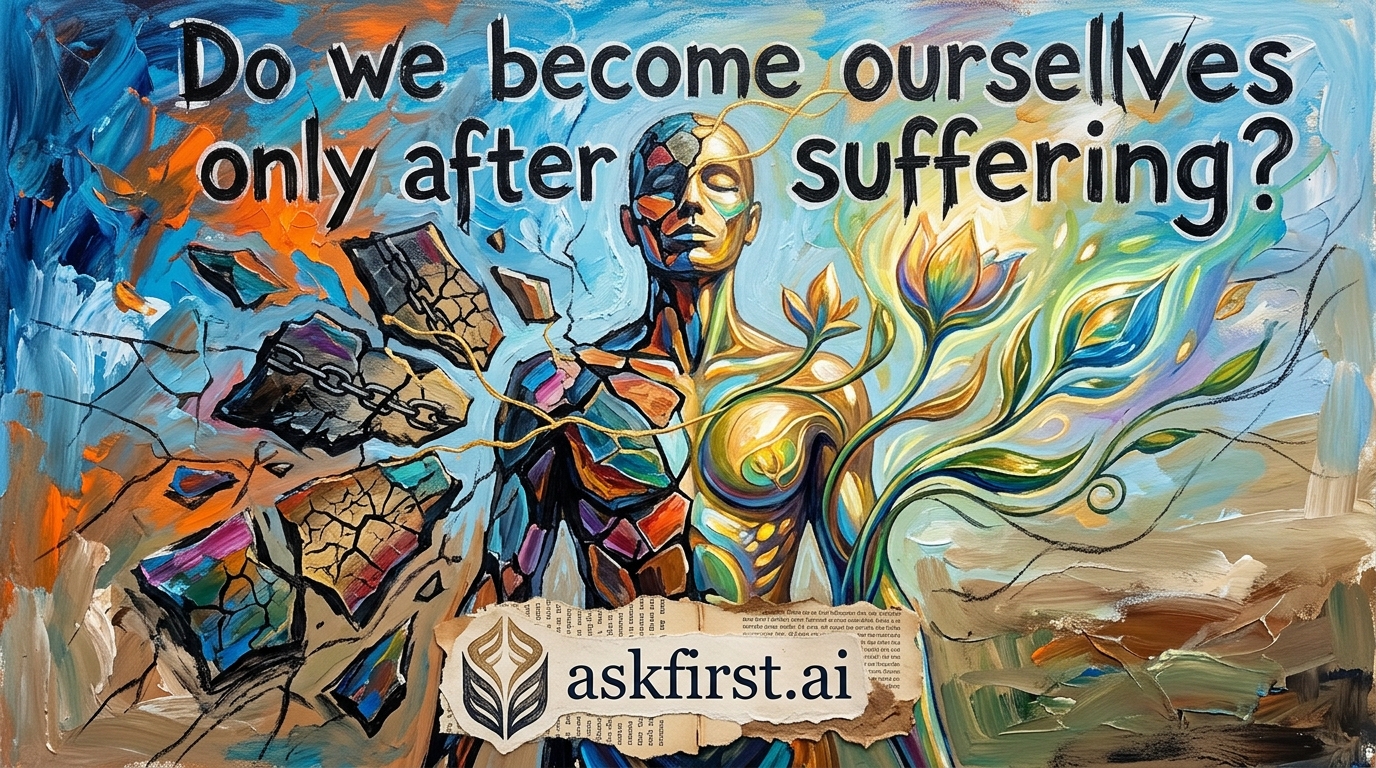
The philosophical inquiry into whether suffering is a prerequisite for the formation of the self is one of the most enduring debates in existentialism, psychology, and literature. For centuries, thinkers have grappled with the idea that the "self" is not a static entity we are born with, but rather a construct forged through the crucible of adversity. While some argue that joy and contentment are equally formative, the prevailing consensus among those who study the human condition is that suffering acts as a catalyst for the crystallization of identity.
The Existentialist Perspective: Suffering as a Catalyst
Existentialist thinkers, most notably Jean-Paul Sartre and Albert Camus, posited that the human condition is inherently defined by "anguish" or the "absurd." In Being and Nothingness, Sartre argues that we are "condemned to be free," and it is in the moments of radical choice—often forced upon us by crisis—that we define our essence. When a person is comfortable, they tend to drift along the currents of societal expectation. It is only when the structure of their life is shattered by loss or hardship that the individual is stripped of their borrowed identity.
Consider the work of Viktor Frankl, a psychiatrist and Holocaust survivor who wrote Man’s Search for Meaning. Frankl observed that the prisoners who survived the concentration camps were not necessarily the strongest physically, but those who could find a "why" for their suffering. Through this extreme trial, their internal sense of self became unshakable. Frankl’s conclusion—that we find ourselves by taking responsibility for our own meaning in the face of unavoidable suffering—suggests that suffering is not merely an obstacle to the self, but the very chisel that removes the excess stone to reveal the sculpture beneath.
Psychological Growth: Post-Traumatic Growth (PTG)
In modern psychology, the concept of Post-Traumatic Growth (PTG), pioneered by researchers Richard Tedeschi and Lawrence Calhoun, provides empirical support for the idea that suffering transforms the self. Unlike Post-Traumatic Stress Disorder (PTSD), which focuses on the impairment caused by trauma, PTG examines how individuals experience positive psychological change as a result of struggling with highly challenging life circumstances.
Tedeschi and Calhoun suggest that after a traumatic event, people often report five specific areas of growth:
- Appreciation of life: A shift in priorities toward the present moment.
- Relationships with others: A deeper sense of compassion and connection.
- New possibilities: The discovery of previously unknown paths in life.
- Personal strength: The realization that one is capable of surviving more than they imagined.
- Spiritual change: A deepening of one’s philosophical or existential foundation.
This framework demonstrates that the self is often "reorganized" after a crisis. The individual who emerges on the other side of deep suffering is rarely the same person who entered it; they have been forced to integrate their pain into a new, more complex narrative.
The Mythological and Literary Archetype: The Hero’s Journey
Joseph Campbell, in his seminal work The Hero with a Thousand Faces, maps the universal structure of the "Hero’s Journey." A critical stage of this journey is the "Ordeal"—a descent into the abyss, a death of the old self, and a subsequent rebirth. This archetype is present in virtually every culture’s mythology because it mirrors the human developmental process.
Think of Odysseus in Homer’s The Odyssey. He is not the same man at the end of his ten-year struggle as he was at the start of the Trojan War. His identity is hammered out through the loss of his men, the deception of the gods, and the exhaustion of his endurance. His suffering does not destroy him; it defines the king he must become to reclaim his home. Literature teaches us that we do not become "ourselves" in the tranquil harbor; we become ourselves in the storm.
The Argument for Joy as an Architect
While the case for suffering is strong, it is worth noting that the self is also forged through love, curiosity, and creative pursuit. Friedrich Nietzsche, in Thus Spoke Zarathustra, spoke of the "Will to Power," which is not just about overcoming obstacles, but about the exuberant expansion of the self. However, Nietzsche also famously noted, "To live is to suffer, to survive is to find some meaning in the suffering." He suggests that the two are inseparable. Joy, in this context, is often the reward for the suffering endured to achieve it. Without the contrast provided by pain, the self lacks the necessary depth to appreciate the heights of human experience.
Conclusion: The Synthesis of Experience
Do we become ourselves only after suffering? Perhaps it is more accurate to say that suffering accelerates the process of self-actualization. While one could theoretically reach maturity through a life of unmitigated comfort, such a life rarely demands the radical introspection required to truly know one's boundaries and values. Suffering acts as a mirror; it reflects our limitations back to us, forcing us to decide who we are when everything else is stripped away. Ultimately, the self is a project, and suffering is the most demanding, yet most effective, tool we have to complete that work. We are the sum of our experiences, and the chapters written in ink of hardship are often the ones that define the protagonist.