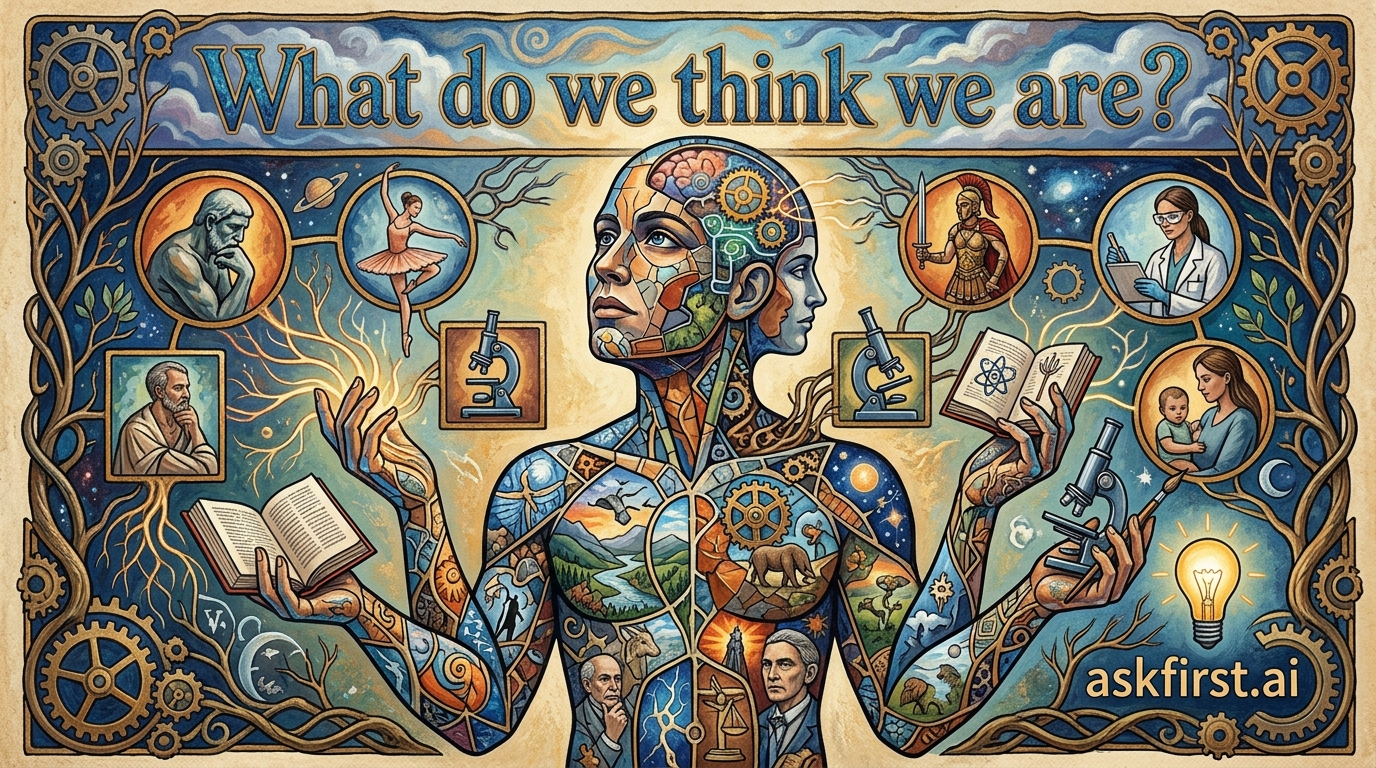
The question of what we think we are is perhaps the most profound inquiry in the history of human consciousness. It sits at the intersection of neuroscience, philosophy, psychology, and evolutionary biology. Throughout the ages, thinkers have attempted to define the "self," yet we remain a species that is fundamentally defined by its own internal narrative. We are not merely biological organisms; we are, as the philosopher Daniel Dennett famously posited in Consciousness Explained (1991), "centers of narrative gravity."
The Biological and Neurological Perspective
At our most fundamental level, we perceive ourselves as the occupants of a physical vessel. Neuroscience, particularly the work of Antonio Damasio in The Feeling of What Happens (1999), suggests that the sense of self is a biological construct designed for survival. Damasio argues that the brain creates a "proto-self," a collection of neural patterns that map the state of the body moment by moment.
We think we are the pilots of our bodies, but in reality, our brains are complex prediction machines. We are a collection of sensory inputs—sight, sound, touch—that the brain stitches together into a coherent "movie" of experience. We believe we have a singular, unchanging "I," yet neurobiology tells us that the brain is a modular system. When the corpus callosum is severed—a phenomenon famously studied by Roger Sperry and Michael Gazzaniga—the brain’s hemispheres can act independently, suggesting that our "unified self" is a convenient illusion maintained by the left hemisphere’s "interpreter" mechanism.
The Philosophical Construct: The Narrative Self
Beyond the biological, we think of ourselves as the protagonists of a story. We define who we are by our past experiences, our cultural affiliations, and our future aspirations. This is what Paul Ricoeur explored in Time and Narrative (1984), arguing that human identity is inherently storied. We are not static objects; we are processes.
Think of a person who undergoes a radical life change—a career shift, a migration to a new country, or a personal tragedy. They remain the same biological entity, yet they often feel like a "new person." This occurs because the narrative structure of their life has shifted. We perceive ourselves through the lens of memory, and as the psychologist Endel Tulving noted in his research on episodic memory, our ability to project ourselves into the past and future is what creates the continuity of the self. We think we are the same person we were ten years ago, but that continuity is a psychological construct, not a physical one.
The Social and Cultural Self
We also think we are defined by our relationships to others. In the sociological tradition, particularly Charles Horton Cooley’s "Looking-Glass Self" (1902), we understand that our identity is largely a reflection of how we believe others perceive us. We are social animals; we do not exist in a vacuum. Our self-conception is a negotiation between our internal desires and external societal expectations.
This phenomenon is exacerbated in the digital age. As Sherry Turkle discusses in Alone Together (2011), we now curate "digital selves" that exist alongside our physical selves. We think we are the curators of our own images, carefully selecting the highlights of our lives to present to the world. Consequently, we often mistake our curated performance for our authentic essence, leading to a profound sense of alienation when the "online self" fails to match the "inner self."
The Existentialist Challenge
Jean-Paul Sartre, in his foundational work Being and Nothingness (1943), suggested that "existence precedes essence." This is the ultimate existentialist claim: we are not born with a pre-defined purpose or "self." Instead, we are a "nothingness" that must create itself through action. We think we are fixed, finished products, but Sartre argues that we are always in a state of "becoming."
We are terrified by this freedom. We often cling to labels—our jobs, our nationalities, our political leanings—because they provide a sense of stability. We think we are these labels, but in truth, these are merely masks we wear to navigate a chaotic world. The realization that we are fundamentally free—and therefore responsible for creating our own meaning—is the core of the human experience.
Conclusion: The Paradox of the Self
So, what do we think we are? We think we are the captains of our souls, the heroes of our stories, and the permanent residents of our bodies. However, a deep investigation reveals that we are far more ephemeral. We are a dynamic, ever-changing flux of neurological processes, social reflections, and narrative inventions.
The beauty of the human condition lies in this paradox. We are a biological machine that has somehow evolved the capacity to ponder its own existence. While we may never find a single, objective "self" at the center of our being, the act of searching for that self is precisely what makes us human. We are not static statues; we are the ongoing, unfolding performance of our own lives. We are, in the end, the stories we tell ourselves about who we are, and in that storytelling, we find the power to change, to grow, and to define our own significance in an indifferent universe.