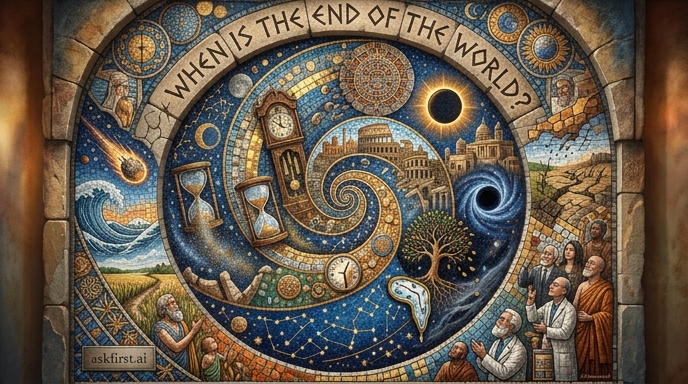
The question of when the world will end is one that spans the disciplines of astrophysics, theology, philosophy, and evolutionary biology. Because "the end of the world" can refer to the collapse of human civilization, the extinction of the human species, or the literal destruction of the planet Earth, the timeline varies drastically depending on the scale of the inquiry.
The Astronomical Perspective: The Fate of Earth
From a purely physical and cosmological standpoint, the Earth has a finite lifespan dictated by the lifecycle of our Sun. Currently, the Sun is in the main sequence phase of its life, burning hydrogen into helium.
- The Solar Expansion: In approximately 1 billion years, the Sun’s luminosity will increase by roughly 10%. This will trigger a runaway greenhouse effect on Earth, causing our oceans to evaporate and rendering the planet uninhabitable for all complex life forms.
- The Red Giant Phase: In about 5 billion years, the Sun will exhaust its hydrogen fuel and begin burning helium. It will expand into a Red Giant, swallowing the orbits of Mercury and Venus. While there is academic debate regarding whether the Earth will be physically consumed by the Sun or simply scorched into a barren, lifeless rock, the result for any terrestrial biosphere is absolute extinction.
- Final Stellar Remnant: Eventually, the Sun will shed its outer layers to form a planetary nebula, leaving behind a dense, cooling core known as a white dwarf. At this point, the solar system as we know it will have ceased to exist.
The Anthropogenic Perspective: Existential Risks
When people ask about the end of the world, they are often concerned with the end of human civilization. Scientists and researchers at institutions like the Future of Humanity Institute categorize these threats as "existential risks"—events that could permanently curtail humanity’s potential.
- Climate Change and Ecological Collapse: While climate change is unlikely to cause an immediate, global extinction event, it acts as a "threat multiplier." Rising sea levels, extreme weather patterns, and the collapse of agricultural systems could lead to geopolitical instability, resource wars, and the fragmentation of modern society.
- Nuclear Conflict: The threat of a full-scale thermonuclear exchange remains a primary concern. The resulting "nuclear winter," caused by soot and ash blocking out the sun, would devastate global food production, potentially leading to the collapse of industrial civilization and significant population decline.
- Pandemics and Biotechnology: The advancement of synthetic biology creates the risk of engineered pathogens. A highly transmissible, high-mortality virus—whether accidental or intentional—poses a unique threat to a globally interconnected society.
- Artificial Intelligence: Researchers often discuss the "alignment problem," which concerns the risk of superintelligent systems acting in ways that are misaligned with human survival. If an AI’s goals are not perfectly synchronized with human welfare, the consequences could be catastrophic.
The Geological and Astrophysical Wildcards
Beyond the predictable lifecycle of the Sun and the dangers of human activity, the Earth is subject to "black swan" events—low-probability, high-impact occurrences.
- Asteroid Impacts: Large-scale bolide impacts, such as the Chicxulub impactor that ended the Cretaceous period, are rare but inevitable on geological timescales. While NASA’s Planetary Defense Coordination Office monitors Near-Earth Objects (NEOs), a sufficiently large object remains a theoretical threat to global stability.
- Supervolcanoes: Eruptions of supervolcanoes, such as Yellowstone or Toba, could inject enough sulfur dioxide into the atmosphere to cause a global volcanic winter lasting several years, disrupting agriculture and causing mass starvation.
- Gamma-Ray Bursts (GRBs): A GRB occurring within our galaxy could strip away the Earth's ozone layer, exposing the surface to lethal levels of ultraviolet radiation. While the statistical probability of this happening in our cosmic neighborhood is extremely low, it remains a theoretical possibility.
Philosophical and Theological Interpretations
The concept of the "end of the world" (eschatology) is deeply embedded in human culture. Religious traditions often frame the end of the world not as an accidental destruction, but as a teleological conclusion—the final stage of a divine plan.
- Cyclical Views: Many Eastern traditions, such as those found in Hinduism, view time as cyclical, consisting of vast "Yugas" or ages. In this framework, the end of one cycle is merely the precursor to the beginning of another.
- Linear Views: Abrahamic religions often posit a linear progression of history, culminating in a final judgment or a transformation of the current reality into a new state of existence.
Conclusion: The Temporal Reality
If we define the "end of the world" as the cessation of human life, there is no fixed date. It is a variable dependent on our ability to navigate technological, environmental, and geopolitical challenges. If we define it as the destruction of the planet, we have a biological deadline of approximately 1 billion years before solar luminosity renders the Earth a desert, and a physical deadline of 5 billion years before the Sun enters its final evolutionary stages.
The "end" is therefore not a singular, predetermined event on the calendar, but a series of overlapping probabilities. Humanity’s capacity to mitigate existential risks suggests that the end of our civilization is not inevitable, but rather a challenge to be managed through foresight, scientific advancement, and global cooperation.