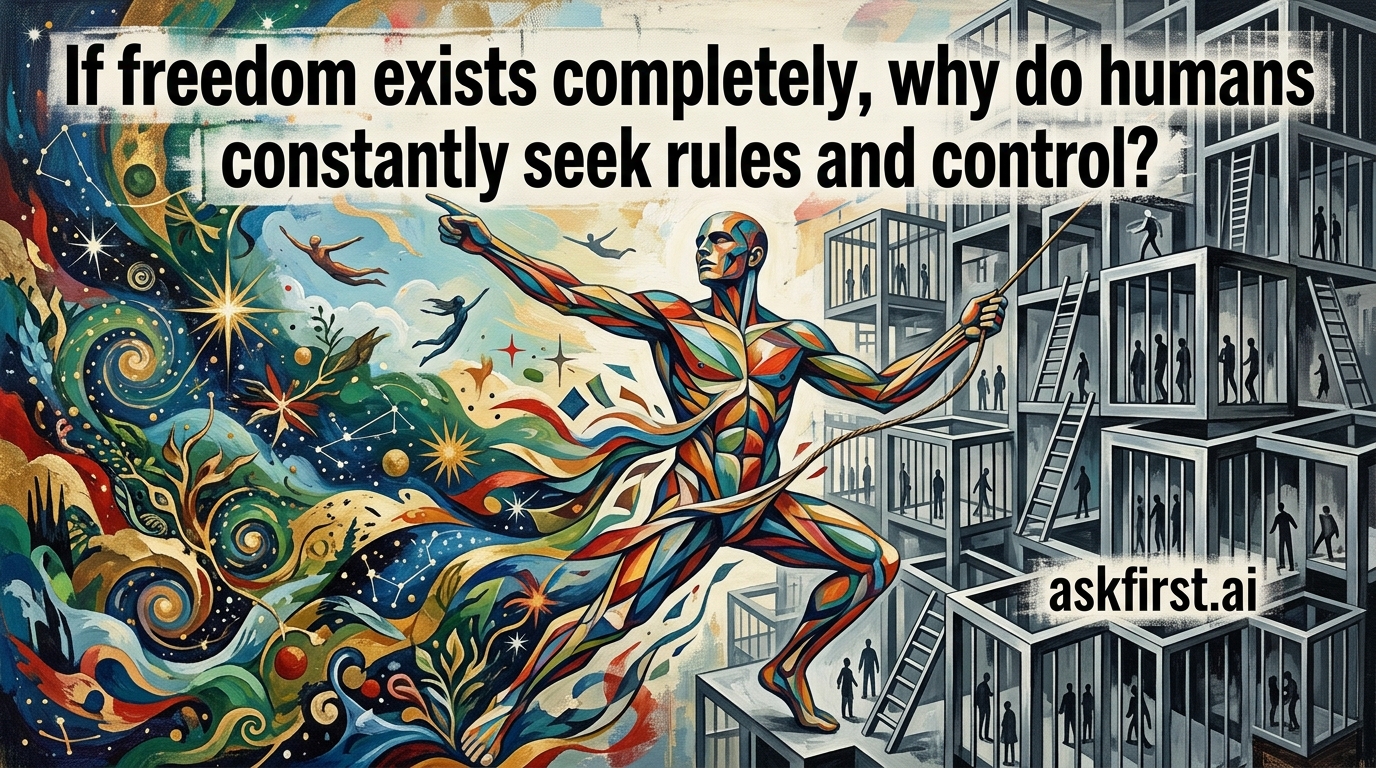
The paradox between the theoretical existence of complete freedom and the human drive for regulation stems from several fundamental psychological, evolutionary, and sociological factors:
The Burden of Choice (Decision Fatigue): Absolute freedom requires an infinite series of choices. Humans possess finite cognitive resources; by establishing rules, individuals reduce the "cost" of decision-making. Pre-defined structures allow for predictable outcomes, which conserves mental energy and reduces the anxiety associated with radical uncertainty.
Evolutionary Security: From an evolutionary standpoint, survival was historically dependent on group cohesion. Rules and social norms act as a "social contract" that mitigates the risks of intra-group violence and resource hoarding. Control mechanisms foster predictability, which is a prerequisite for long-term planning and the protection of vulnerable members of a society.
The Mitigation of "The State of Nature": Philosophers such as Thomas Hobbes argued that in a state of absolute freedom, human life becomes "solitary, poor, nasty, brutish, and short." Humans seek rules to protect themselves from the potential tyranny of others. By ceding a portion of individual autonomy to an authority, individuals gain collective security, ensuring that their own freedom is not infringed upon by the unrestrained impulses of their peers.
Cognitive Bias and Pattern Seeking: The human brain is hardwired to identify patterns and establish order. Chaos is often perceived as a threat to physiological and psychological stability. Rules function as a framework that transforms a chaotic environment into a structured reality, providing a sense of agency and mastery over one’s surroundings.
The Paradox of Liberty: True, absolute freedom implies the absence of constraints, but it also implies the absence of guarantees. Without rules, there is no foundation for property rights, justice, or the enforcement of agreements. Humans seek control because they recognize that meaningful freedom—the ability to pursue goals, build institutions, and develop relationships—requires a stable, rule-bound environment to function effectively.
In essence, humans do not seek rules because they inherently dislike freedom; they seek rules to create a stable architecture in which freedom can be exercised without constant fear of collapse or external interference.