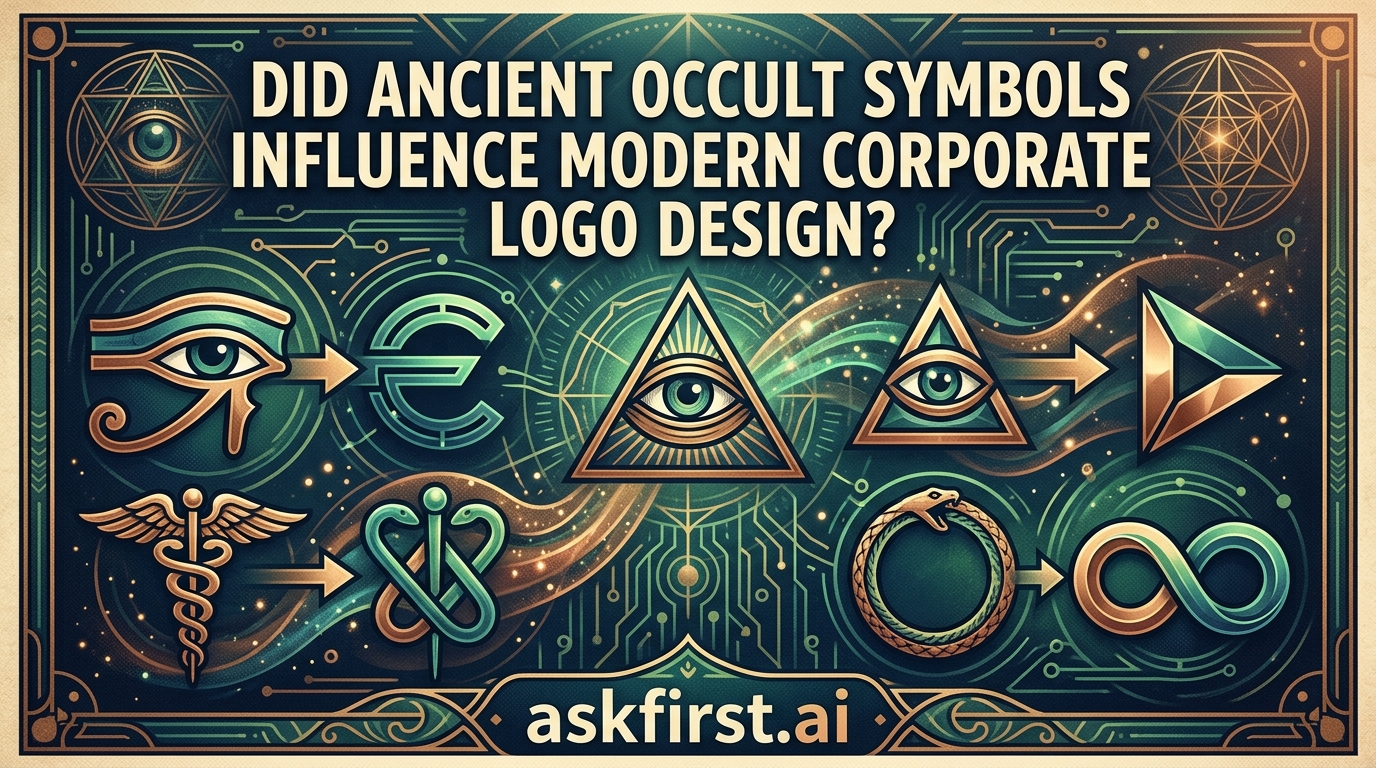
The Hidden Geometry: Occult Roots in Modern Branding
Many global corporations utilize visual identities that seem to echo the geometry of antiquity. While conspiracy theories often suggest malevolent intent, the reality lies in the intersection of semiotics, psychology, and historical archetypes. Ancient symbols were designed to convey complex, universal truths instantly; modern branding seeks the same efficiency.
The Power of Sacred Geometry
Symbols like the circle, the triangle, and the vesica piscis have been used for millennia to represent wholeness, divinity, and structure. Modern designers often tap into these shapes not because they are inherently occult, but because they are aesthetically balanced and neurologically familiar. The human brain is hard-wired to prioritize geometric symmetry as a sign of safety and reliability.
- The Triangle: Frequently associated with the trinity or hierarchical power, it remains a staple in tech and energy company logos.
- The Circle: Used extensively to suggest globality, unity, and infinite progress, mimicking the ancient ouroboros or the sun disk.
- The Eye: A common motif in insurance and finance that echoes the "all-seeing" protective symbols found in Egyptian mythology.
Jungian Archetypes and Brand Trust
Carl Jung’s theory of archetypes posits that certain images reside in the collective unconscious. Branding experts frequently leverage these universal symbols to establish subconscious trust. When a logo mirrors an ancient icon—such as the winged imagery seen in automotive branding (reminiscent of Hermes or solar deities)—it evokes feelings of speed, protection, and mastery without the consumer needing to study history. This is the sophisticated manipulation of semiotic shorthand.
The Convergence of Aesthetics and Utility
There is no grand conspiracy of corporate entities adopting occultism for dark ritual. Instead, there is an evolution of graphic communication. Designers study the history of art, and they learn that certain shapes possess innate psychological weight. When a brand seeks to appear "eternal" or "authoritative," they naturally gravitate toward the same geometric configurations that ancient cultures used to convey those exact qualities. The influence is not one of secret societies, but of visual language continuity.
Decoding the Influence
While some companies may intentionally borrow from esoteric traditions to cultivate a sense of mystery or exclusivity, the majority of logos utilizing "occult" patterns do so because those patterns represent the gold standard of visual hierarchy. By stripping away the mysticism and focusing on the underlying mathematics, these brands achieve a timeless quality that allows them to remain relevant for generations. The influence is grounded in the science of perception rather than the shadows of the occult, proving that while human tools change, our fundamental response to shape and symmetry remains remarkably consistent.