How Renaissance Occultists Shaped Modern Cryptography
The Mystical Roots of Data Security
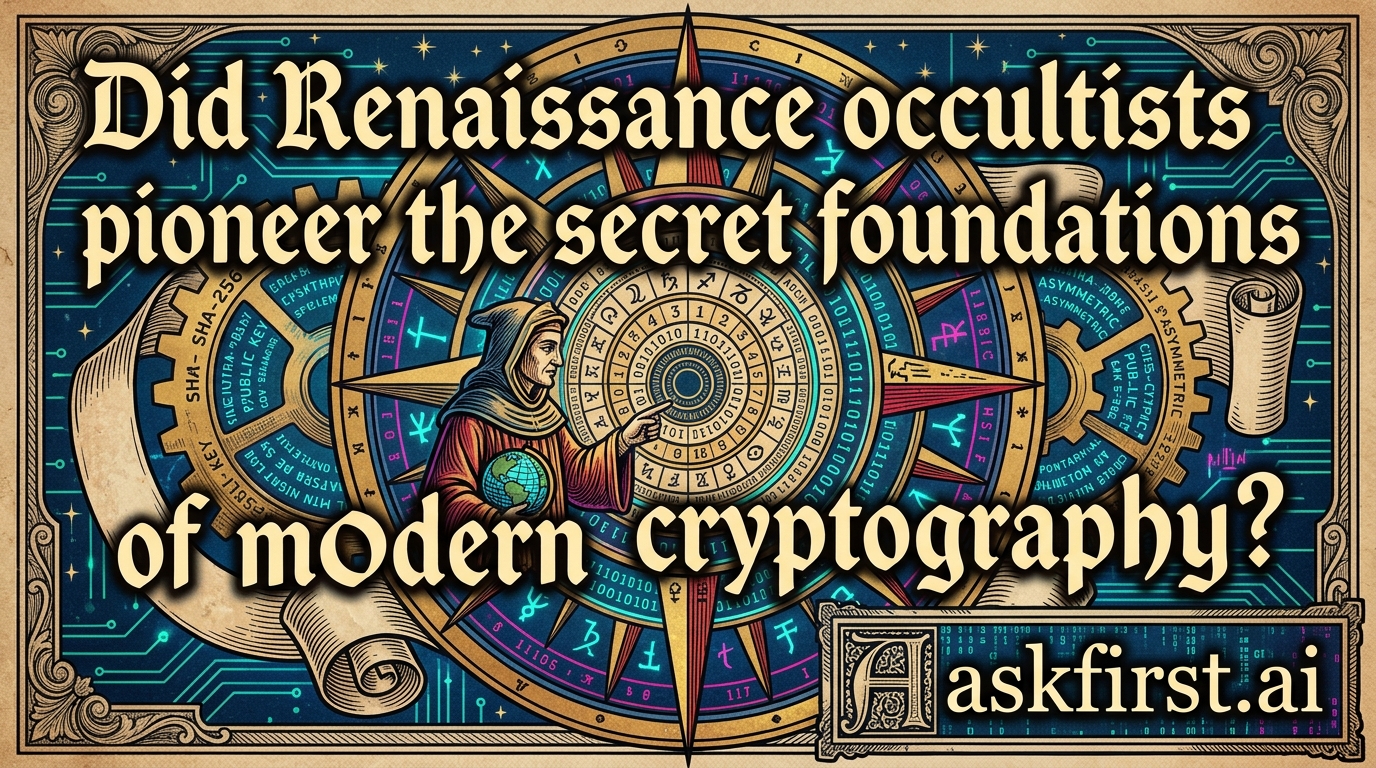
The history of cryptography is often viewed through the lens of military strategy or mathematical innovation, yet a profound, often overlooked chapter links these advancements to Renaissance occultism. During the 15th and 16th centuries, figures like Johannes Trithemius, Heinrich Cornelius Agrippa, and John Dee viewed the world as a system of encoded divine messages. Their pursuit of hidden knowledge—the 'arcane'—demanded methods of concealment that predate and heavily influence the logical structures of modern digital security.
The Polygraphic Innovation
Johannes Trithemius, a Benedictine abbot and polymath, published Steganographia (c. 1499), a work that appears at first glance to be a collection of magical incantations and angelic invocations. Beneath this occult veneer lies a sophisticated system of steganography and polyalphabetic substitution. Trithemius effectively created the first known systematic method for concealing a message within an innocuous text, a technique known today as 'null ciphers' or 'steganographic embedding.' By assigning specific numeric values to his 'magical' words, he enabled the transmission of sensitive political information under the guise of religious liturgy. This concept of mapping hidden data onto harmless structures remains the fundamental principle of modern digital watermarking and data masking.
The Shift to Mechanical Concealment
Trithemius’s work inspired later cryptologists to move away from purely linguistic puzzles toward mechanical and algorithmic solutions. The 'Tabula Recta,' a square table used for polyalphabetic ciphers, became the bedrock of the Vigenère cipher. This method, long considered unbreakable, allowed for the dynamic shifting of alphabets based on a keyword, a logic gate that mirrors modern stream ciphers and symmetric encryption protocols. These early occultists did not merely invent codes; they invented the algorithmic thinking necessary to secure information against unauthorized interception.
From Alchemy to Algorithms
Why did these individuals focus on secrecy? The Renaissance occultist functioned in a landscape of high political surveillance and ecclesiastical scrutiny. Secrets involving alchemy, cosmology, or unauthorized political correspondence carried significant social risk. Consequently, the development of secure communication became a form of survival. This necessity fueled a shift toward abstraction. By stripping the meaning from text and replacing it with procedural rules—rules that could only be reversed with the correct 'key' or ritual understanding—these thinkers established the foundational methodology for computer science: the decoupling of information from its readable form. Today, every time data is encrypted via modern protocols, it utilizes the same conceptual framework: the transformation of plaintext into ciphertext through a procedural logic that the original occultists pioneered during their search for hidden divine knowledge. Their legacy is not merely in the mystery they cultivated, but in the rigorous, rule-based secrecy that defines the digital age.