The Hidden Productivity Killer: Multitasking
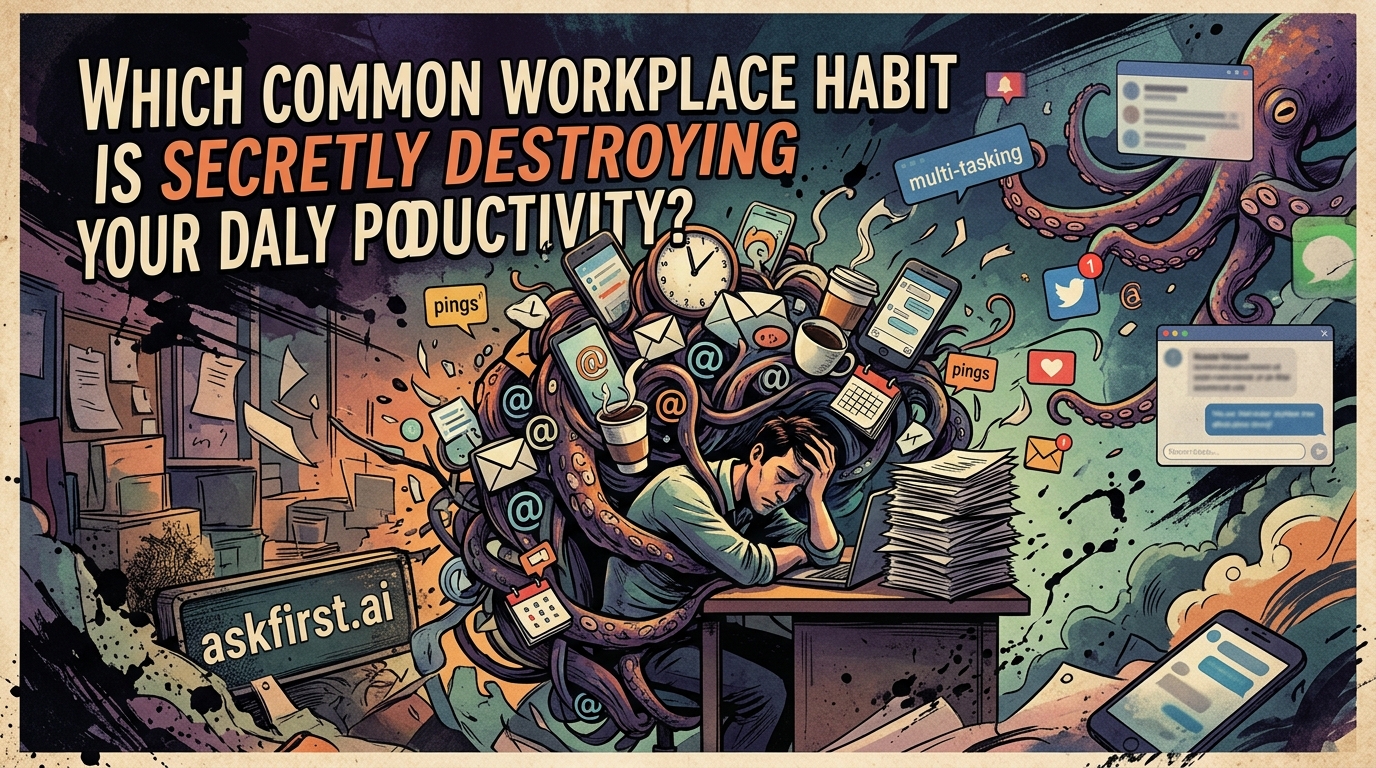
Many professionals pride themselves on their ability to juggle multiple tasks at once, believing that rapid task-switching is the hallmark of a high-achiever. However, extensive research in cognitive psychology reveals a sobering truth: multitasking is a cognitive myth. When an individual attempts to process two or more streams of information simultaneously, the brain does not actually perform tasks in parallel. Instead, it engages in rapid task-switching, a process that incurs a significant 'switching cost' every time the focus shifts. This habit is the single most destructive force eroding workplace productivity today.
The Neuroscience of Switching Costs
Cognitive scientists refer to this phenomenon as 'context switching.' When a brain moves from writing a report to answering an urgent email and then back to the report, it takes time to clear out the mental workspace and load the new task parameters. Studies from the American Psychological Association suggest that these micro-transitions can consume up to 40% of an individual's productive time throughout the day. By the time a worker refocuses on their primary task, the momentum and depth of thought—often called 'flow'—have been entirely disrupted.
Why the Brain Fails at Multitasking
- The Attention Bottleneck: The brain has limited capacity for executive function. Trying to force complex cognitive tasks into the same processing loop results in diminished quality across all efforts.
- Increased Error Rates: Because the brain is forced to suppress relevant information to switch contexts, the likelihood of making mistakes in both tasks increases significantly.
- The Dopamine Loop: Many individuals engage in multitasking because it provides a false sense of accomplishment. Checking notifications gives a quick hit of dopamine, creating a cycle of shallow, distracted work that feels productive but results in very little deep work output.
Practical Strategies to Reclaim Focus
To combat the destructive habit of multitasking, professionals must embrace structured cognitive strategies that prioritize deep, singular focus over frenetic activity.
1. Implement Time Blocking
Dedicate specific blocks of time to singular objectives. During a 'deep work' block, all non-essential communication tools must be closed. This creates an environment where the brain can engage with complex material without the interference of peripheral tasks.
2. Practice Monotasking
Make a conscious choice to complete one task before starting the next. This requires discipline but yields superior results. When the brain is allowed to focus on a single objective for an extended period, it enters a state of 'flow,' where performance peaks and time seems to accelerate.
3. Audit Your Digital Environment
Notifications are the enemy of sustained concentration. Disable all non-essential alerts on desktops and mobile devices. By controlling when communication reaches the workspace, rather than allowing communication to dictate the rhythm of the day, individuals regain sovereignty over their cognitive resources.
The Long-Term Impact on Professional Growth
Beyond immediate output, the persistent habit of multitasking fundamentally alters how the brain processes information. A brain habituated to distraction struggles to maintain the sustained attention required for critical thinking, complex problem-solving, and creative innovation. In an era where AI and automation handle routine tasks, the ability to perform deep, analytical, and highly focused work will be the primary driver of career longevity and success. Investing in the capacity for deep focus is not just a productivity hack; it is a vital career strategy.
Conclusion: Quality Over Quantity
The secret to doubling your productivity is not doing more things; it is doing one thing at a time with absolute, undistracted focus. By recognizing that multitasking is a drain on cognitive energy rather than a multiplier of output, professionals can pivot toward a more sustainable and effective working style. Stop trying to juggle the impossible and start mastering the art of the singular objective. The results will be reflected not only in the volume of completed work but in the heightened quality of every project undertaken.