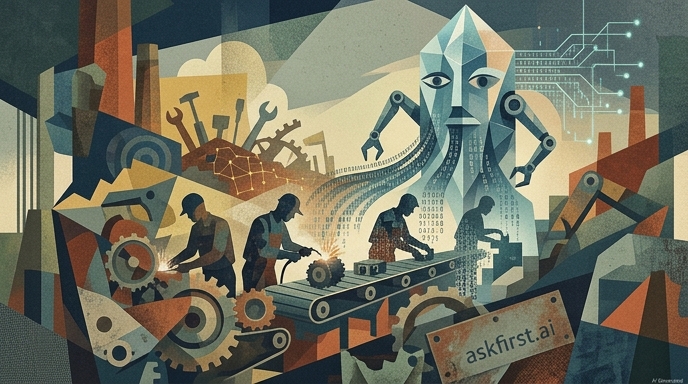
The integration of artificial intelligence into the global economy represents a fundamental shift in the nature of labor, comparable to the Industrial Revolution or the advent of the digital age. While technological progress has historically created more jobs than it has destroyed, the current wave of generative AI and machine learning poses unique structural challenges that threaten to displace workers across sectors previously considered immune to automation. Understanding how this transition leads to unemployment requires a look at the mechanisms of labor market disruption, the speed of adoption, and the nature of the tasks being replaced.
The Mechanism of Task Displacement
Unlike previous waves of automation that primarily targeted manual labor, contemporary AI focuses on cognitive labor. The core mechanism of displacement is "task automation" rather than "job automation." When an AI system can perform a specific subset of tasks within a role—such as drafting emails, summarizing legal documents, or writing basic code—the total labor hours required for that role decrease.
When the productivity gain is significant enough, organizations do not necessarily hire more people to do more work; instead, they consolidate roles. This leads to technological unemployment in roles that rely heavily on information processing, data synthesis, and routine logical tasks. As these tasks become commoditized, the market value of human labor in those specific areas drops, leading to redundancy.
The Compression of Skill Acquisition
One of the most concerning aspects of AI-driven unemployment is the speed at which it renders professional skills obsolete. Traditionally, workers had decades to adapt to technological shifts. Today, Large Language Models (LLMs) can master new technical domains in months. This creates a "skills gap" where the pace of AI advancement outstrips the ability of the workforce to retrain.
When a professional spends years acquiring expertise in a field like graphic design, translation, or entry-level software engineering, only to find that AI can replicate that output in seconds at a fraction of the cost, a structural mismatch occurs. Many workers are left with "stranded assets"—skills that are no longer economically viable—leading to long-term unemployment for those unable to pivot into the narrow niches where human judgment and high-level strategy remain superior.
The "Hollowing Out" of the Middle Class
Economists have observed a phenomenon known as job polarization. AI tends to augment high-skill, high-wage roles (by making experts more productive) and automate routine, middle-skill roles (the backbone of the middle class).
- Routine Cognitive Roles: Administrative assistants, paralegals, data entry clerks, and junior analysts face the highest risk. These positions involve predictable, rule-based workflows that are "low-hanging fruit" for AI integration.
- The Middle-Skill Gap: As these middle-tier jobs disappear, the labor market risks becoming bifurcated. On one end, there are highly paid specialists who manage AI systems; on the other, there are low-wage, manual service jobs that remain difficult or expensive to automate (such as specialized elder care or skilled manual trades). This "hollowing out" leads to a loss of the career ladders that once allowed workers to climb from entry-level positions to management, effectively trapping many in stagnant, low-growth employment sectors.
Diminishing Returns on Human Labor
In a capitalist framework, labor is a cost center. When AI provides a cheaper, 24/7 alternative that does not require benefits, office space, or management oversight, businesses are incentivized to substitute capital for labor. We are currently witnessing a shift where the marginal cost of producing "intelligence" is trending toward zero.
As the cost of generating content, code, and insights plummets, the relative scarcity—and thus the value—of human labor decreases. This leads to a decline in wage bargaining power. Even for those who remain employed, the threat of automation acts as a downward pressure on wages. If a worker knows that their tasks can be automated, they are less likely to demand raises or improved conditions, further destabilizing the traditional employment contract.
The Lag in Institutional Adaptation
The transition period—the time between the obsolescence of old roles and the creation of new ones—is where structural unemployment becomes most acute. Our educational institutions and social safety nets are designed for a linear career path that no longer exists.
- Educational Lag: Universities and vocational schools are struggling to update curricula to match the pace of AI development. By the time a student graduates, the skills they learned may already be secondary to AI capabilities.
- Systemic Rigidity: Current labor laws and tax structures often incentivize companies to replace humans with machines. For example, in many jurisdictions, labor is heavily taxed through payroll contributions, while investment in software and hardware is often tax-deductible or depreciable. This creates a fiscal bias in favor of AI, artificially accelerating unemployment.
Conclusion: The Structural Reality
The path to AI-driven unemployment is not necessarily a sudden "mass firing" event, but rather a slow, relentless erosion of job security and career mobility. As AI integrates into every layer of the corporate stack, the demand for human labor will likely shift toward roles requiring high-level emotional intelligence, complex physical dexterity, and ultimate accountability—areas where AI remains fundamentally constrained. Without a fundamental rethink of how societies distribute wealth and how labor is valued, the displacement caused by AI could lead to persistent structural unemployment for a significant portion of the global workforce.