The Landscape of Opportunity: Strategic Business Ventures for South Africa in 2026
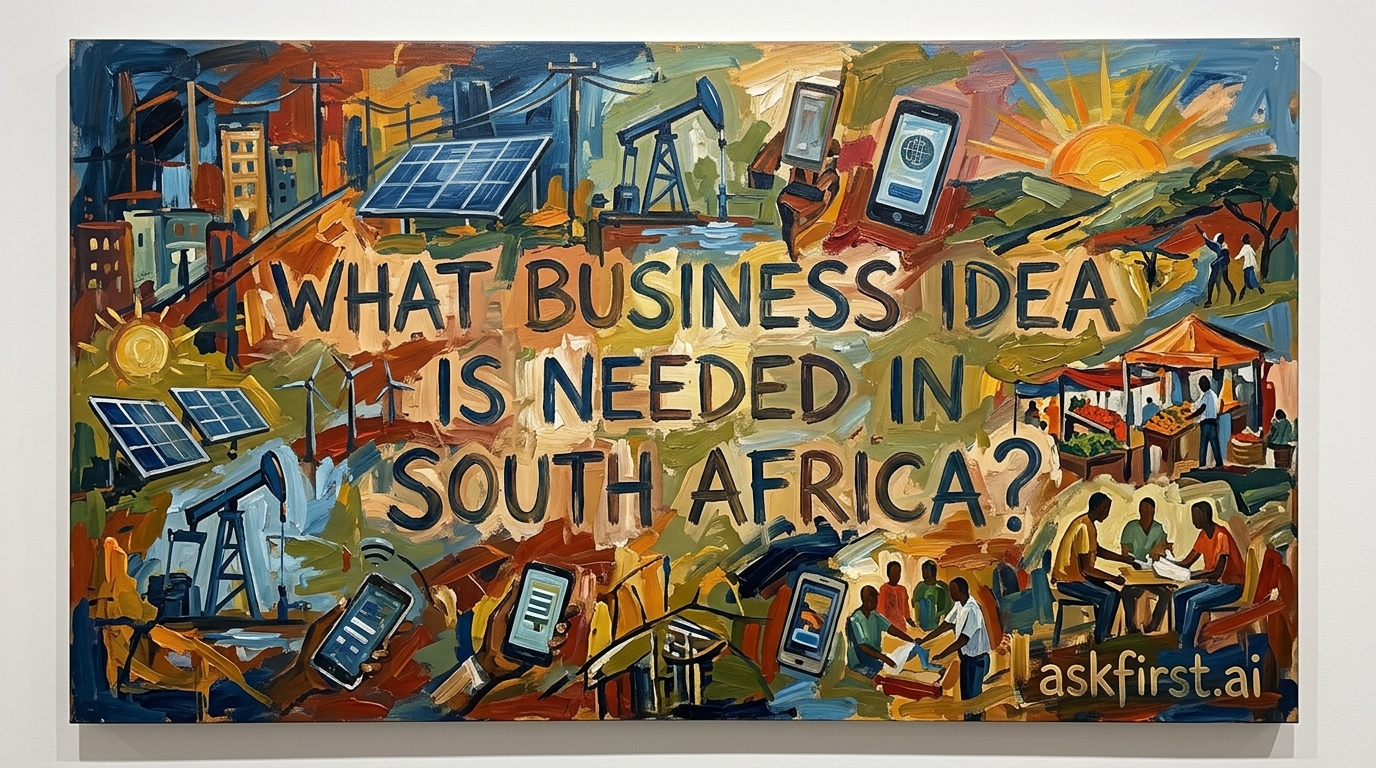
South Africa currently stands at a critical juncture of economic transition. With a population exceeding 60 million, a burgeoning youth demographic, and an infrastructure landscape undergoing significant decentralization, the country is ripe for innovation. To succeed in the current South African market, entrepreneurs must move away from generic retail models and toward solving "friction points"—the structural inefficiencies in energy, logistics, and digital access that define daily life for both businesses and households.
1. Decentralized Renewable Energy Services (The "Energy-as-a-Service" Model)
The most pressing need in South Africa remains the reliable supply of electricity. Despite the progress made by independent power producers, the national grid remains volatile. While many companies focus on selling solar panels, there is a massive, underserved gap in Energy-as-a-Service (EaaS) for the SME sector.
Small businesses—such as bakeries, laundromats, and small manufacturers—often lack the capital to purchase high-end lithium-ion storage and solar arrays outright. A business model that installs, maintains, and manages solar-plus-storage systems for a fixed monthly fee (rather than an upfront cost) is highly scalable. By leveraging IoT (Internet of Things) to monitor grid load shedding patterns, these companies can act as "virtual power plants," optimizing usage for their clients. As noted by Anton Eberhard in his research on power sector reform via the University of Cape Town’s Power Futures Lab, the future of South African energy lies in distributed generation. This is not just a trend; it is a fundamental requirement for industrial survival.
2. Cold-Chain Logistics for Emerging Agri-Tech
South Africa is a global powerhouse in agricultural exports, yet post-harvest losses remain staggering due to inadequate cold-chain infrastructure in rural and peri-urban areas. There is an urgent need for "Modular Cold Storage Solutions."
Using repurposed shipping containers equipped with solar-powered refrigeration units, entrepreneurs can provide "cold storage hubs" for small-scale farmers in provinces like Limpopo and the Eastern Cape. By offering this as a rental service, farmers can store their produce longer, negotiate better prices, and reduce the 30% to 40% loss rate currently plaguing the sector. This concept aligns with the National Development Plan (NDP) 2030 goals regarding rural development and food security. Providing the "middle mile" of logistics—connecting remote producers to urban retailers—is currently the most lucrative gap in the value chain.
3. Fintech for the Informal Economy (The "Stokvel" Digital Transformation)
The informal economy, or "township economy," represents a massive portion of South Africa's GDP, yet it remains largely disconnected from formal financial instruments. While traditional banks have focused on mobile banking, there is a specific need for Digital Governance Platforms for Stokvels.
Stokvels (traditional savings clubs) manage billions of Rands annually. However, they rely on manual record-keeping and cash handling, which are prone to theft and mismanagement. A secure, blockchain-based or encrypted mobile application that allows for automated contributions, transparent ledger management, and collective investment in formal instruments (like money market funds) would be revolutionary. As highlighted in “The Stokvel Economy” by Kasi-focused market researchers, the key to success here is not just technology, but trust. The platform must be culturally integrated, allowing for the social dynamics of these groups while providing the security of a banking institution.
4. EdTech Focused on Vocational "Micro-Credentialing"
The South African unemployment crisis is largely a skills-mismatch crisis. Traditional university degrees are often too slow to adapt to the rapidly changing needs of the digital economy. A business model focused on Vocational Micro-Credentialing—short, intensive, industry-aligned courses in fields like cloud computing, precision agriculture, or renewable energy installation—is essential.
The model should partner directly with industry leaders to guarantee placement for graduates. Instead of selling a "degree," you are selling a "job-ready certification." By focusing on high-demand technical roles that do not require a three-year degree, you tap into a massive market of school-leavers who are eager to enter the workforce but lack the technical training required by modern firms.
5. Circular Economy and Waste-to-Value
South Africa’s waste management systems are under extreme pressure. A business model centered on Industrial Symbiosis—collecting industrial waste from one sector to be used as a raw material for another—is both environmentally necessary and economically viable. For example, converting organic waste from large-scale food manufacturing into high-grade compost or insect-based animal feed for the poultry industry. The Department of Forestry, Fisheries and the Environment has been pushing for a circular economy shift, and businesses that can quantify their carbon offset while producing a tangible product will find significant support through green finance grants and government incentives.
Conclusion
The most successful business ideas in South Africa for the remainder of the decade will be those that embrace "frugal innovation"—doing more with less. Whether it is through decentralizing energy, digitizing traditional financial practices, or creating circular waste streams, the winning strategy is to solve a real-world problem that the state currently struggles to address. By focusing on the "middle market"—the millions of South Africans working in the informal sector and the thousands of SMEs struggling with infrastructure—entrepreneurs can build resilient, high-impact businesses that contribute to the country's long-term economic stability. The opportunity is not in replicating Western models, but in adapting those models to the unique, vibrant, and challenging landscape of South Africa.