The persistence of wealth and poverty across generations is one of the most studied phenomena in economics, sociology, and political science. While popular culture often attributes financial status to "hard work" or "laziness," empirical evidence suggests that the mechanisms maintaining these states are systemic, psychological, and structural. To understand why wealth remains concentrated and poverty remains entrenched, we must examine the interplay of capital accumulation, institutional barriers, and the "scarcity mindset."
The Multiplier Effect of Capital Accumulation
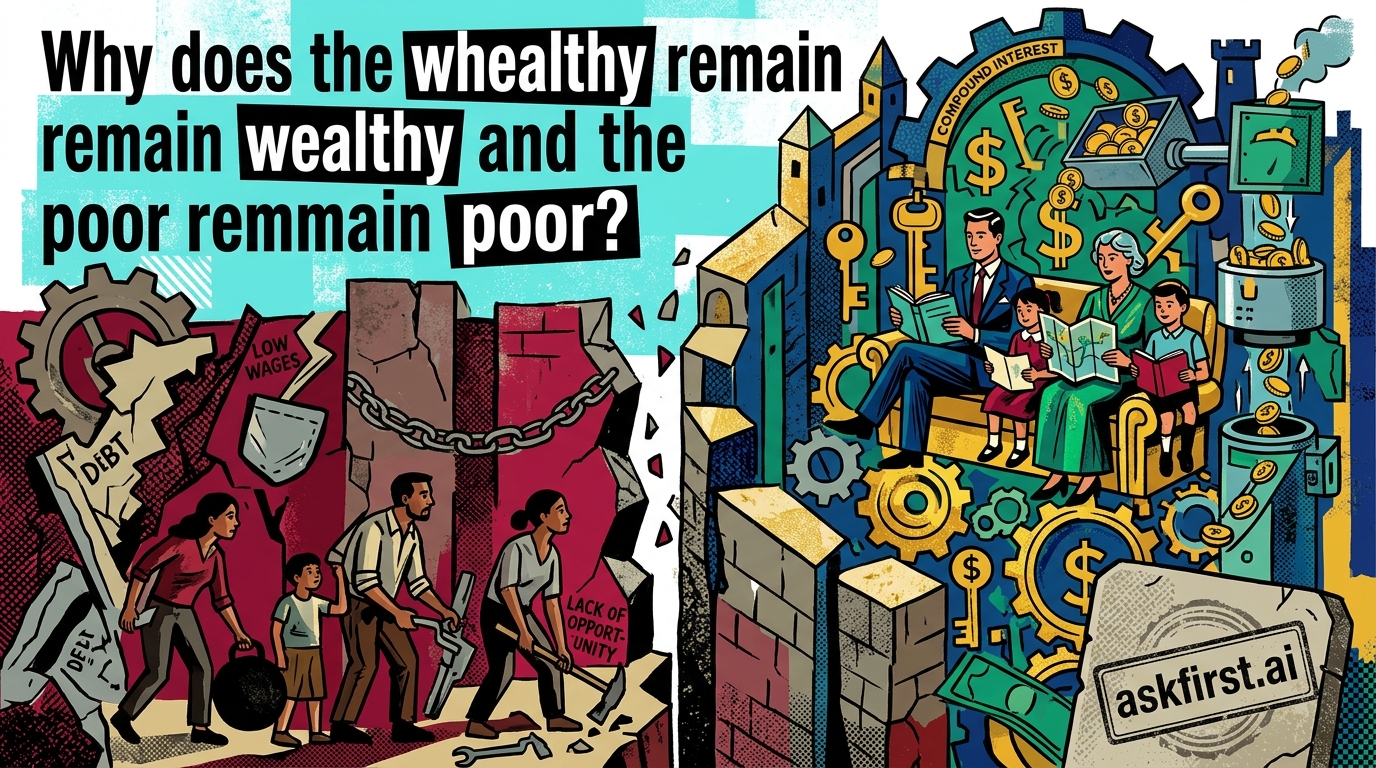
The most fundamental reason the wealthy remain wealthy is the mechanics of compound growth. Thomas Piketty, in his seminal work Capital in the Twenty-First Century (Harvard University Press, 2013), famously proposed the formula r > g, where r represents the rate of return on capital (investments, stocks, real estate) and g represents the economic growth rate (wages).
When the return on capital consistently outpaces the growth of wages, those who own assets see their wealth expand faster than those who rely solely on labor. For the wealthy, money functions as a self-replicating engine. If an individual inherits or earns a significant surplus, they can invest in diversified portfolios. These investments generate passive income, which is then reinvested. Over decades, this creates a "snowball effect" that is nearly impossible for someone living paycheck-to-paycheck to replicate.
Furthermore, wealth provides access to "insider" opportunities. As documented by Robert Putnam in Our Kids: The American Dream in Crisis (Simon & Schuster, 2015), the wealthy operate within networks that provide access to private equity deals, elite educational institutions, and high-level mentorship. These social networks act as a gatekeeper, ensuring that the benefits of the economy are distributed among those already within the circle.
The Institutional Barriers to Mobility
Conversely, the poor often face a series of institutional "poverty traps." Poverty is not merely a lack of cash; it is a high-cost environment. As noted by Sendhil Mullainathan and Eldar Shafir in their book Scarcity: Why Having Too Little Means So Much (Times Books, 2013), living in poverty imposes a "bandwidth tax" on the brain. When an individual is constantly stressed about immediate survival—rent, food, utility bills—their cognitive capacity for long-term planning is severely diminished.
This is exacerbated by structural disadvantages:
- The Cost of Being Poor: Low-income individuals often pay more for basic services. They may lack access to credit, forcing them to rely on predatory payday lenders with triple-digit interest rates. They may live in "food deserts" where healthy food is expensive and scarce, leading to long-term health issues that incur massive medical debt.
- Educational Disparity: In many nations, particularly the United States, school funding is tied to local property taxes. This creates a cycle where children in poor neighborhoods receive an inferior education, limiting their future earning potential and ensuring the cycle repeats in the next generation.
- The Risk Threshold: For a wealthy person, a $5,000 car repair is an inconvenience. For a person living in poverty, that same expense can lead to job loss, eviction, and a total collapse of their financial stability. The wealthy can take risks (starting a business, investing in stocks) because they have a "cushion." The poor are forced into risk-aversion, which paradoxically keeps them from the high-reward opportunities necessary to build wealth.
The Role of Inheritance and Tax Structures
Wealth is rarely just about current income; it is about the intergenerational transfer of assets. In many developed nations, tax codes favor capital gains over labor income. Labor income is taxed at progressive rates, while capital gains—the primary income source for the ultra-wealthy—are often taxed at lower rates.
Additionally, the existence of inheritance taxes, or the lack thereof, plays a critical role. When wealth is passed down through generations, it creates a dynastic effect. As noted by sociologists Dalton Conley and others, the "head start" provided by family wealth allows the offspring of the wealthy to fail without catastrophic consequences. They can afford to take unpaid internships, pursue high-risk entrepreneurial ventures, or simply wait for the right career opportunity. A poor individual, by contrast, must take the first available job to survive, often locking them into a low-wage trajectory.
Conclusion
The persistence of wealth and poverty is not an accidental byproduct of a free market, but rather a reflection of how systems are designed to reward existing capital over labor. The wealthy remain wealthy because they own the assets that grow faster than the economy, and they possess the social and intellectual capital to navigate the system to their advantage. The poor remain poor because the cost of survival consumes the resources that would otherwise be used for investment, while institutional barriers prevent the accumulation of the necessary cushion to break the cycle. To bridge this gap, structural changes—such as equitable education funding, progressive taxation, and access to low-cost financial services—are required, rather than simple individual effort alone.