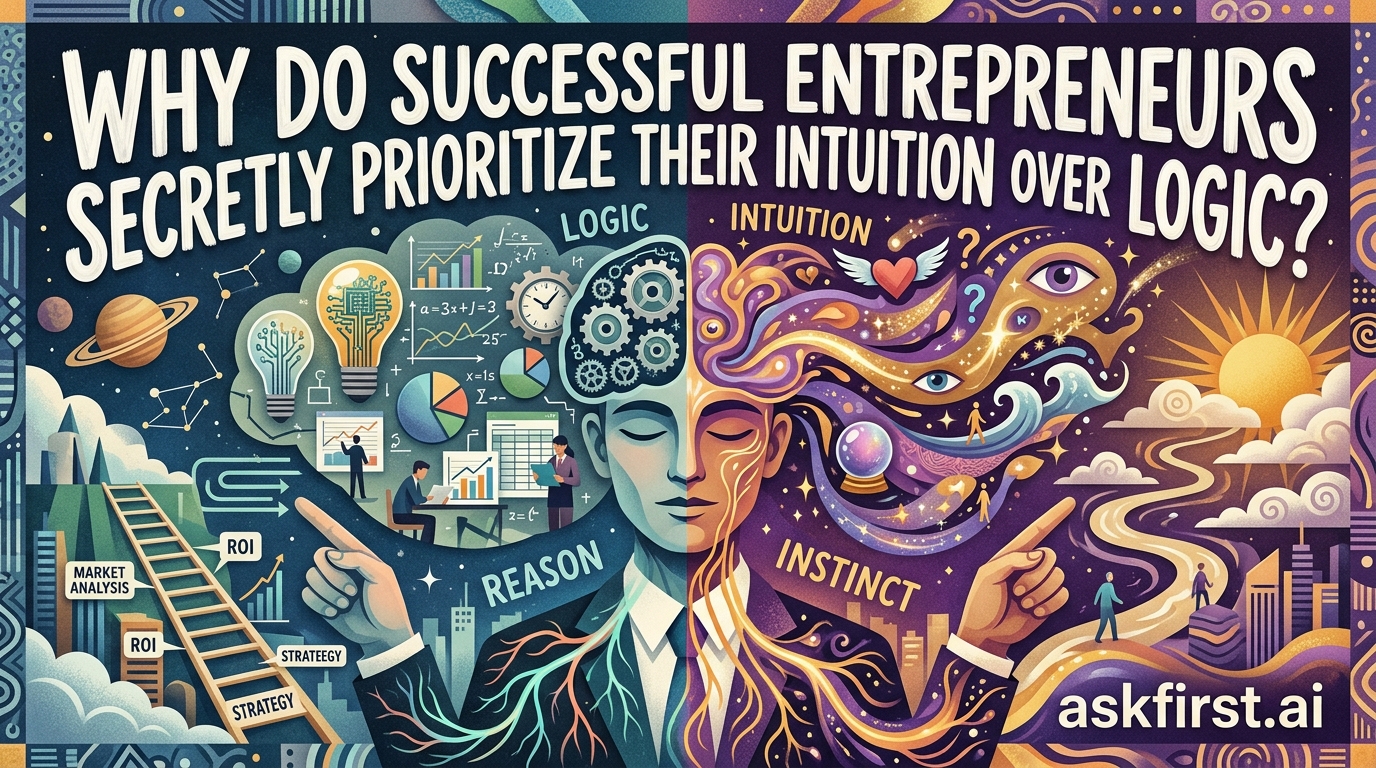
The Hidden Engine of Entrepreneurial Success: Understanding Intuition
In the high-stakes world of modern business, the prevailing narrative suggests that success is the byproduct of cold, hard data, rigorous market research, and logical extrapolation. However, behind the closed doors of boardrooms and the late-night strategy sessions of multi-billion dollar founders, a different reality persists: the silent, authoritative guidance of human intuition. While logic helps sustain a business, intuition is often what defines the trajectory of a breakout success.
What is Entrepreneurial Intuition?
Contrary to popular belief, intuition is not a mystical or supernatural phenomenon. According to cognitive psychology, specifically the research conducted by Nobel laureate Daniel Kahneman, intuition is 'recognition primed decision making.' It is the brain's ability to access a vast, subconscious library of past experiences, patterns, and subtle signals that the conscious mind has yet to process or analyze formally. For the veteran entrepreneur, intuition serves as a sophisticated filter that bypasses the latency of traditional analysis.
The Limitations of Pure Logic
Logic operates linearly. It functions within the constraints of the data already collected, meaning it is inherently backward-looking. In a rapidly evolving market, relying solely on logic creates a significant risk: the "analysis paralysis" loop. By the time a comprehensive set of data points is collected and synthesized into a logical conclusion, the market window has often already shifted. Successful entrepreneurs recognize this lag and leverage intuition to leapfrog the competition.
- Speed of Execution: Intuition allows for near-instantaneous decision-making, which is crucial in volatile environments.
- Pattern Recognition: Founders often encounter situations that are 'data-poor' but 'context-rich.' Intuition identifies patterns in these thin-slice environments that spreadsheets miss.
- Risk Management: While logic assesses known variables, intuition acts as an early warning system for anomalies—the 'gut feeling' that something is off, even when the numbers look perfect.
The Science of the 'Gut Feeling'
Neuroscience reveals that the gut (the enteric nervous system) contains millions of neurons that communicate directly with the brain via the vagus nerve. This is why high-pressure decisions often manifest physically. Successful leaders learn to interpret these physiological markers as data points in their own right. This is not about guessing; it is about trusting the brain's ability to synthesize thousands of past outcomes into a singular, emotional prompt.
Cultivating Informed Intuition
Intuition is not an excuse for laziness or recklessness. It is a muscle that must be conditioned through rigorous experience. The most successful entrepreneurs follow a specific framework to ensure their intuition is reliable:
- Deep Domain Expertise: You cannot have a reliable gut feeling about an industry you do not understand. Intuition is the byproduct of deep immersion.
- The Post-Mortem Audit: After making an intuitive decision, these leaders conduct thorough retrospectives to determine whether the intuition led to the intended result. This feedback loop sharpens future accuracy.
- De-biasing: Experts recognize that the ego can mimic intuition. They create cognitive distance by asking, 'Would I be this confident if the roles were reversed?'
Real-World Impact on Business Strategy
Many of history's most iconic business moves—such as Steve Jobs’ insistence on the aesthetics of the original Macintosh or Netflix’s pivot from DVD mail-order to streaming—were initially viewed by analysts as 'illogical.' These were not simple gambles; they were instances of high-level intuitive synthesis. The founders perceived a shift in consumer behavior and technology maturity that traditional logical modeling deemed premature or unnecessary.
Conclusion: The Balanced Approach
Ultimately, the most effective strategy is not choosing between logic and intuition, but integrating them. Logic serves as the foundation for operational efficiency and scaling, while intuition acts as the North Star for innovation and disruption. The entrepreneur who secretively relies on intuition does so because they understand that logic is the map of where we have been, but intuition is the compass for where we must go. By cultivating both, the business leader gains the ability to make decisions that are not only defensible in a spreadsheet but transformative in the marketplace.