The Psychology of Professional Stagnation
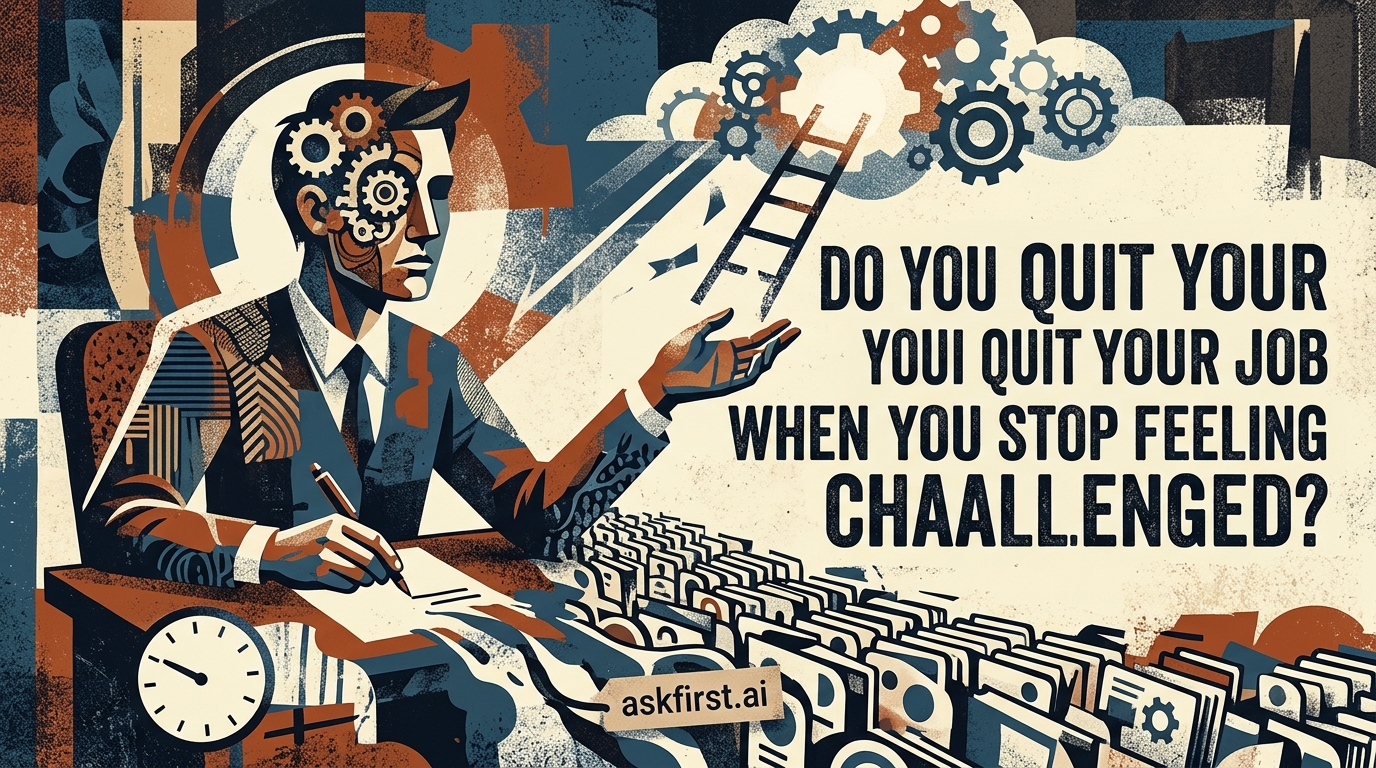
When the initial spark of excitement in a career fades and the daily tasks transition from thrilling challenges to mundane repetitions, many professionals face an existential crisis. The urge to resign is often framed as an intuitive signal for growth, yet modern organizational psychology suggests that quitting is merely one of many possible reactions to a lack of challenge. Deciphering whether the absence of challenge is a temporary plateau or a permanent ceiling requires a methodical assessment of professional trajectory, mental health, and the architecture of the current role.
The Myth of the 'Always Challenged' Employee
One of the most persistent myths in the corporate world is that a successful career must be characterized by perpetual disruption and constant acquisition of new skills. However, cognitive science indicates that human performance follows a 'Goldilocks' curve. If tasks are too difficult, stress and burnout ensue. If tasks are too easy, boredom and atrophy occur. The 'flow state,' as defined by psychologist Mihaly Csikszentmihalyi, exists in the sweet spot between these extremes. It is vital to recognize that staying in a role during a period of stability can provide the necessary recovery time and confidence-building exercises required to sustain long-term career resilience.
Strategic Evaluation: Three Pillars of Retention
Instead of immediate resignation, professionals should conduct a structured audit based on these three dimensions:
- Capability Mastery vs. Utility: Have the current responsibilities been truly mastered, or is there a 'depth' of knowledge still to be uncovered? Experts often note that true mastery reveals nuances that are invisible to the novice.
- Organizational Mobility: Does the current environment offer horizontal movement? Many employees assume that progress requires vertical promotion, yet lateral transfers—switching departments or working on interdisciplinary projects—can reignite passion without the need to switch employers.
- The Value of Autonomy: Often, boredom is not a lack of task complexity, but a lack of influence. If the current role allows for high levels of autonomy, it might be the ideal environment to initiate 'intrapreneurship'—creating new projects or improving processes within the existing system.
The Cost of Premature Departure
Resigning because the 'challenge' has waned can be a costly error. Frequent job hopping, often perceived by recruiters as a lack of grit or commitment, can hinder long-term career progression. The 'network effect' of remaining within a company allows an individual to build institutional capital, trust, and deep industry relationships that are impossible to replicate in short-term roles. Furthermore, the energy required to onboard and establish oneself in a new environment often diverts attention away from meaningful, high-level creative work.
Redefining Growth: Beyond the Job Description
If the job itself no longer provides the intellectual stimulation needed, the challenge should be sought outside the primary responsibilities. Professional growth does not have to be strictly vertical or strictly internal. Consider these alternative pathways:
- Mentorship and Teaching: Transmitting knowledge to junior colleagues forces a deeper understanding of the subject matter and transforms the role into a leadership position.
- Professional Certification: Use the steady pace of the current role to invest time in acquiring formal credentials or advanced technical certifications that increase market value.
- Volunteering and Industry Committees: Engage in professional bodies or community initiatives where one can take on the high-level project management or strategic challenges that might currently be unavailable at the primary workplace.
The 'Bridge Strategy' for Career Pivots
When a job truly offers no further room for development, it should not be abandoned haphazardly. Instead, apply the 'Bridge Strategy.' Use the stability and income of the current role to systematically prepare for the next step. This involves researching the desired role, identifying the skills gap, and closing it through part-time learning, networking, or side projects while still employed. This ensures that the transition is not a reaction born of frustration, but a proactive step towards a defined vision of the future.
Final Verdict
The decision to quit should be governed by strategic clarity rather than reactive emotion. If the absence of challenge creates a toxic environment that impacts mental well-being or prevents professional development that cannot be self-remedied, then it is indeed time to move on. However, if the boredom is simply a sign of mastery, the most astute professionals choose to leverage that stability to create new frontiers of success within their current domain. True excellence is found not in constantly jumping to the next challenge, but in finding the depth and meaning within the current one.