The Paradox of Monopolies and Innovation
For decades, conventional wisdom has positioned monopolies as the ultimate enemies of progress. Economic textbooks frequently teach that competition is the lifeblood of technological advancement, pushing firms to lower prices and iterate rapidly to survive. However, the 'Schumpeterian hypothesis' flips this narrative on its head. Economist Joseph Schumpeter famously argued that large-scale firms with significant market power are, in fact, the most potent engines of innovation. This counter-intuitive perspective challenges our understanding of industrial organization and reveals a complex relationship between market structure and technological breakthrough.
The Resource Advantage
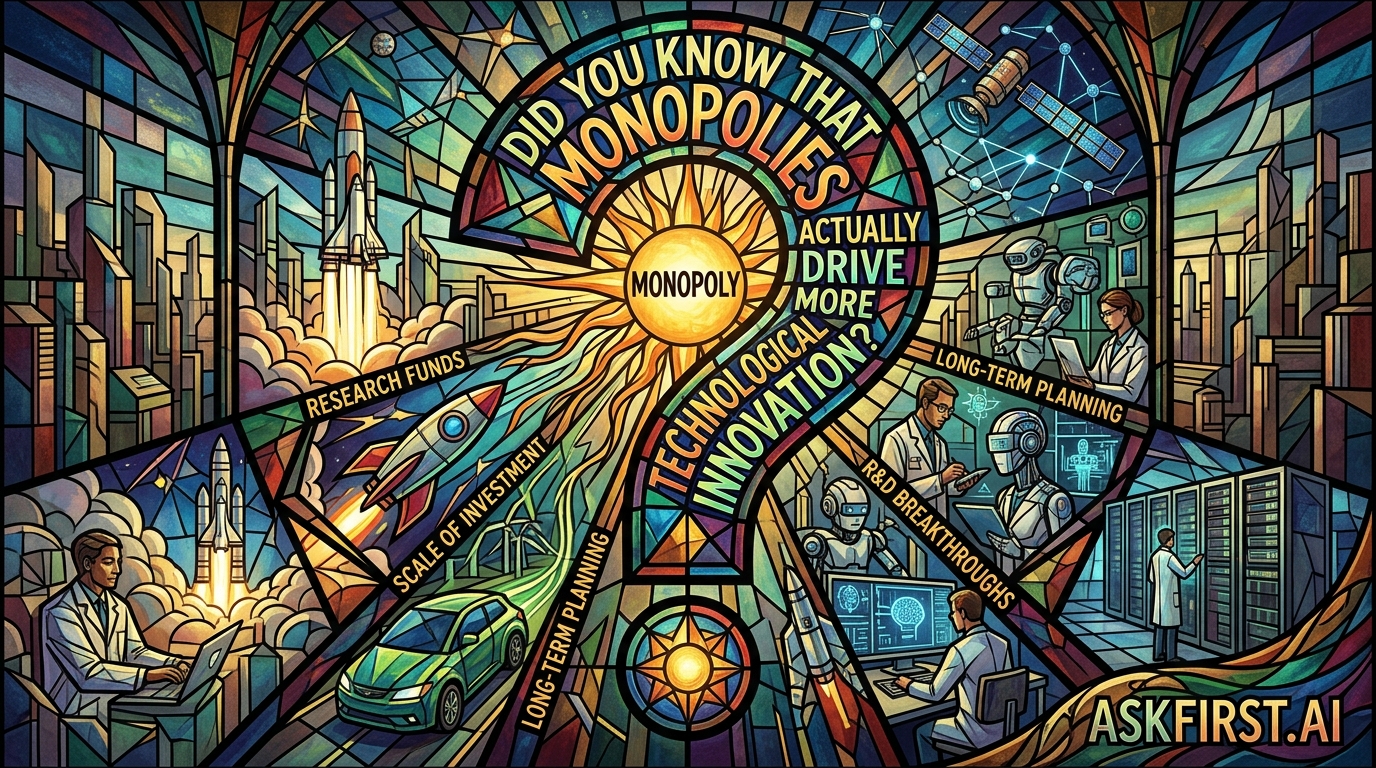
One of the most compelling arguments for the innovative capacity of monopolies is the availability of capital reserves. Disruptive innovation is rarely cheap. Developing a new pharmaceutical drug, building a proprietary semiconductor factory, or constructing a global satellite network requires billions of dollars in sunk costs and carries massive risks of failure. Smaller firms, while nimble, often lack the deep pockets necessary to sustain decade-long research and development (R&D) cycles.
- Long-term Horizon: Monopolistic entities can allocate revenue streams from existing, mature products to fund high-risk, experimental research that may not yield results for ten years or more.
- Economies of Scale: Large companies can leverage existing infrastructure, supply chains, and distribution networks to bring innovations to market faster than startups that must build these systems from scratch.
- Talent Attraction: High-power corporations offer the financial stability and high-end laboratories required to attract the world's most brilliant minds, allowing for concentrated, multi-disciplinary research efforts.
The Creative Destruction Mechanism
Schumpeter coined the term creative destruction to describe how modern capitalism evolves. According to this theory, the prospect of earning monopoly profits is the primary incentive for innovation. A firm does not innovate simply for the sake of progress; it innovates to gain a temporary monopoly by rendering the old ways of doing business obsolete. Once it captures a market, that monopoly position acts as a temporary 'prize' until the next innovator comes along to displace it. Therefore, the search for monopoly power is actually the engine that drives continuous technological change.
Historical and Case Study Evidence
History provides several compelling examples where dominant market players were responsible for the most significant leaps in modern technology:
- Bell Labs (AT&T): During the era of the telephone monopoly in the United States, Bell Labs produced an unparalleled string of inventions. This included the transistor—the fundamental building block of modern computing—the laser, and the foundation of satellite communications. The guaranteed revenue of a regulated monopoly allowed for pure research that was decoupled from immediate quarterly profit pressures.
- DuPont and Chemical Science: For much of the 20th century, DuPont held significant market power in chemical engineering. This position allowed them to fund the invention of revolutionary materials like Nylon, Teflon, and Kevlar, which completely transformed manufacturing and consumer goods.
- Modern Tech Giants: Today, the world's largest digital platforms invest hundreds of billions into artificial intelligence, quantum computing, and sustainable energy. These entities have the resources to build foundational AI models that no small competitor could hope to replicate on their own, essentially serving as modern-day research engines for the rest of the digital ecosystem.
Balancing Competition and Consolidation
This is not to say that unregulated monopoly is a utopia. The risks of market stagnation, rent-seeking behavior, and the stifling of small-scale competition remain significant threats. When a monopoly stops innovating and focuses exclusively on defensive legal strategies or predatory pricing to protect its turf, the economic benefits vanish.
Innovation thrives best when there is a contestable market structure. This means the company is currently large and dominant, but remains perpetually afraid of the next 'Schumpeterian gale'—a radical invention from a newcomer that could sweep them away. The secret to technological progress is not necessarily preventing monopolies, but rather ensuring that the barriers to entry remain porous enough for the next generation of innovators to eventually challenge the incumbent.
Conclusion
The perception of monopolies as static, slow-moving giants is a fundamental misunderstanding of how high-tech development operates in the 21st century. By providing the financial insulation necessary for 'moonshot' projects and fostering a cycle of creative destruction, dominant firms play a critical role in pushing humanity toward the next technological frontier. Understanding this dynamic is essential for policymakers and investors alike, as it suggests that the goal should not be to dismantle size, but to incentivize the relentless pursuit of innovation within those powerful organizations.