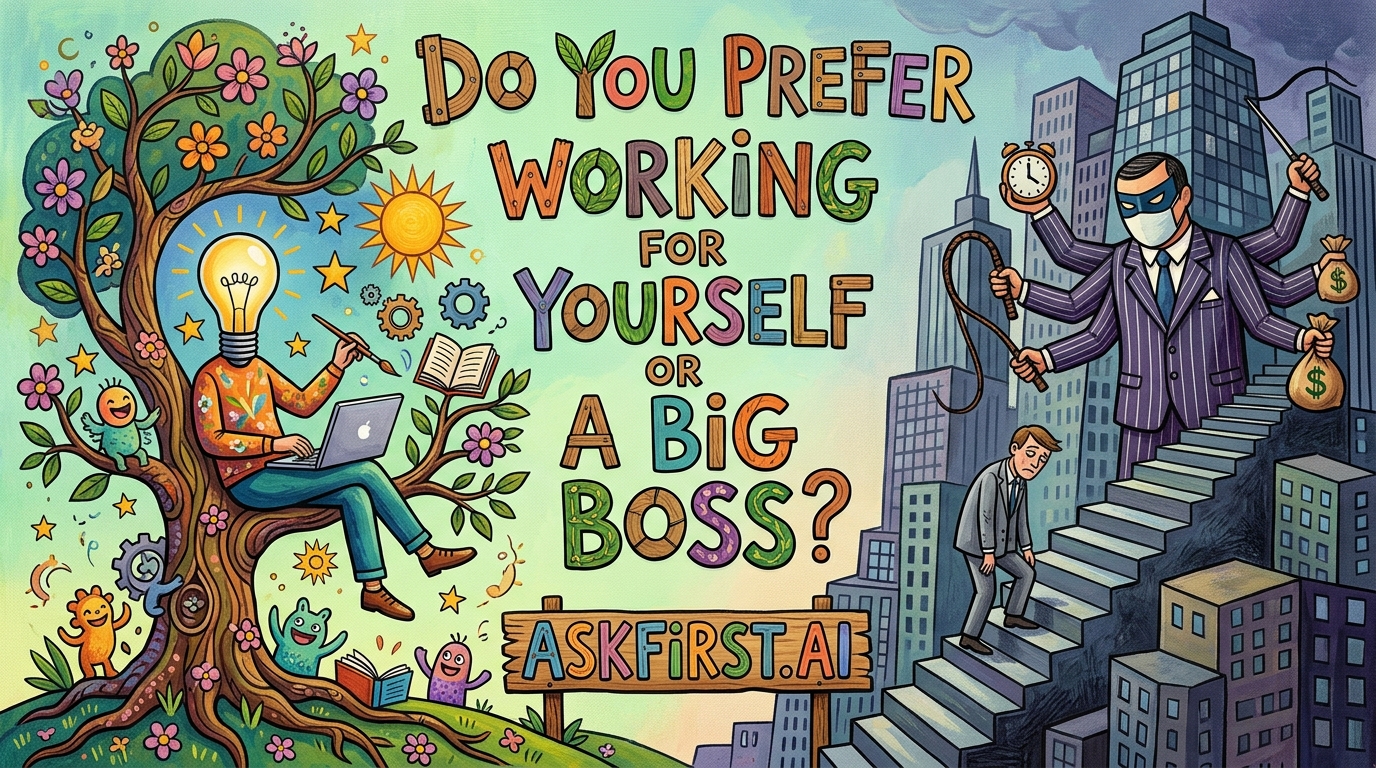
The Fundamental Shift in Professional Autonomy
The debate between entrepreneurship and corporate employment represents more than a career choice; it is a fundamental inquiry into human psychology and the pursuit of professional fulfillment. Understanding the dichotomy between working for oneself and operating under a 'big boss' requires examining the trade-offs between autonomy, security, structure, and risk mitigation.
The Allure of Entrepreneurship
Working for oneself is often associated with the zenith of creative freedom. According to self-determination theory, human beings possess an innate need for autonomy, competence, and relatedness. Entrepreneurship offers the ultimate mechanism for achieving autonomy.
- Unconstrained Decision Making: The absence of a middle-management hierarchy allows for rapid iteration and pivots. This velocity can be a significant competitive advantage in volatile markets.
- Alignment of Values: Individuals working for themselves ensure that the mission, vision, and operational practices align perfectly with personal ethics and goals.
- Unlimited Growth Potential: Unlike salary structures, business ownership decouples income from hours worked, allowing for exponential scaling based on market impact.
However, this path is not without substantial challenges. Research consistently highlights the 'entrepreneurial burden,' which includes higher rates of decision fatigue and the intense pressure of financial instability. The responsibility for every operational failure rests solely on the owner, which requires a robust psychological toolkit to manage.
The Stability of the Corporate Framework
Conversely, working for a large entity under experienced leadership provides a structured environment that many professionals find inherently more stable.
- Resource Leveraging: Big organizations provide access to vast capital, existing supply chains, and established infrastructure. Employees can focus on specific domains rather than juggling every aspect of an operation.
- Risk Mitigation: Employment within a stable corporate structure offers the buffer of regular compensation, benefits, and collective bargaining power. The psychological toll of existential business failure is largely transferred to senior leadership and shareholders, rather than the individual worker.
- Mentorship and Networking: Large organizations often serve as massive hubs for knowledge transfer. Exposure to diverse teams and established management methodologies fosters professional growth that is often difficult to replicate in isolation.
Psychological and Practical Considerations
Choosing between these two models involves an honest assessment of one's tolerance for ambiguity. Psychologists often distinguish between 'promotion focus' and 'prevention focus.'
- Promotion Focus: Individuals with a strong promotion focus are motivated by growth, accomplishment, and advancements. These individuals often thrive when working for themselves, as they view challenges as opportunities to push boundaries.
- Prevention Focus: Individuals with a strong prevention focus are motivated by safety, security, and the avoidance of negative outcomes. For these individuals, the structural security of a corporate environment is often not a hindrance, but a prerequisite for peak performance.
A Comparative Synthesis
| Feature | Working for Self | Working for a Boss |
|---|---|---|
| Autonomy | Absolute | Limited/Contextual |
| Financial Risk | High | Low/Predictable |
| Growth | Variable | Structured |
| Responsibility | Comprehensive | Functional |
It is essential to recognize that this is not a binary choice that must be maintained for a lifetime. Many professionals engage in a 'portfolio career,' blending elements of both models by engaging in freelance work while maintaining steady employment or utilizing the 'intrapreneurship' model. Intrapreneurship occurs when an employee acts like an entrepreneur within a large organization, taking ownership of projects and driving innovation with the backing of corporate resources. This hybrid approach often yields the highest levels of satisfaction, as it marries the safety of the corporate structure with the creative agency of independent work.
Conclusion
Determining a preference depends heavily on how one defines success. If success is defined by the ability to dictate every variable of the workflow, then self-employment is the logical path. If success is defined by the ability to influence large-scale systems and utilize institutional resources, then the corporate route is superior. Ultimately, the question serves as a mirror: it reveals one's underlying relationship with risk, authority, and self-efficacy. By identifying which side of this divide one occupies, professionals can better align their career trajectories with their deepest psychological drivers.