The Dichotomy of Achievement: Skill vs. Stochasticity
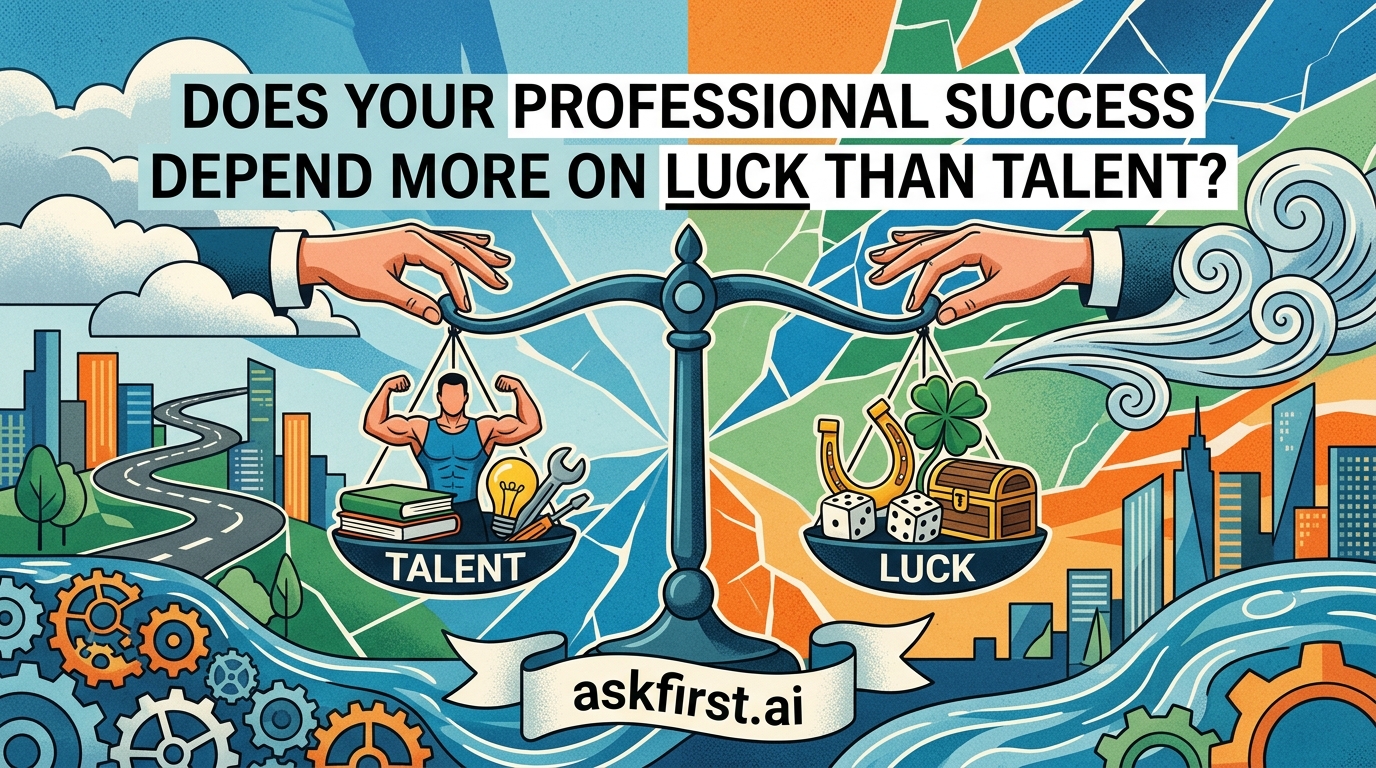
The age-old debate regarding whether professional success is an internal product of talent or an external byproduct of luck remains one of the most polarizing topics in organizational psychology. While meritocracy serves as the foundational myth of modern industry, rigorous analysis suggests that the reality is significantly more nuanced. Success is rarely a solo performance by skill alone; rather, it is a complex interaction where talent provides the entry price, but luck determines the multiplier.
The Role of Competence: The Baseline Requirement
Talent, in this context, refers to a combination of raw cognitive ability, acquired technical proficiency, and disciplined execution. It serves as a threshold variable. In high-stakes fields—such as medicine, aviation, or software engineering—a baseline level of competence is non-negotiable. Without this foundational talent, one cannot even participate in the marketplace. Research into the 'Threshold Hypothesis' suggests that while talent correlates with success up to a certain point, the correlation weakens significantly as one climbs the hierarchy of performance. Once a group reaches a high level of expertise, differences in outcome become increasingly dominated by stochastic variables.
Luck as a Strategic Variable
Luck is frequently misunderstood as entirely random chance, but it is better categorized through several distinct lenses:
- Serendipitous Networking: Being in the right place at the right time is often the result of broad exploration rather than focused narrow-tasking.
- The Matthew Effect: A phenomenon described by Robert K. Merton, where initial minor advantages (early luck) accrue into major benefits over time, making it appear that the successful individual is exponentially more talented than their peers.
- Timing and Market Cycles: A brilliant entrepreneur launching a revolutionary product during a recession will face vastly different outcomes than one launching during a boom, regardless of the quality of their execution.
The Pareto Principle and Success Distribution
Data scientist Alessandro Pluchino and his colleagues at the University of Catania famously utilized computer simulations to model the trajectory of careers. Their findings were counter-intuitive: the most successful individuals were not necessarily the most talented, but rather those who benefited from the most 'luck events.' This study highlights that because talent is distributed according to a normal distribution (bell curve) while success is distributed according to a power law, there must be another force—luck—driving that exponential disparity. When everyone in a field is highly talented, the differentiator shifts from internal capacity to environmental opportunity.
How to Navigate the Luck-Talent Spectrum
If luck plays such a significant role, does effort become meaningless? Absolutely not. Instead, the strategy for career success must shift from 'trying harder' to 'increasing the surface area of luck.'
- High-Volume Experimentation: By increasing the frequency of one's actions, one mathematically increases the probability of encountering a positive 'luck event.'
- Strategic Positioning: Seek environments where high-impact opportunities are abundant. Placing oneself in an industry or a network that is undergoing rapid growth acts as a catalyst for success that talent alone cannot manufacture.
- Developing Anti-Fragility: Nassim Taleb’s concept of anti-fragility suggests that one should structure their career to benefit from volatility. By building a diverse skill set, an individual becomes capable of capturing gains from unexpected shifts in the market.
Cultivating Resilience in an Uncertain World
Ultimately, success is a partnership between individual agency and environmental factors. Recognizing that luck plays a massive role does not diminish the value of talent; it reframes it. Talent is the 'sail' that allows one to catch the winds of opportunity, but luck is the 'wind' itself. The most successful professionals are those who recognize they cannot control the weather, but they spend their entire careers ensuring their ship is in the best possible shape to sail when the winds do blow. Understanding this balance leads to a more grounded approach to ambition, tempering frustration during inevitable lulls and fostering humility during periods of rapid ascent. By focusing on variables within one's control—education, persistence, and network expansion—one optimizes the odds until luck eventually meets preparation.