The Psychology of Entrepreneurial Hesitation
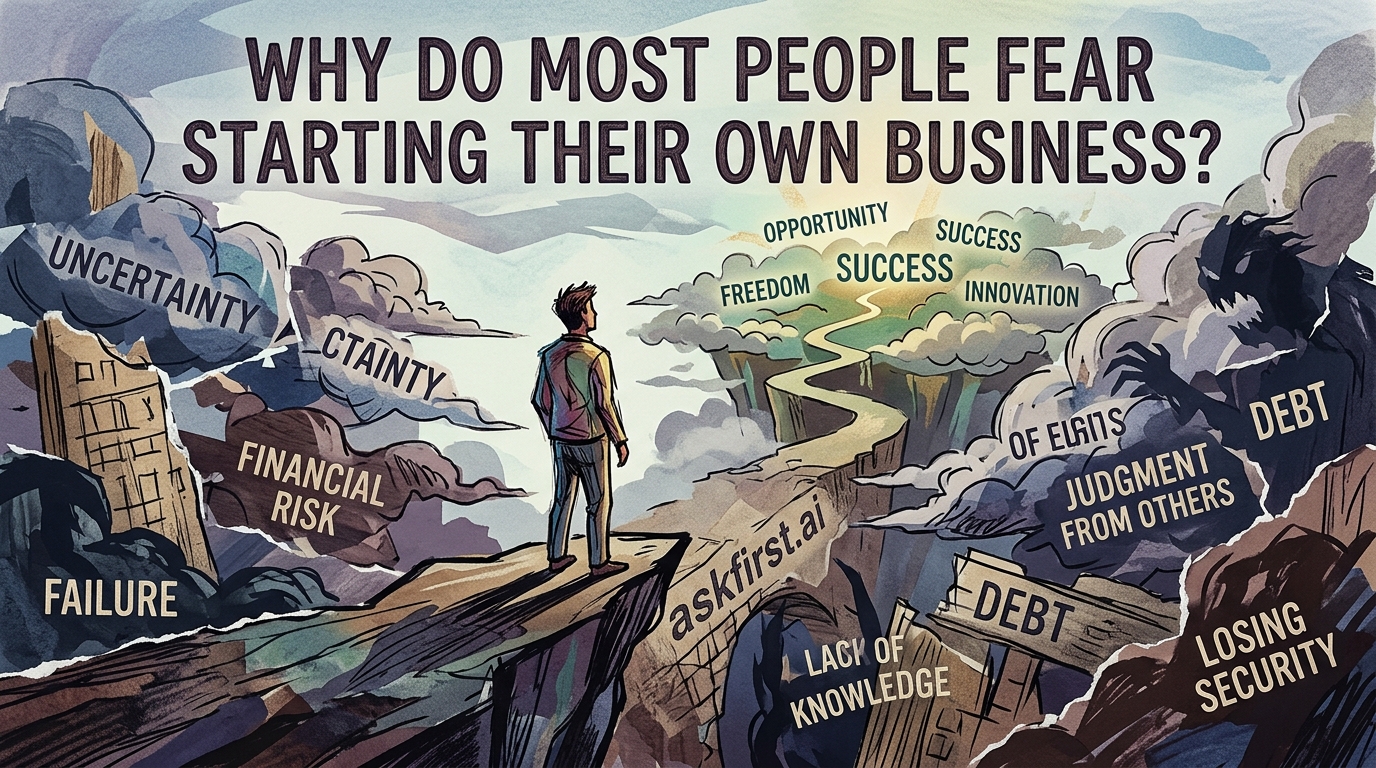
The apprehension surrounding the launch of a new business is a multi-faceted psychological phenomenon. At its core, this fear is not merely about the loss of capital; it is rooted in biological defense mechanisms, societal conditioning, and the cognitive weight of decision-making. Understanding these triggers is essential for anyone analyzing why the gap between wanting to start a business and actually doing it remains so wide.
1. The Survival Instinct and Financial Insecurity
From an evolutionary perspective, human beings are hardwired to prioritize safety and predictable resources. For millennia, survival depended on the security of the tribe and a consistent food supply. In modern terms, this translates to the 'stable paycheck' paradigm. The brain perceives the departure from a steady salary as a direct threat to survival. This 'loss aversion' bias, a concept famously explored by psychologists Daniel Kahneman and Amos Tversky, suggests that the pain of losing is psychologically twice as powerful as the joy of gaining. When individuals contemplate entrepreneurship, the brain fixates on the potential loss of income rather than the potential for limitless growth.
2. The Fear of Failure as a Social Construct
Societal conditioning plays a massive role in creating an environment where business failure feels synonymous with personal inadequacy. In many educational systems, failure is punished with poor grades, which in turn leads to a stigma that follows people into adulthood. When an entrepreneur considers starting a business, they are not just evaluating the business model; they are evaluating the impact on their reputation. The fear of public embarrassment—of having to explain a failed venture to friends, family, or professional peers—often outweighs the desire for self-actualization.
3. The Paralysis of Decision-Making (Analysis Paralysis)
Starting a business requires an infinite series of decisions, ranging from product design to legal structures and marketing strategies. Unlike a traditional employment role where tasks are assigned, an entrepreneur must define their own trajectory. This absolute autonomy can lead to choice overload. Research into the 'paradox of choice' indicates that when humans are presented with too many options, the ability to make any decision decreases significantly. The sheer volume of unknowns—tax codes, supply chains, human resources, and competitive landscapes—creates a psychological barrier that causes many to freeze before taking the first step.
4. The Sunk Cost Fallacy and Comfort Zones
Many aspiring entrepreneurs are already heavily invested in their existing careers. This is the 'Sunk Cost Fallacy' at work: the tendency to continue an endeavor once an investment in money, effort, or time has been made. If someone has spent ten years climbing the corporate ladder, the prospect of starting at ground zero in a new business venture feels like 'wasting' those years. The comfort zone serves as a protective layer, and venturing out feels inherently chaotic and risky, even when the current path offers limited long-term satisfaction.
5. Lack of Mentorship and Predictive Modeling
Fear often thrives in the absence of information. Because most people are surrounded by peers who have chosen the traditional employment route, they lack the mental models necessary to visualize success in entrepreneurship. Without examples of how to navigate the 'valley of death'—the period where a business consumes resources without yet turning a profit—individuals tend to overestimate the dangers. Exposure to successful entrepreneurs who have overcome similar obstacles is often the only catalyst strong enough to override these innate fears.
6. The Imposter Syndrome Trap
Even when the financials are sound and the idea is viable, many individuals are held back by Imposter Syndrome. This is the persistent belief that one's achievements are due to luck rather than competence and the fear of being exposed as a fraud. In the context of business, this manifests as: 'Who am I to create a product for the market?' or 'Others are much better equipped to handle this.' This internal critic serves as a powerful deterrent, forcing individuals to settle for playing small rather than embracing their potential.
Breaking the Cycle
To overcome this collective fear, one must adopt a mindset shift:
- Incremental Risk-Taking: Instead of quitting a job to start a business, many successful entrepreneurs begin as 'side-hustlers,' minimizing financial exposure while testing market fit.
- Reframing Failure: View failure as 'data gathering' rather than a personal character flaw. Every failed experiment provides actionable insights that move the needle closer to eventual success.
- Seek Communities: Surrounding oneself with fellow entrepreneurs helps normalize the struggles and provides a blueprint for problem-solving.
Ultimately, the fear of starting a business is not a sign that one should stay away; it is a signal that one is stepping into a realm of high stakes and high rewards. By acknowledging these psychological hurdles, individuals can systematically deconstruct them, turning paralyzing fear into fuel for professional and personal transformation.