The Secret of Strategic Neglect: How Top CEOs Master Less to Achieve More
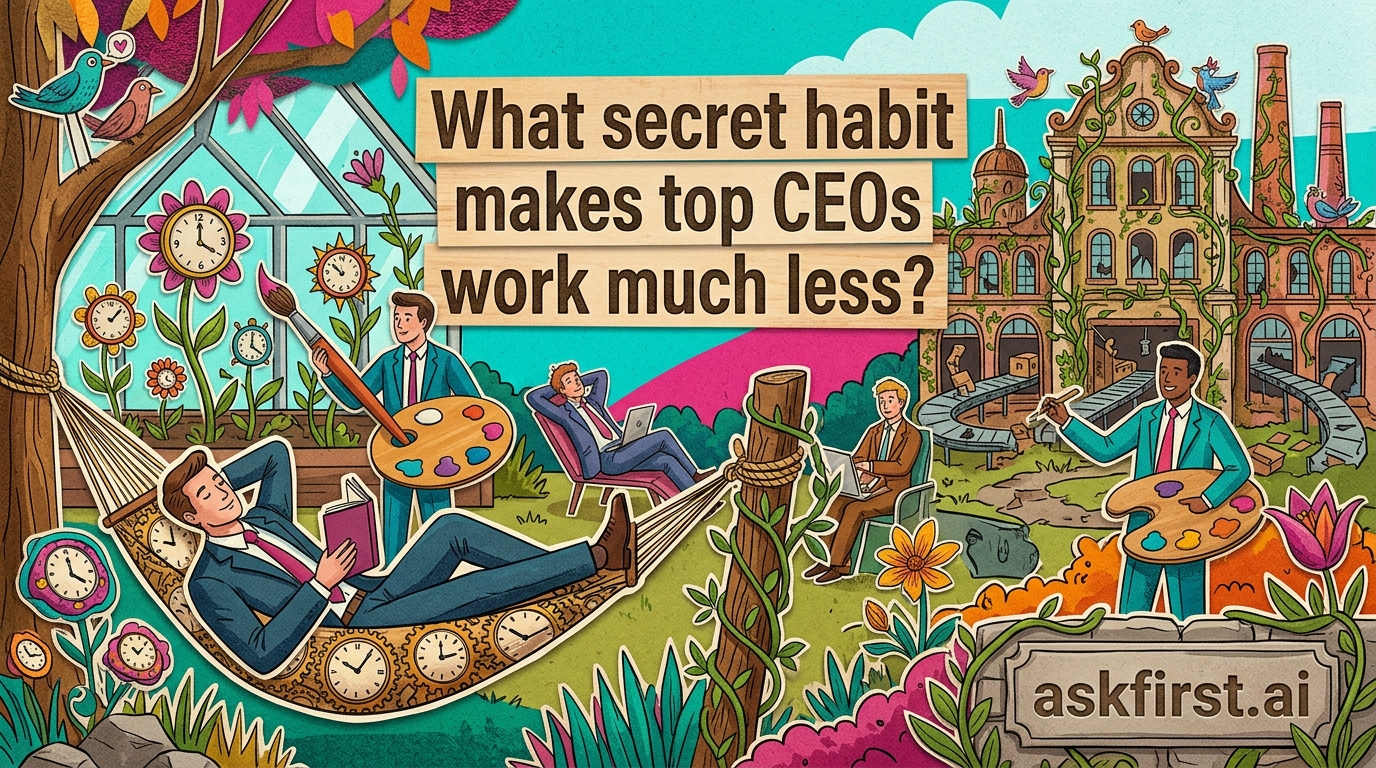
In the high-stakes world of corporate leadership, a persistent myth suggests that productivity is a direct byproduct of hours clocked. However, data suggests that the most successful CEOs have adopted a counter-intuitive habit known as Strategic Neglect. This is not laziness, but rather an aggressive form of priority pruning that allows leaders to achieve superior results while working significantly fewer hours than their peers. By ruthlessly identifying and ignoring the non-essential, elite executives protect their cognitive resources for high-impact decisions.
The Architecture of Essentialism
Strategic Neglect is built upon the foundational principle of the Pareto Principle, or the 80/20 rule. High-performing CEOs understand that 80 percent of their desired outcomes are generated by a mere 20 percent of their activities. While typical managers allow their calendars to be dictated by incoming emails, meeting requests, and low-level administrative crises, the world's most effective leaders employ a rigorous gatekeeping mechanism.
The Three Pillars of Strategic Neglect:
- Cognitive Load Management: By limiting daily decisions to three primary high-impact areas, leaders prevent decision fatigue. This allows for superior mental clarity when addressing systemic business challenges.
- Radical Delegation: Effective CEOs view tasks as liabilities rather than accomplishments. If a task can be performed by a team member with 80 percent of the leader's efficacy, it is delegated. This practice fosters autonomy within the organization.
- The Power of the 'No' Protocol: Top executives possess a sophisticated set of criteria for declining opportunities, social engagements, and project involvements that do not align with long-term organizational trajectory.
Reframing Productivity as Leverage
For a top CEO, productivity is defined as leverage. Instead of focusing on output (how much work gets done), they focus on leverage (how much impact is created per unit of time). This shift in perspective transforms the calendar from a list of obligations into a strategic map. A common practice among these leaders is the implementation of 'Deep Work' blocks, popularized by Cal Newport. During these windows, phones are silenced, emails are blocked, and the executive focuses exclusively on a single objective that drives institutional value.
Why Busyness is Often a Competitive Disadvantage
The obsession with 'busyness' often masks a lack of strategic focus. When an executive is constantly reactive, they lose the capacity for long-term vision. Research conducted by Harvard Business School suggests that CEOs who spend time on reflective activities are significantly better at navigating market disruptions. By working 'less' in the traditional sense, they gain the time required for 'high-level contemplation.' This is where breakthroughs occur—far away from the noise of operational minutiae.
Implementing Strategic Neglect in Any Career
The principles of Strategic Neglect are not reserved for those in the C-suite. Individuals across all sectors can apply these methods to increase output and reduce work-induced burnout:
- Conduct a Time Audit: Identify exactly where hours are being spent. Categorize tasks into 'Impactful,' 'Routine,' and 'Waste.'
- Automate or Eliminate: Utilize modern tools for routine tasks. If an activity provides minimal value, remove it from the schedule entirely.
- Define Your 20 Percent: Determine the specific actions that contribute most heavily to your professional goals and prioritize those at the beginning of the day when cognitive energy is highest.
The Psychology of Detachment
One of the most difficult hurdles in mastering this habit is the psychological discomfort of letting go. Many professionals fear that by working less, they will appear disengaged or ineffective. However, history demonstrates that leaders who master their own boundaries often command more respect from their organizations. By modeling high-level prioritization, they encourage their entire workforce to value quality over quantity. This shift transforms a corporate culture from a frantic, reactive environment into a steady, outcome-oriented powerhouse.
Ultimately, the secret habit of top CEOs is the realization that their most valuable resource is not their talent or their capital—it is their uninterrupted attention. By protecting that attention with the iron shield of Strategic Neglect, they achieve more before lunch than their peers accomplish in a week. Success is not about how many tasks are crossed off a list; it is about the impact of the few tasks that actually moved the needle. Through this lens, doing less becomes the ultimate competitive advantage in an increasingly complex global economy.