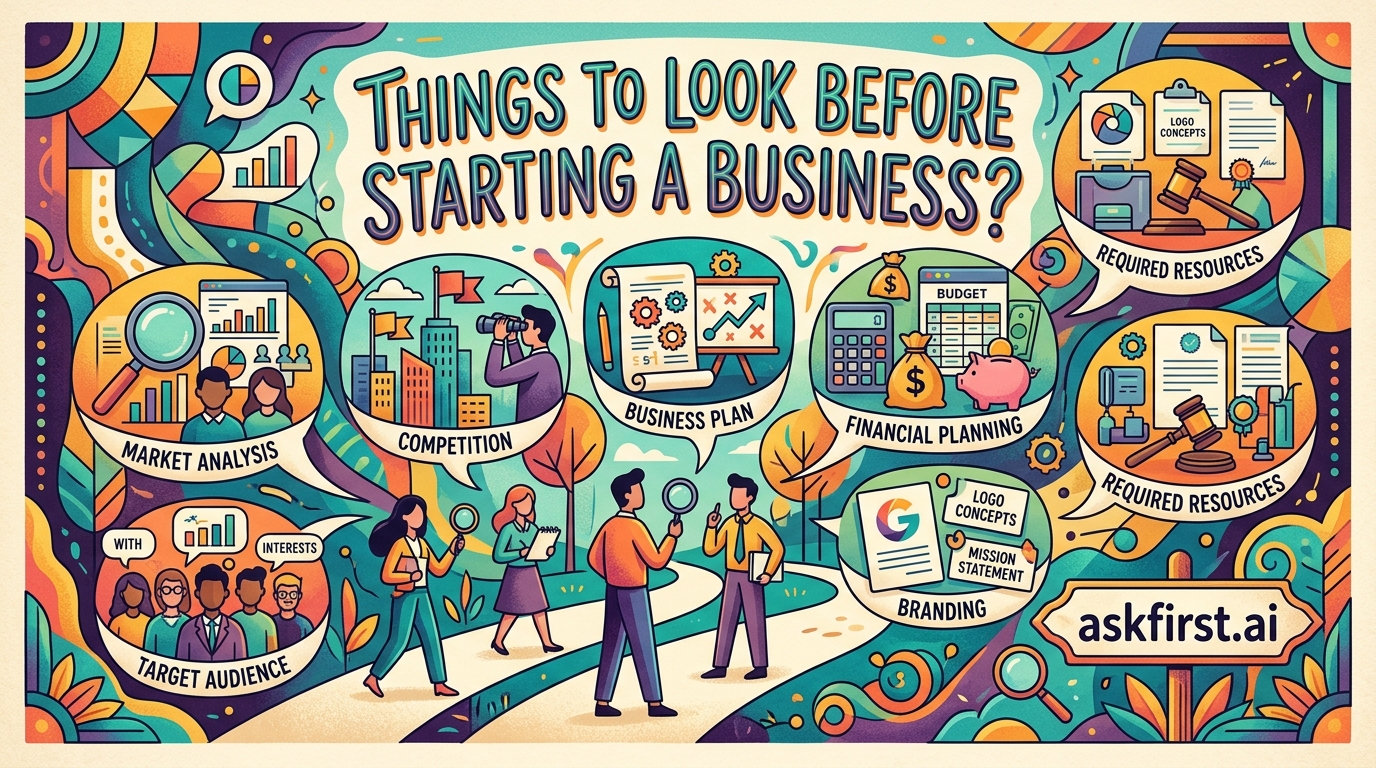
Launching a business is a transformative endeavor that requires far more than just a creative spark or a unique product idea. It demands a rigorous, multi-dimensional assessment of market viability, personal readiness, and operational architecture. Before investing capital, time, and emotional energy, an entrepreneur must navigate several critical pillars of due diligence to ensure the business is built on a foundation capable of weathering the inevitable volatility of the marketplace.
1. Rigorous Market Validation and Pain Point Analysis
The most common reason startups fail is the lack of "market need." According to Eric Ries in his seminal work, The Lean Startup, entrepreneurs must focus on validated learning rather than mere intuition. You must identify a specific "pain point"—a problem that customers are currently experiencing and are actively seeking to solve.
- The Problem-Solution Fit: Ask yourself if your product is a "vitamin" (a nice-to-have) or a "painkiller" (an essential necessity). Painkillers are infinitely easier to sell during economic downturns.
- Target Audience Segmentation: Do not aim for "everyone." Define your beachhead market—the smallest segment of customers you can dominate first. Use tools like the Value Proposition Canvas popularized by Alexander Osterwalder in Business Model Generation to map exactly how your product alleviates specific customer pains.
2. The Financial Reality Check: Burn Rate and Runway
Before you open your doors, you must have a clear understanding of your unit economics. Many founders fall into the trap of focusing only on revenue, ignoring the crucial distinction between cash flow and profit.
- Fixed vs. Variable Costs: Calculate your "burn rate"—the amount of money your business spends each month before it starts generating revenue.
- Runway: You need a minimum of 6 to 12 months of operating expenses in reserve. As noted by Mike Michalowicz in his book Profit First, you should structure your business to prioritize profitability from day one rather than treating profit as an afterthought. Determine your "break-even point"—the exact sales volume required to cover both fixed and variable costs.
3. Legal Structure and Compliance Framework
The legal foundation of your business dictates your personal liability and tax obligations. Choosing the wrong structure can have long-term repercussions.
- Entity Selection: Whether you choose a Sole Proprietorship, an LLC (Limited Liability Company), or a C-Corp depends on your growth ambitions and risk profile. An LLC, for instance, offers a layer of protection between your personal assets and business liabilities.
- Regulatory Environment: Research local, state, and federal requirements. Do you need specific licenses, permits, or industry-specific certifications? Ignoring these can result in heavy fines or forced closure. Consult with a CPA or a business attorney to ensure your tax strategy is optimized from the outset.
4. Competitive Landscape and Differentiation
You are rarely the only person with an idea. You must conduct a SWOT analysis (Strengths, Weaknesses, Opportunities, Threats) regarding your competitors.
- The Unfair Advantage: What is your "moat"? In Zero to One, Peter Thiel argues that competition is for losers—meaning, you should aim to build a monopoly in a niche market through proprietary technology, network effects, or economies of scale.
- Differentiation: If your product is not significantly better or cheaper than existing solutions, customers have no incentive to switch. Identify your unique selling proposition (USP) and ensure it is defensible.
5. Personal Readiness and Resilience
Entrepreneurship is a psychological marathon. It is rarely the glamorous journey depicted on social media.
- The "Why": Simon Sinek, in Start with Why, emphasizes that your purpose must be strong enough to sustain you when the revenue is low and the challenges are high. If your only motivation is money, you will likely burn out when the initial excitement fades.
- Support Systems: Assess your personal risk tolerance and the stability of your home life. Do you have a support network? Are you prepared to work unconventional hours? Building a business is a lifestyle change that affects your mental health, social life, and family dynamics.
6. Scalability and Operational Systems
Finally, consider the long-term mechanics of your operation. If your business succeeds, can it handle the volume?
- Processes and SOPs: Document your Standard Operating Procedures (SOPs) early. Michael Gerber, in The E-Myth Revisited, highlights that most small businesses fail because the founder tries to do everything themselves. Your goal is to build a system that works independently of your constant intervention.
- Technology Stack: Determine what software, CRM, and accounting tools you need. Automating mundane tasks—such as invoicing, lead generation, and customer support—is essential for maintaining a lean operation as you grow.
Conclusion
Starting a business is an act of calculated risk-taking. It requires the courage to move forward and the humility to constantly re-evaluate your assumptions. By validating your market, mastering your unit economics, securing your legal standing, and preparing yourself mentally for the challenges ahead, you transition from being a dreamer to being a builder. Remember that the goal is not merely to start, but to build a sustainable, scalable entity that provides genuine value. Review your plan, stress-test your assumptions, and proceed with the discipline of a professional who understands that the foundation you lay today will determine the height of the skyscraper you build tomorrow.