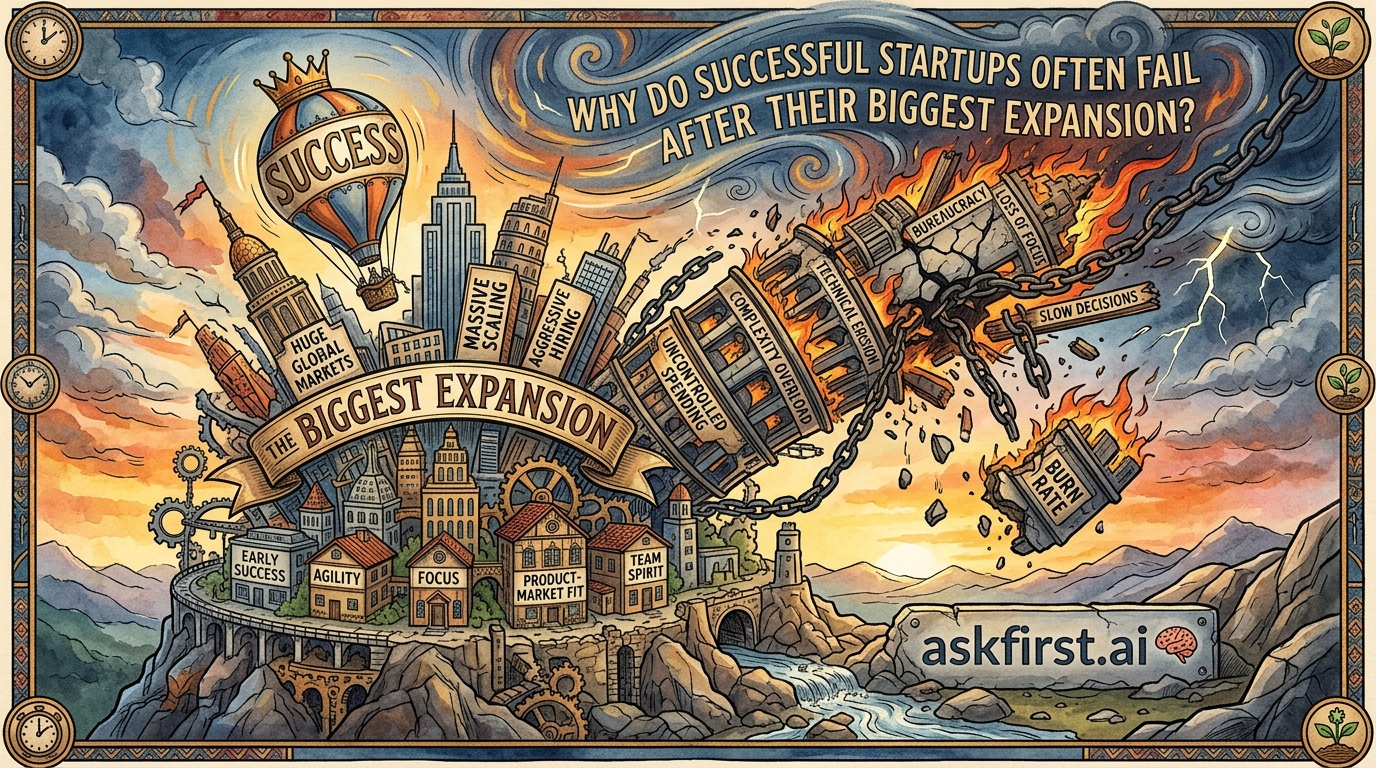
The transition from a high-growth startup to a sustainable enterprise is a treacherous journey often referred to as the scaling trap. While rapid expansion appears to be the ultimate indicator of success, it frequently serves as a catalyst for systemic failure. This phenomenon occurs because the infrastructure, culture, and operational mechanics that fueled early survival often become liabilities during hyper-growth.
1. The Dilution of Organizational Culture
In the early stages, a startup thrives on a tight-knit team where communication is informal, fluid, and intuitive. Founders often share a singular vision that permeates every decision. However, when a company scales, headcount increases rapidly. This process inevitably introduces new layers of middle management and bureaucratic processes. As the number of employees grows, the original 'mission-driven' spirit is diluted. Without deliberate efforts to codify values and standardize onboarding, the unique culture that provided the startup with its competitive edge dissipates, leading to internal misalignment and reduced employee motivation.
2. The Debt of Technical and Operational Complexity
Startups often prioritize speed to market over long-term architecture. This 'move fast and break things' mentality results in significant technical debt. When expansion requires moving from a local market to a global one, this fragile infrastructure frequently collapses under the pressure of scale. Systems that served ten thousand users fail to handle ten million. Furthermore, operational processes that functioned when handled by five people in a single room become inefficient and prone to error when distributed across hundreds of employees in different time zones. Without rigorous investment in robust internal systems, the organization begins to suffer from self-inflicted chaos.
3. Misalignment of Product-Market Fit
Many startups fail to realize that the customer base that brought them success in the 'early adopter' phase is not the same as the 'mainstream' customer base they must capture to scale. Successful growth often requires pivoting or expanding the product suite. If leadership misreads this shift and attempts to push an early-stage product onto a mainstream audience without the necessary feature maturation, they encounter high churn rates. The company effectively outgrows its original solution before establishing a new, stable foundation for its larger user base.
4. The Trap of Premature Scaling
As noted by researcher Steve Blank, premature scaling is a leading cause of failure. Investors often demand aggressive growth targets, leading founders to pour capital into marketing and sales before proving that their business model is repeatable and profitable. When expansion outstrips the company's ability to maintain unit economics, the result is a cash burn rate that is unsustainable. If the cost of acquiring a customer exceeds the lifetime value of that customer, the startup is essentially paying to destroy its own financial foundation.
5. Leadership Fragility and Management Overhead
Founders who excel at innovation are not always the best executives for a large-scale operation. The skill set required to navigate a startup through its first million dollars of revenue is drastically different from the skill set required to manage a global corporation with thousands of staff. When founders fail to delegate effectively or refuse to bring in experienced professional management, the organization loses its strategic focus. Decision-making bottlenecks emerge, and the company struggles to respond to market changes with the same agility it possessed during its inception.
Key Principles for Navigating Scaling Challenges
To survive the expansion phase, sustainable organizations focus on several critical pillars:
- Codify Culture Early: Explicitly define the values that drive success so they can be taught to new cohorts of hires.
- Prioritize Unit Economics: Ensure that every new customer acquired contributes positively to the bottom line before scaling marketing spend.
- Invest in Modular Architecture: Build systems that are designed to be scaled independently, reducing the impact of failures.
- Build a Professional Management Layer: Recognize when the founders' role needs to transition from hands-on 'doer' to strategic 'architect'.
Conclusion
Scaling is not merely a quantitative exercise of adding people or locations; it is a qualitative transformation of the entire business entity. Successful startups that survive this transition are those that treat scaling as a disciplined strategic evolution rather than a reckless sprint. They understand that to grow large, they must become more sophisticated, more intentional, and more resilient than they ever were in their early days. By managing these fundamental tensions, companies can bypass the 'scaling trap' and move toward long-term institutional stability.