The Foundations of Interconnectivity
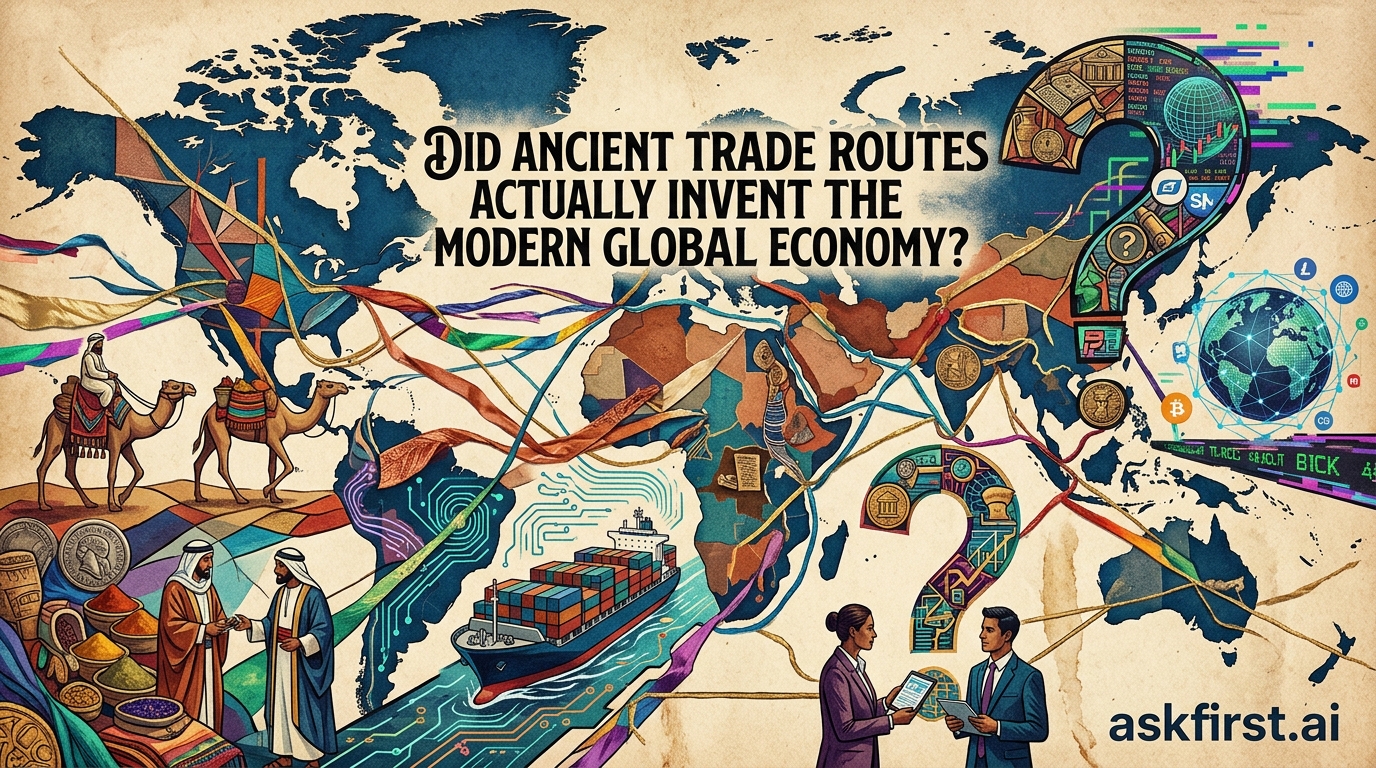
To understand whether ancient trade routes truly invented the modern global economy, one must look beyond mere commodity exchange and analyze the systemic architectures of human interaction. The short answer is a resounding yes; the blueprints for global capitalism, logistical supply chains, and international banking were all drafted on the dusty paths of the Silk Road, the Incense Route, and the maritime networks of the Indian Ocean.
The Birth of Supply Chain Complexity
Long before the concept of 'just-in-time' manufacturing, ancient merchants faced the same core challenges as modern CEOs: risk management, inventory turnover, and market volatility. The Silk Road was not just a conduit for silk; it was an information network. Merchants acted as information brokers, mapping consumer preferences across thousands of miles. By the time spices arrived in Rome from the Malabar Coast, they carried a price premium that accounted for shipping, insurance, and the extreme risks of piracy—effectively the proto-version of modern shipping logistics and financial futures markets.
Financial Innovations: The Credit Revolution
One of the most persistent myths is that modern finance started in the Renaissance. However, evidence suggests that the ancient world utilized sophisticated credit systems to circumvent the dangers of transporting physical coinage. The suftaja in the Islamic Golden Age and earlier mercantile practices in Mesopotamia utilized bills of exchange. By allowing a merchant to deposit money in one city and withdraw it in another, ancient traders laid the groundwork for modern banking. This separation of 'value' from 'physical currency' is the fundamental pillar of our current global financial system.
Standardizing the Global Market
Ancient trade required a common language of value. Weights, measures, and coinage standardization—such as the Roman Denarius or the Persian Daric—served as the ancient equivalents to the Euro or the U.S. Dollar. When states invested in these trade routes by providing safe passage, infrastructure (caravanserais), and protection, they were essentially participating in the first iteration of global trade policy. These agreements were the precursors to modern trade blocs and multilateral treaties. The concept of 'most-favored-nation' status has its roots in these ancient tribute and trade treaties where rulers provided secure access to merchant guilds in exchange for tax revenue.
Cultural Exchange and the Economic Engine
Trade routes facilitated the exchange of technology, which is the true driver of modern economic growth. When papermaking technology moved from China to the Islamic world and eventually to Europe, it revolutionized record-keeping, which in turn spurred more complex commercial contracts. This cycle—trade leading to intellectual property transfer, leading to innovation, leading to more trade—is the exact engine that powers the modern Silicon Valley-driven global economy. The ancient world proved that innovation follows the money, a principle that remains the bedrock of modern venture capital.
Did They Really 'Invent' It?
If we define the modern global economy as a set of rules regarding the movement of capital, the standardization of goods, and the interconnectedness of supply chains, then the ancient merchants were indeed the original architects. They transitioned the world from isolated, autarkic village economies to a networked civilization. Modernity has simply increased the speed and digitized the ledger, but the underlying mechanisms of profit, arbitrage, and risk mitigation remain startlingly similar to those used by Sogdian merchants or Phoenician seafarers.
Key Pillars of the Ancient-to-Modern Transition:
- Arbitrage: The practice of buying low in one region and selling high in another is the core of modern commodity trading.
- Risk Hedging: The use of sea and land insurance contracts dates back to ancient maritime laws like the Lex Rhodia.
- Specialization: Nations or regions focusing on what they produce best (comparative advantage) was established through regional resource reliance thousands of years ago.
- Language and Trust: Developing trust across borders required the creation of merchant law, the direct ancestor of modern international commercial law.
Conclusion: The Persistent Pattern
While the technology has shifted from camels and dhows to fiber optics and container ships, the structural DNA of global commerce is distinctly ancient. The modern global economy is not a new invention but an evolution of these primordial trade routes. By studying these ancient patterns, we gain a deeper appreciation for the resilience and complexity of human cooperation. We are, in many ways, just operating a much faster version of a system that was perfected in the shadow of the Great Walls and the bustling ports of the ancient world.