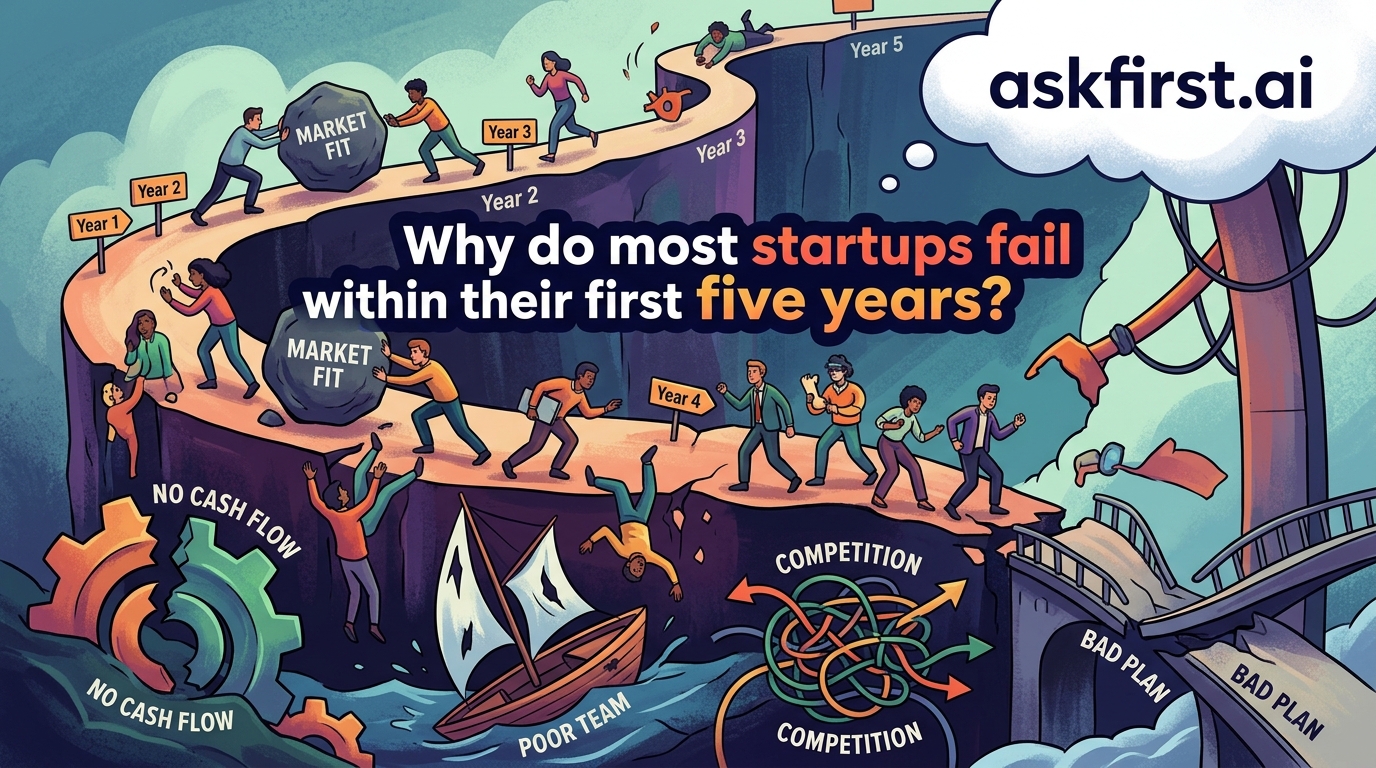
The Anatomy of Startup Failure: Understanding the Five-Year Threshold
Statistics consistently reveal a harsh reality: approximately 90% of startups fail, with the majority succumbing within the first five years. This phenomenon is not merely a matter of bad luck; it is a systematic breakdown of business fundamentals, market misalignment, and operational scalability. Understanding these pitfalls is essential for any aspiring entrepreneur looking to navigate the treacherous waters of business creation.
1. Lack of Market Need: The Cardinal Sin
The most prevalent reason for failure is the creation of a product for which there is no market. Entrepreneurs often fall in love with their own ideas, neglecting the critical validation process. If a solution does not solve a genuine, painful problem for a clearly defined customer segment, it is destined for failure. This is often described as building a 'solution in search of a problem.' Investors call this the 'market need' gap, and it remains the primary driver of attrition in the early stages.
2. The Capital Exhaustion Trap
Many startups fail because they run out of cash before achieving product-market fit. This is often the result of poor financial planning, excessive burn rates, or an inability to raise subsequent rounds of funding. Effective cash management requires a balance between aggressive growth and sustainable operation. Startups that prioritize vanity metrics—such as registered users or social media engagement—over revenue-generating activities frequently find themselves unable to survive when venture capital dries up.
3. Dysfunctional Team Dynamics
Business is fundamentally a team sport. A team that lacks the necessary skill sets, whether in product development, sales, or financial management, will inevitably stumble. Furthermore, interpersonal conflicts between co-founders often lead to toxic workplace cultures or operational paralysis. A strong, cohesive leadership team is the bedrock upon which successful companies are built. When the founders cannot align on the mission or vision, the entire organizational structure fractures.
4. Ignoring the Competitive Landscape
Startups often operate with a blind spot toward established competitors or emerging threats. Even if a startup has a unique value proposition, failing to understand the incumbent's ability to pivot or lower prices can prove fatal. A comprehensive competitive analysis must look beyond direct rivals to include indirect competitors and potential substitutes that might solve the same problem more efficiently.
5. Ineffective Business Models
Scaling a business without a clear path to profitability is a recipe for disaster. While some startups survive on the 'growth-at-all-costs' model, this is unsustainable for the vast majority. A robust business model should clearly define how the company creates, delivers, and captures value. If the unit economics—the cost to acquire a customer versus the lifetime value of that customer—are unfavorable, the business model is inherently broken.
6. Poor Marketing and Customer Acquisition
Even with a perfect product, failure occurs if the customer acquisition strategy is flawed. Startups often underestimate the difficulty of reaching their target audience. Reliance on a single channel for customer acquisition is a major vulnerability. Successful startups diversify their marketing efforts and focus heavily on user feedback loops to refine their value proposition based on real-world interactions rather than theoretical assumptions.
7. Over-Extending and Premature Scaling
Premature scaling is frequently cited as the 'silent killer' of startups. This occurs when a business expands its team, office space, or marketing budget before establishing a sustainable product-market fit. Rapid growth can mask operational inefficiencies until it is too late to correct them. It is far better to perfect the product with a smaller, loyal user base before attempting to conquer the mass market.
The Path Forward: Strategic Resilience
To beat the odds, founders must adopt a mindset of agile experimentation. This involves:
- Prioritizing Lean Methodology: Use the 'Build-Measure-Learn' feedback loop to minimize waste.
- Relentless Customer Validation: Interview potential users constantly, even after the product launch.
- Disciplined Financial Stewardship: Treat cash flow as the ultimate indicator of organizational health.
- Adapting to Feedback: Be willing to 'pivot'—changing the business strategy based on what the market data is telling you, rather than what the internal ego desires.
In conclusion, the five-year survival barrier is not a wall, but a filter. It separates ventures built on fragile assumptions from those grounded in rigorous market validation, solid unit economics, and resilient leadership. By focusing on solving real problems and maintaining operational discipline, the probability of longevity significantly increases.