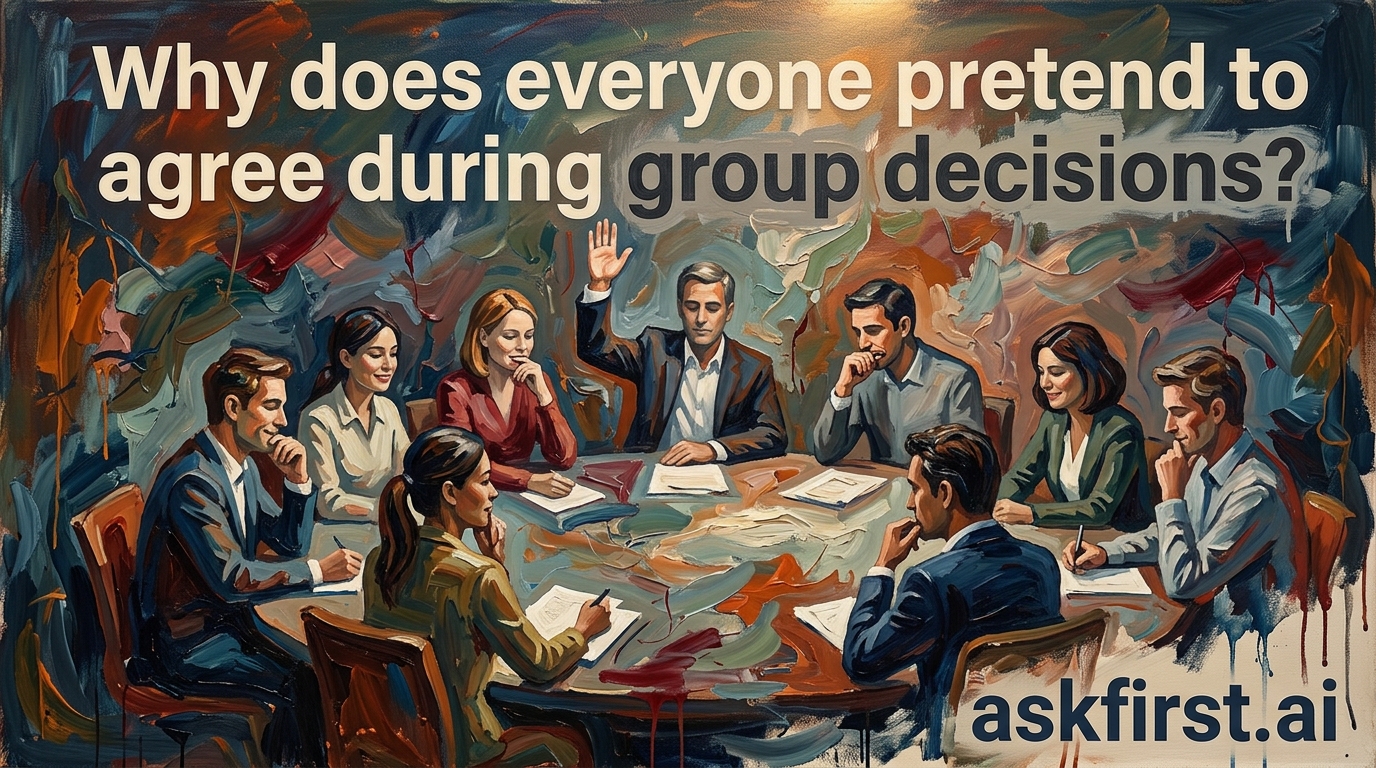
The phenomenon of artificial consensus, often observed in corporate boardrooms, family planning, and social circles, is a complex psychological dance rooted in human evolutionary biology and social architecture. When groups converge on a decision, individuals frequently suppress genuine reservations to avoid conflict, a behavior known as groupthink. This mechanism is primarily a survival strategy, where the perceived cost of social exclusion outweighs the objective benefit of pointing out a flaw in the plan.
The Evolutionary Roots of Social Harmony
From an evolutionary perspective, human ancestors relied heavily on group cohesion for protection and resource gathering. Being ostracized from the tribe was equivalent to a death sentence. Therefore, brains evolved to prioritize social standing and group affiliation above independent critical thinking. In modern environments, this manifests as an automatic preference for harmony. When a leader or the majority of a group pushes for a specific direction, the human amygdala—the brain's threat detection center—flags dissent as a potential social threat, triggering a subconscious shift toward compliance.
The Psychological Pillars of Compliance
Several cognitive biases drive the performance of agreement:
- The Abilene Paradox: Popularized by management expert Jerry B. Harvey, this paradox occurs when a group collectively decides on a course of action that is counter to the preferences of many or all individuals in the group. Participants go along simply because they mistakenly assume everyone else wants to do it.
- Social Proof: As identified by Robert Cialdini, humans have a deep-seated tendency to look to others for cues on how to behave. If others are nodding or expressing support, the individual concludes that this must be the correct path, regardless of their private doubts.
- Evaluation Apprehension: People fear being perceived as 'difficult,' 'unproductive,' or 'negative.' The professional environment often punishes dissent, even if that dissent is constructive, leading to the rational choice of remaining silent to protect one's career trajectory.
Structural Inhibitors of Truth
Beyond psychology, group structures often inadvertently kill honest communication. Hierarchical organizations foster an environment where power dynamics silence subordinates. If a senior executive expresses a strong opinion, the 'HIPPO' effect (Highest Paid Person's Opinion) takes over. The room implicitly understands that the highest-paid person's view is the default, and challenging it carries unnecessary professional risk. Without deliberate 'devil’s advocate' protocols or anonymous feedback loops, these hierarchies ensure that silence is viewed as consent.
The Cost of Artificial Consensus
While superficial harmony feels comfortable in the short term, it is often catastrophic for long-term health and innovation.
- Stifled Innovation: When dissent is discouraged, creative solutions are never tabled. The group remains locked in 'safe' ideas that fail to push boundaries.
- Increased Risk: Catastrophic project failures often stem from team members who secretly knew a plan was flawed but lacked the environment to speak up.
- Low Morale: When individuals feel their true voices are not heard, engagement levels drop. This leads to burnout and a sense of detachment from the collective mission.
Cultivating Cognitive Diversity
To break the cycle of fake agreement, organizations must transition from a culture of politeness to a culture of candor. This requires intentional design:
- The Pre-Mortem Technique: Before a decision is finalized, the team is asked to imagine the project has already failed and to generate reasons why. This legitimizes negative feedback as a form of intellectual exercise rather than personal attack.
- Delphi Method: Collecting anonymous opinions before a public meeting prevents the anchoring effect, where the first person to speak dictates the tone of the room.
- Appointing a Devil's Advocate: Assigning someone the specific role of identifying risks in a plan removes the social stigma of being the 'negative' person. It transforms the act of dissent into a constructive, assigned task.
Ultimately, the 'performance' of agreement is a defense mechanism against social friction. By understanding that silence is rarely a sign of approval, leaders and team members can create structures that reward intellectual honesty. When a group prioritizes the truth over comfort, it stops pretending and starts succeeding.