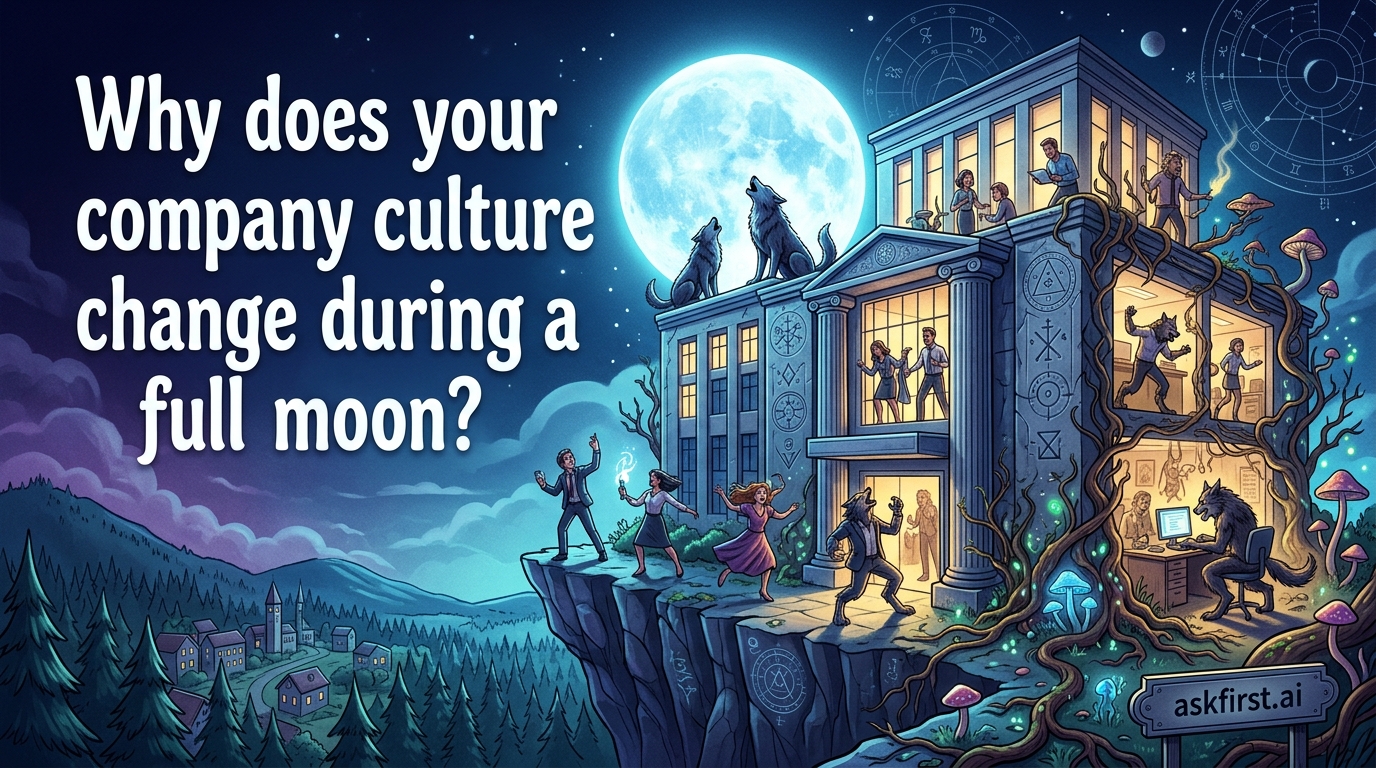
The Lunar-Organizational Nexus: Beyond Folklore
For decades, human resources professionals and organizational behavior researchers have observed subtle, recurring shifts in workplace atmosphere that appear to correlate with the lunar cycle. While the scientific community often dismisses these observations as cognitive bias—specifically the 'illusory correlation' where individuals perceive a relationship between two events that are not actually connected—there is a growing body of management theory suggesting that the 'Full Moon Effect' on company culture may actually be a byproduct of collective human biology and psychological priming.
Psychological Priming and the Belief Effect
The primary driver of organizational shifts during a full moon is often the Self-Fulfilling Prophecy. If leadership or the workforce collectively believes that a full moon leads to increased agitation, heightened creativity, or elevated conflict, they act in ways that confirm that expectation. This phenomenon, known in psychology as the Pygmalion Effect, demonstrates that high expectations or belief systems regarding external circumstances can alter performance and behavior. If employees expect a 'wild' day, the office atmosphere becomes palpably more erratic, not because of gravity, but because of the collective behavioral shift triggered by the belief.
The Role of Circadian and Ultradian Rhythms
While lunar cycles do not possess a direct, quantifiable mechanism to alter corporate strategy, the biological link to human sleep patterns is well-documented. Studies published in journals like Current Biology suggest that human sleep depth and REM latency can fluctuate with the lunar cycle. Even in urban environments where light pollution is prevalent, humans exhibit slight changes in melatonin secretion based on the lunar phase. In a company setting, a workforce that is collectively experiencing even a minor decrease in sleep quality will inherently manifest different cultural markers:
- Reduced Emotional Regulation: Lower patience thresholds among middle management.
- Heightened Sensitivity: An increase in perceived interpersonal slights.
- Fluctuating Collaboration: Shifts in the willingness to engage in cross-departmental brainstorming.
These biological ripples transform into cultural waves within a workspace. When the collective energy levels of a team dip simultaneously, the established 'company culture' often shifts from high-performance collaboration to survival-mode communication.
The Sociological Perspective: Tradition and Ritual
Culture is, at its core, a collection of rituals and shared meaning. Organizations that embrace the 'full moon' phenomenon often do so because it provides a convenient framework for humanizing the workplace. Many high-functioning teams intentionally use the lunar phase as an excuse to:
- Introduce Novelty: Management may implement a 'Full Moon Reset' to shake up stagnant routines.
- Acknowledge Human Nature: By naming a phenomenon—even a pseudo-scientific one—companies provide a non-threatening outlet for employees to express stress or excitement.
- Encourage Mindfulness: Bringing awareness to environmental or cyclic changes can ironically lead to a more mindful, present-focused work environment.
Debunking the Myths: Separating Fact from Fiction
It is vital to distinguish between folklore and management science. There is no evidence that the gravitational pull of the moon influences human brain chemistry in a way that dictates corporate success or failure. The impact of the lunar phase on company culture is entirely mediated through the human mind. The 'change' experienced in the office is an internal, human-centered reaction to an external, rhythmic reminder of the passage of time.
Key takeaways for modern organizations include:
- Acknowledge the narrative: Recognize that teams are affected by the stories they tell about their work environment.
- Focus on wellness: If teams feel sluggish during certain times of the month, prioritize sleep hygiene and wellness rather than chasing superstitions.
- Leverage the pattern: Use consistent lunar cycles as a structural anchor for project milestones, allowing the team to lean into the rhythm of the business rather than resisting the natural fluctuations of human morale.
Conclusion: The Future of Cultural Synchronization
Ultimately, the 'Full Moon Effect' in a professional setting serves as a mirror for the organization's psychological state. A culture that remains resilient and productive during these times is one that has achieved high emotional intelligence, where individuals can acknowledge their own biological realities without letting them derail their professional responsibilities. By understanding that the 'change' in atmosphere is an opportunity for improved self-awareness, leaders can cultivate an environment that is both intellectually grounded and inherently appreciative of the subtle rhythms that govern human performance.