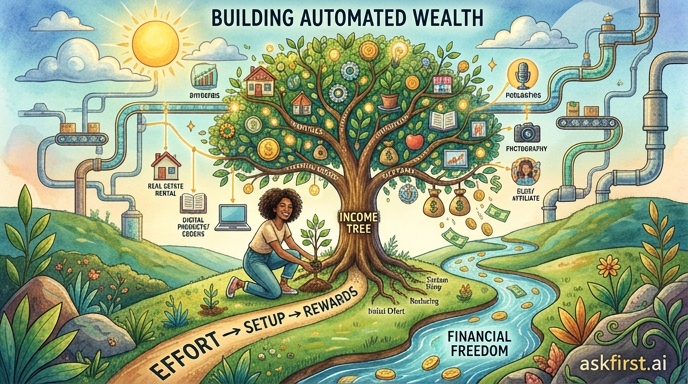
Creating a sustainable passive income stream is not a "get-rich-quick" scheme; it is a strategic endeavor that requires significant upfront investment of either time, capital, or intellectual property. The goal is to build an asset that generates revenue with minimal ongoing maintenance. Achieving this requires a shift in mindset from trading time for money to building systems that work independently of your physical presence.
1. The Foundation: Capital-Intensive Income Streams
If you have accumulated savings, the most traditional way to generate passive income is through investment vehicles that provide dividends or interest.
- Dividend Growth Investing: By purchasing shares in established, blue-chip companies with a history of increasing their dividend payouts, you can create a reliable cash flow. The key here is the "compounding effect." By reinvesting these dividends, you accelerate the growth of your capital base, which in turn generates larger payouts over time.
- Real Estate Investment Trusts (REITs): Investing in REITs allows you to gain exposure to the real estate market without the burden of property management. These companies own and operate income-producing real estate—ranging from commercial office buildings to healthcare facilities—and are legally required to distribute a significant portion of their taxable income to shareholders as dividends.
- High-Yield Savings and Bonds: While interest rates fluctuate based on macroeconomic conditions, government bonds and high-yield savings accounts provide a low-risk, albeit lower-return, baseline for passive income. These are essential for capital preservation.
2. The Intellectual Property Route: Digital Products
In the modern digital economy, the most scalable form of passive income is the creation of digital assets. Unlike physical goods, digital products have zero marginal cost of reproduction.
- Online Courses and E-books: If you possess specialized knowledge, packaging it into a comprehensive course or an e-book is a powerful strategy. Once the content is created and uploaded to platforms like Udemy, Teachable, or Amazon Kindle Direct Publishing, it can be sold indefinitely. The primary effort lies in the initial creation and the subsequent setup of an automated marketing funnel.
- Stock Photography and Digital Assets: If you are a designer or photographer, licensing your work on stock websites allows you to earn royalties every time your file is downloaded. Similarly, selling templates (e.g., Notion templates, website themes, or graphic design assets) on marketplaces like Etsy or Creative Market creates a steady flow of micro-payments.
- Software and SaaS: Building a micro-SaaS (Software as a Service) application that solves a specific, recurring problem for a niche audience can be highly lucrative. While this requires technical skill or the budget to hire developers, a well-maintained tool can generate subscription revenue for years.
3. Leveraging Content and Audience: Affiliate Marketing
Affiliate marketing is the process of earning a commission by promoting other companies' products. This is highly effective if you have an established platform, such as a blog, YouTube channel, or social media following.
- Content Authority: The secret to successful affiliate marketing is trust. By creating high-quality, valuable content that solves a user's problem, you earn the authority to recommend specific tools or products.
- Automated Funnels: You can embed affiliate links within evergreen content. When a reader clicks a link and makes a purchase, you earn a percentage. Because the content remains accessible on the web, it continues to drive traffic and sales long after the initial publication date.
4. Real Estate: The Traditional Path
Real estate remains one of the most reliable ways to build long-term wealth, though it is often "semi-passive" rather than truly passive.
- Rental Properties: Purchasing residential or commercial property provides monthly rental income. To make this truly passive, you should hire a professional property management firm. While they will take a percentage of the rent (usually 8–12%), they handle tenant disputes, maintenance, and administrative tasks, effectively turning the property into a hands-off investment.
- House Hacking: This involves living in one unit of a multi-family property while renting out the others. The rent from your tenants covers your mortgage, allowing you to live for free while building equity in an asset that appreciates over time.
The Strategy for Success: The "Build-Measure-Learn" Loop
To succeed, you must avoid the "shiny object syndrome." Pick one stream and commit to it until it reaches a point of self-sustainability.
- Select your vehicle: Choose between capital-intensive (investing) or labor-intensive (creating) assets.
- Front-load the effort: Spend the first 6–12 months doing the heavy lifting. This is the period where you will likely see the lowest return on your time.
- Optimize and Automate: Once the system is generating revenue, use your profits to outsource tasks or reinvest in the system to scale it.
- Diversify: Once one stream is stable, use the excess cash flow to seed a second or third stream. This mitigates risk and ensures that a decline in one area does not jeopardize your entire financial stability.
Ultimately, passive income is about buying back your time. By systematically building assets that generate value while you sleep, you transition from a worker who is dependent on a paycheck to an owner who is supported by a portfolio of assets.