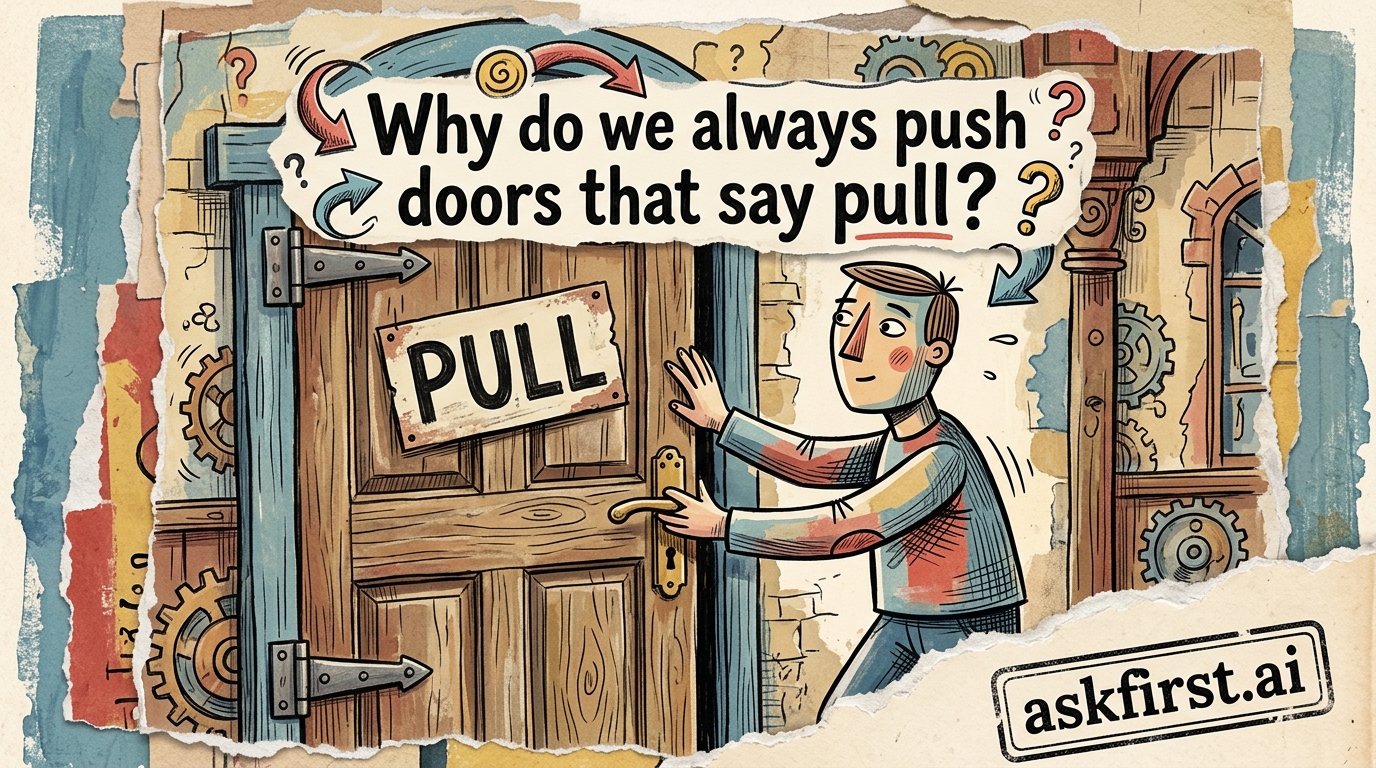
The phenomenon of pushing a door labeled 'pull' is so common that it has earned a specific nickname in design circles: the Norman Door. Named after Don Norman, a cognitive scientist and author of the seminal book The Design of Everyday Things, these doors represent a failure of 'affordances'—the perceived properties of an object that indicate how it should be used. When a door features a large, flat metal plate where a handle should be, the brain instinctively processes the plate as a surface meant to be pushed. Even if a small sign explicitly states 'pull,' the physical design cues override the textual instructions. This is a classic example of cognitive dissonance between sensory input and rational instruction.
The Science of Intuitive Design
Human beings interact with the world based on heuristics—mental shortcuts that allow for quick decision-making. When approaching a door, the brain does not stop to analyze every instruction. Instead, it scans the environment for visual clues. A vertical handle implies a pulling motion, whereas a horizontal bar or a flat metal plate implies a pushing motion. When a door is designed with a plate but intended for pulling, it creates a 'gulf of execution.' The user's internal model of how a door works conflicts with the physical interface, leading to the embarrassing and universal 'push-pull' mistake.
Why We Ignore Signs
Human perception is heavily biased toward physical interaction over linguistic interpretation. According to studies in cognitive psychology, visual symbols and spatial arrangements are processed significantly faster than text. By the time the brain deciphers the word 'pull,' the hands have already engaged with the surface. Furthermore, human habituation plays a role. If a person spends their day opening hundreds of doors, most of which are push-operated, the brain develops a motor reflex. The repetitive nature of daily tasks automates behavior, making it difficult to switch modes even when presented with contradictory information. We essentially operate on autopilot, and when the environment breaks that rhythm with a poorly designed interface, the mistake becomes inevitable.
Psychological Hooks and Design Failure
Designers often prioritize aesthetics over functionality. A clean, minimalist door design with a flush plate is visually appealing, but it fails the 'user experience' (UX) test. When form is prioritized over function, the user suffers. This gap between the designer's intent and the user's perception highlights why usability is paramount. A good design should be intuitive; if a door requires a sign to explain its function, it is, by definition, a flawed design. The persistence of the 'Norman Door' phenomenon is a reminder that even the most intelligent individuals fall victim to poor design because they are relying on subconscious spatial reasoning rather than conscious instruction-reading.
Can We Fix the Pull Door?
To eliminate this universal confusion, designers suggest using 'human-centered design' principles. A door that needs to be pulled should have a handle that physically necessitates a grasping motion. A door that needs to be pushed should have a surface that is difficult to grasp but perfect for pressing. These tactile cues are language-agnostic; they work whether a person speaks English, Spanish, or Chinese. When designers align the 'affordance' with the required physical action, the confusion vanishes. By removing the need for a sign, the design itself communicates the instruction silently and effectively.
Conclusion
Next time you find yourself pushing a door that explicitly says 'pull,' do not feel embarrassed. You are not experiencing a lapse in intelligence; you are experiencing a failure of environmental design. Your brain is simply trusting its spatial intuition over a sticker. As society continues to refine the spaces we inhabit, the goal remains clear: to move away from relying on signs and toward creating interfaces that respect the intuitive nature of human cognition. Remember, the next time you encounter a confusing door, it is not your fault—it is just another Norman Door waiting to be fixed.