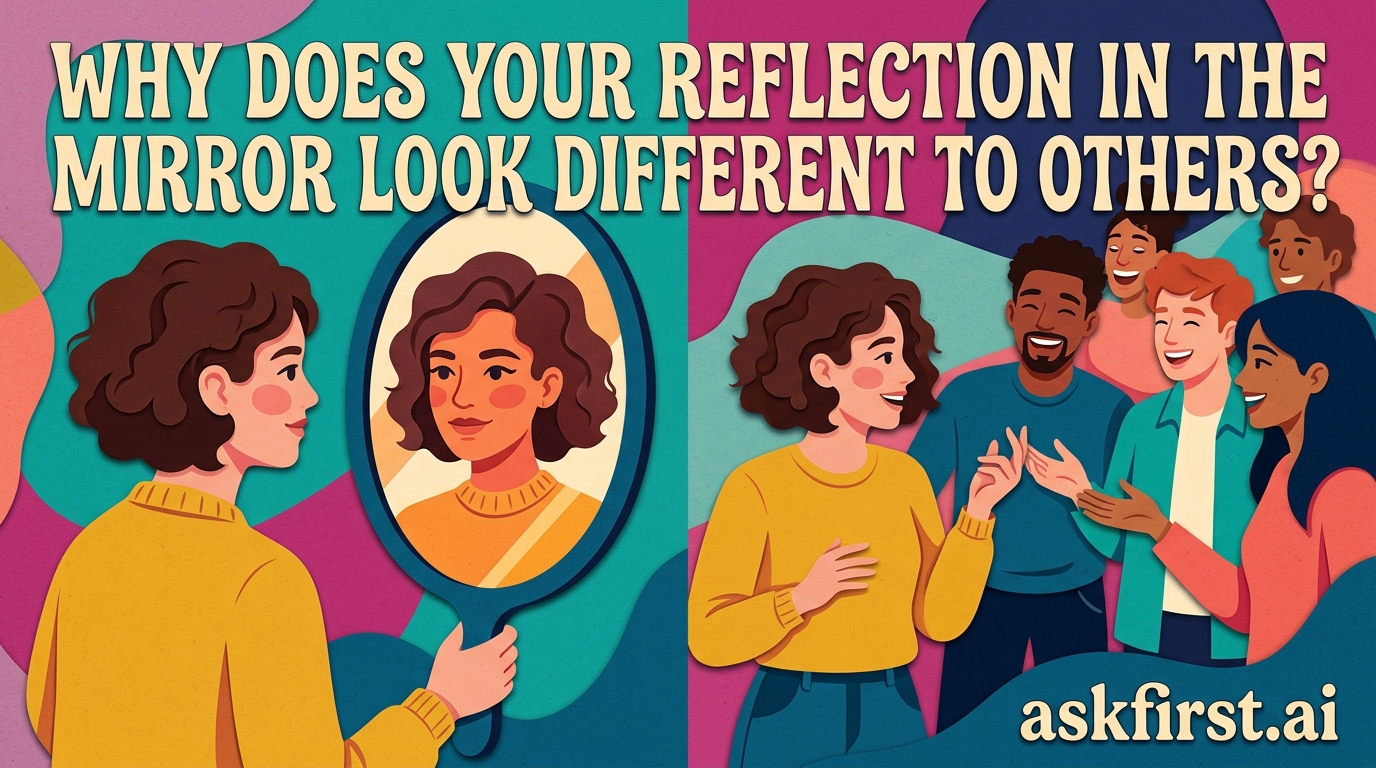
The Optical Illusion of the Self
The perception of one's own reflection is a fascinating phenomenon rooted in the intersection of physics, neurobiology, and psychology. When observing a reflection, individuals are not merely seeing a static image; they are witnessing a complex interaction between light, geometry, and brain processing. While a mirror provides a literal reconstruction of the world, the internal image created by the human brain is highly subjective.
1. The Geometry of the Mirror Reflection
A primary factor in this discrepancy is the concept of lateral inversion. Mirrors reflect light symmetrically across the axis perpendicular to the mirror's surface. This means that while the image appears flipped horizontally—a phenomenon often mislabeled as 'left-right reversal'—it is technically a front-back inversion. This geometric shift changes how facial asymmetries, which are present in every human, are perceived. Because people are accustomed to seeing their faces in a static, two-dimensional format, even subtle asymmetries, such as a slightly crooked nose or uneven eyebrows, appear 'wrong' or 'unfamiliar' when flipped because they conflict with the brain's baseline model of the self.
2. The Mere Exposure Effect
Psychology plays a monumental role in why a mirror reflection feels different compared to a photograph or the perspective of others. The 'Mere Exposure Effect' suggests that people develop a preference for things simply because they are familiar with them. Most individuals see their faces in a mirror thousands of times throughout their lives. Consequently, the brain registers the mirrored image as the 'correct' version of the self. When a photograph is taken—which captures the true, non-mirrored orientation—the face appears unfamiliar, strange, or 'wrong.' Others, however, see the person in the non-mirrored orientation consistently, making the photograph an accurate representation of the person they know, whereas the mirror reflection is actually the 'flipped' version that only the subject identifies as their true self.
3. The Lack of Dynamic Movement
Humans do not process faces as static objects; the brain is evolved to read expressions, micro-movements, and emotional signals. A mirror provides a dynamic experience where the reflection moves in real-time alongside the observer. This synchronization creates a sense of connection and recognition. In contrast, when observing others or looking at a static photograph, this dynamic feedback loop is severed. The brain struggles to bridge the gap between the familiar, moving, mirrored self and the unfamiliar, static, non-mirrored image. This lack of fluidity makes the non-mirrored face feel like a stranger's face rather than a reflection.
4. Facial Asymmetry and Brain Mapping
Scientific research into neuro-aesthetics indicates that the human brain is highly sensitive to facial symmetry. Studies show that when an individual's face is digitally manipulated to be perfectly symmetrical, observers often find it 'uncanny' or less attractive than the natural, slightly asymmetrical version. Because the mirror reflects a familiar, asymmetrical face, the viewer accepts it as 'themselves.' When seeing a photo, the brain is forced to process the familiar facial features in an orientation that it has not been trained to prioritize, causing a momentary cognitive dissonance.
5. Why Others Perceive You Differently
Others do not suffer from the same bias. Because they are not habituated to a 'mirrored' version of the person, they view the face in its true, non-mirrored orientation. To an observer, a photograph of an individual looks identical to the person standing in front of them. For the individual, however, the photo is a reversal of the 'mental map' they have constructed over a lifetime. This is essentially a case of 'identity ownership.'
Summary of Key Factors
- Lateral Inversion: The physical flipping of light paths forces the brain to reconcile with an orientation it does not inhabit daily.
- Cognitive Habituation: The brain forms a strong, long-term memory of the mirrored self, making the real-world perspective seem foreign.
- Lack of Dynamic Synchronization: The loss of the live, mirroring movement patterns disrupts the brain's internal recognition system.
Ultimately, the 'difference' experienced is not a flaw in the mirror or the observer, but a testament to how profoundly the brain adapts to its environment. The reflection is not just a light-bounce phenomenon; it is a personalized psychological construct.