The Psychology of the Norman Door: Why We Fail
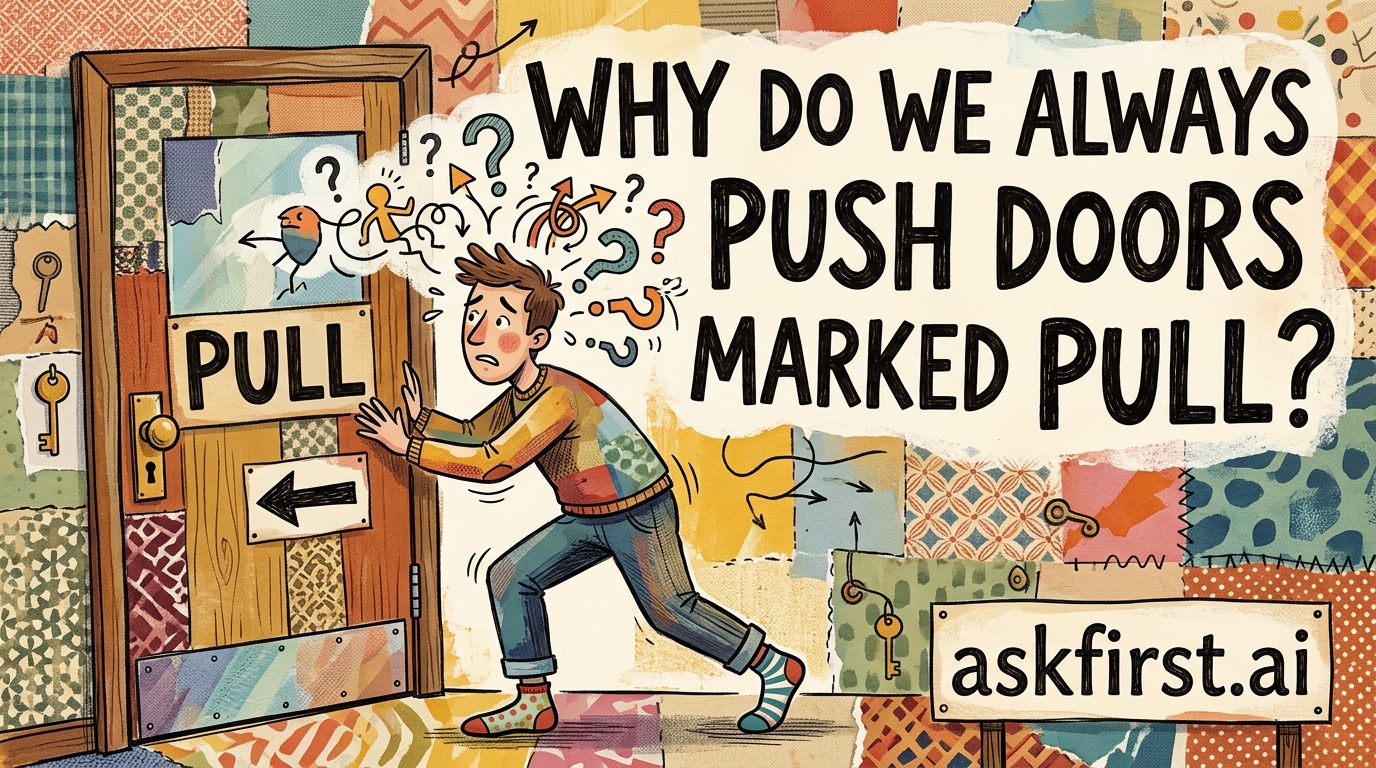
The phenomenon of pushing a door labeled "pull" is so ubiquitous that it has its own academic label in the world of industrial design: the Norman Door. Named after Don Norman, the cognitive scientist who popularized the concept in his seminal book The Design of Everyday Things, this failure of human-machine interaction is not a reflection of human incompetence, but rather a profound indictment of poor design.
The Cognitive Burden of Design
Humans interact with the world through mental models—internal simulations of how things work. When an object provides clear affordances, it tells us how to use it without instructions. A flat plate on a door is a clear affordance to push. A vertical handle is a clear affordance to pull. When a designer places a flat metal plate on a door that is meant to be pulled, they are creating a "gulf of execution." The user’s mental model clashes with the physical reality, leading to the embarrassing "push-pull" dance.
Why the Brain Defaults to 'Push'
Several psychological factors contribute to this universal blunder:
- The Power of Heuristics: The brain prefers cognitive shortcuts. If the door looks like a barrier that requires clearing a path, the automatic response is to shove it aside. We prioritize speed over analysis, assuming that we can move forward simply by exerting forward force.
- Cultural Conditioning: In modern architecture, push-bars on commercial doors are ubiquitous for emergency safety reasons. This has trained us to approach a vertical metal interface and instinctively exert pressure. We are programmed by our environment to ignore text labels until after the physical action has failed.
- Attentional Blindness: Often, the instruction "pull" is placed at eye level, yet we remain blind to it. Because our primary goal is entry, we focus on the goal rather than the affordance. If a door looks "pushable," we effectively hallucinate the push-friendly design, rendering written warnings invisible.
The Anatomy of the Error
When a person pushes a door marked "pull," they are essentially experiencing a breakdown in signifiers. Signifiers are the visual cues that tell users what actions are possible. A handle acts as a strong signifier for pulling, while a flat plate signals pushing. If these signifiers are absent or contradictory—such as a handle attached to a door that requires pushing—the user is forced to stop, look for signs, and engage in "thinking" rather than "acting."
Designing for Human Nature
To solve this, designers must adhere to the Principle of Forcing Functions. A forcing function is a design element that makes it impossible to perform an action incorrectly. For example:
- Eliminate Confusion: If a door must be pulled, do not put a push-plate on it. Use a handle that is physically impossible to push.
- Visual Alignment: If the door is a heavy commercial unit, use hardware that fits the hand, such as a graspable handle, which implicitly signals the necessary motion without needing a sticker.
- Contextual Awareness: In emergency exits, laws often mandate a push-bar because it is the fastest way to egress. In these cases, the failure to "pull" a locked door is a small price to pay for the safety of having an easy-to-open push mechanism for evacuation.
Lessons from Behavioral Economics
Don Norman’s research suggests that when we blame ourselves for "failing" to open a door, we are falling into a trap of self-blame. We believe we are the problem. However, the true culprit is the designer who ignored human psychology. By studying how we interact with everyday objects, we learn that good design should be invisible. It should feel so intuitive that no instructions are necessary.
Ultimately, every time you encounter a door that demands you pull when you instinctively want to push, recognize that you are not experiencing a personal failure. You are witnessing a failure of engineering. The next time you find yourself pushing a pull-door, smile—you have just experienced a classic "Norman Door" moment. It is a testament to the fascinating, imperfect, and predictable nature of human cognitive processing in a built environment that does not always prioritize the user's intuition.