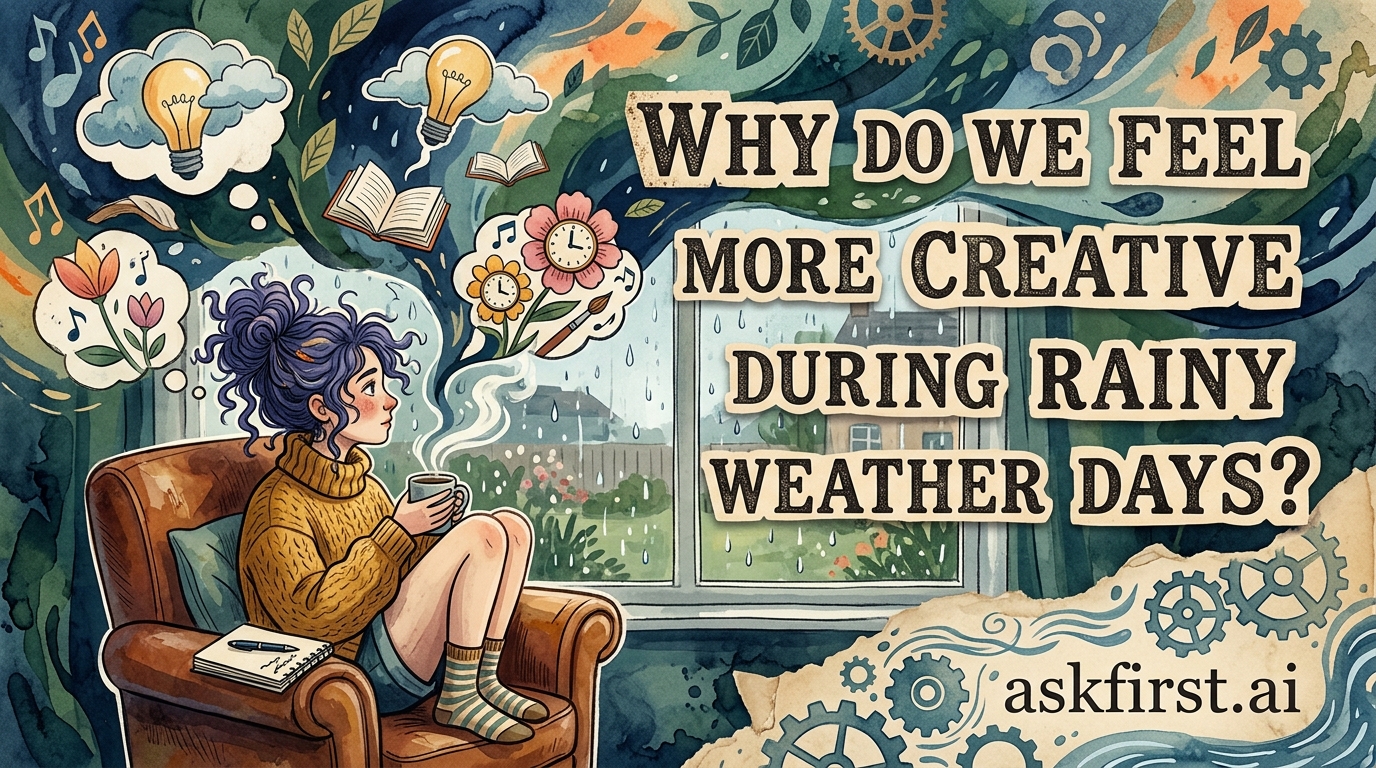
The Cognitive Science of Rainy Day Inspiration
There is a pervasive, almost universal sentiment that grey skies and the rhythmic sound of raindrops act as a catalyst for creative thought. While many assume this is purely a romanticized myth, research into environmental psychology and cognitive load suggests that the atmosphere of a rainy day creates a unique sensory sanctuary that actively promotes divergent thinking. The phenomenon can be broken down into three primary psychological drivers: sensory deprivation, the principle of 'cozy confinement,' and the removal of the pressure to socialize.
1. The Power of Sensory Softness
On a bright, sunny day, the world is saturated with high-contrast visual stimuli. This forces the human brain to dedicate significant processing power to interpreting and filtering constant environmental input. In contrast, rainy days offer 'low-arousal' environments. The overcast sky acts as a natural soft-box, diffusing light and reducing the cognitive load required for visual perception. When the brain is less occupied with managing high-stimuli surroundings, it naturally shifts toward internal modes of thinking—a state associated with daydreaming and creative incubation.
- Cognitive Load Reduction: By muting the external noise, the prefrontal cortex can divert energy from vigilance tasks to associative memory processing.
- Divergent Thinking: Research suggests that low-arousal environments facilitate the making of unexpected connections between disparate concepts, which is the cornerstone of creativity.
2. The Comfort of 'Hygge' and Confinement
There is a psychological phenomenon often described as the 'cocooning effect.' When the weather dictates that staying indoors is the most logical course of action, the pressure to 'be out in the world' vanishes. This self-imposed or weather-imposed confinement provides a psychological safety net. When an individual feels sheltered and secure, the nervous system shifts from a sympathetic (fight-or-flight) state to a parasympathetic (rest-and-digest) state. In this relaxed state, the brain is far more willing to take creative risks.
- The Sanctuary Effect: The physical barrier of walls against the rain emphasizes the boundary between the chaos of the world and the controlled space of the interior.
- Decreased Social Pressure: Rainy days often cancel outdoor commitments, providing the rare gift of unallocated time. Without the urgency of 'doing,' the mind is free to wander toward abstract problem-solving.
3. The Auditory Benefits of White Noise
Rainfall creates a form of 'pink noise' or steady auditory input that has been shown to improve cognitive performance. Unlike erratic noises that trigger an orienting reflex (causing the brain to snap to attention to identify a threat), the consistent sound of rain creates a masking effect. This masks distracting background sounds, essentially silencing the digital and domestic distractions that usually interrupt a creative flow state.
Practical Applications for Creative Productivity
To harness this 'rainy day' mindset even when the sun is shining, one can employ environmental design strategies:
- Manipulate Lighting: Use warm, diffused light sources rather than harsh overhead LEDs to mimic the softness of an overcast sky.
- Use Soundscapes: Utilize ambient sound generators that provide rain or white noise to create a psychological bubble, effectively partitioning the workspace from the outside world.
- Establish Rituals: Create a 'confinement' ritual. By entering a specific space with a set of habits (like a specific beverage or low-fi music), you signal to the brain that it is safe to lower its guard and begin the process of deep, divergent thinking.
Conclusion: The Internal Landscape
Ultimately, the creativity we feel during rain is less about the weather and more about how the weather forces us to recalibrate our relationship with our environment. By reducing external stimuli, providing a sense of physical safety, and offering a rhythmic auditory background, rainy days grant the mind permission to venture into the deeper, more creative realms of thought. This state of 'productive stillness' remains one of the most effective tools for innovation, proving that sometimes, the best way to move forward is to stay inside and wait for the storm to settle.