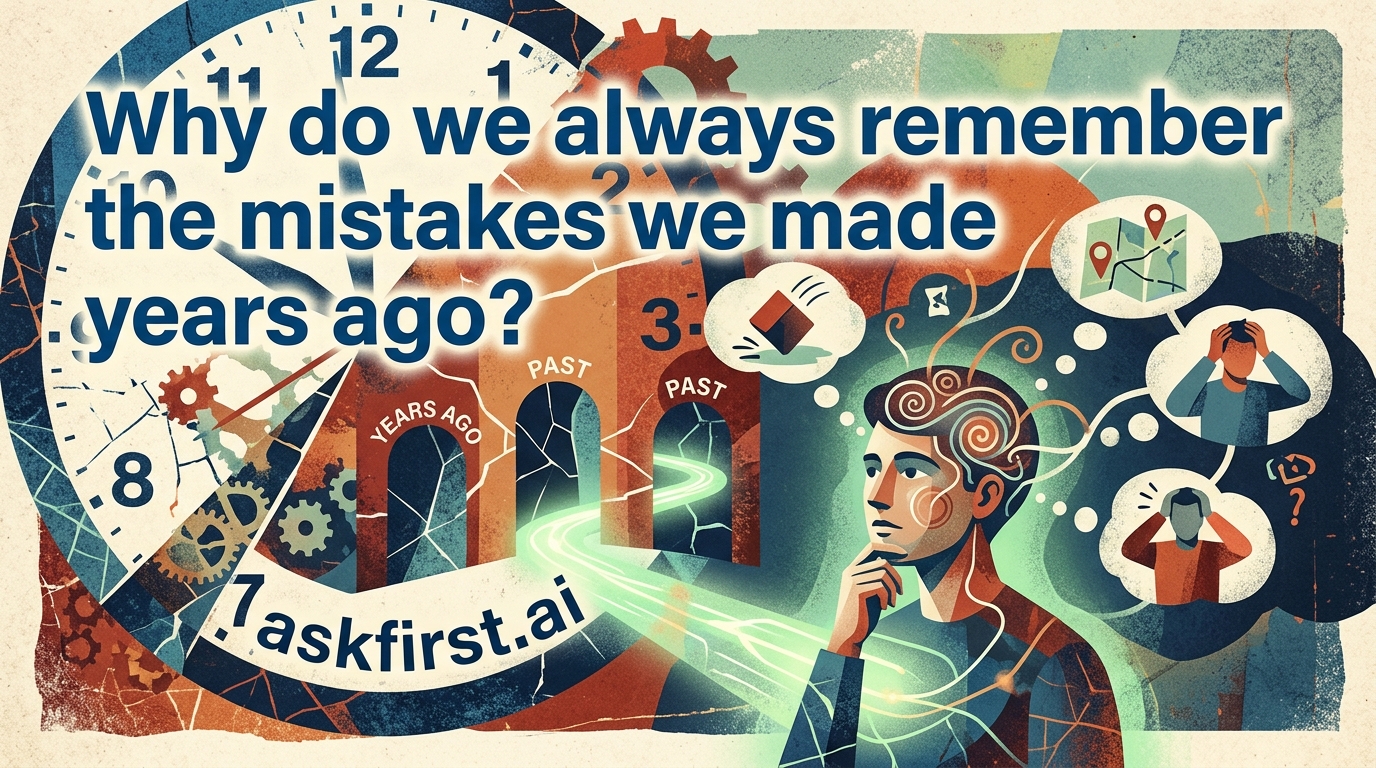
The Psychology of Persistence: Why Memory Holds Onto Errors
The phenomenon of ruminating on past errors, often called the 'Zeigarnik Effect' or 'negative bias', is a fundamental feature of human cognition rather than a defect. While it might feel like a personal curse to dwell on a social blunder from a decade ago, this cognitive architecture serves a distinct evolutionary purpose: survival through optimization. By constantly replaying past mistakes, the human brain creates a high-fidelity internal simulator to prevent future repetition of suboptimal behaviors.
The Zeigarnik Effect and Incomplete Tasks
Named after psychologist Bluma Zeigarnik, the Zeigarnik Effect suggests that the brain treats incomplete or unresolved experiences as high-priority cognitive tasks. When a situation results in an outcome that feels embarrassing or unresolved, the brain keeps that memory in an 'active' state. Because the emotional impact of the mistake was never fully processed or 'closed' by a successful corrective action, the neural circuitry keeps the data accessible. It is the brain's way of saying, 'We have not yet resolved how to handle this scenario; keep it at the top of the stack.'
The Role of Negativity Bias
Evolutionary biology provides the primary explanation for why the brain prioritizes negative experiences over positive ones. This is known as Negativity Bias. In ancestral environments, failing to notice a threat—such as a predator or a toxic plant—could lead to immediate fatality. Conversely, ignoring a positive opportunity rarely resulted in death. Consequently, natural selection favored individuals who possessed a 'hyper-vigilance' for negative stimuli. We remember our social faux pas more vividly than our greatest triumphs because the brain labels the mistake as critical 'survival data' that must be stored to avoid social ostracization, which in early human history was synonymous with death.
The Amygdala-Hippocampus Connection
When a mistake occurs, it is usually accompanied by a sharp spike in cortisol and adrenaline. This physiological reaction engages the amygdala—the brain's emotional processing center—which signals the hippocampus to prioritize the encoding of that specific memory. Essentially, the 'emotional weight' of the mistake acts as a chemical adhesive. The more intense the embarrassment or regret, the deeper the neural pathway is carved, making the memory significantly more resistant to natural decay. This is why a simple comment can feel like it was etched into the brain, while mundane details of the same day vanish entirely.
Counter-Intuitive Benefits: The Simulator Effect
Contrary to common belief, this ruminative process is not entirely negative. Experts define this as Counterfactual Thinking—the process of imagining 'what could have been.' By revisiting these memories, the brain is effectively running mental simulations. When an individual imagines a different path taken during a past mistake, they are actually training their neural networks to respond differently to future stimuli. This cognitive 'rehearsal' increases adaptability. The mistake acts as a case study, allowing the individual to refine their social intelligence and decision-making capabilities without having to repeat the physical experiment in the real world.
How to Reframe the Narrative
To manage this natural biological tendency, psychology suggests several proactive strategies:
- Cognitive Distancing: View the memory from the perspective of an objective observer. When the mind replays the mistake, ask: 'Would I hold a friend to the same standard of scrutiny for this?' This helps reduce the emotional charge associated with the memory.
- The 'Growth Mindset' Shift: Rebrand the memory from a 'failure' to a 'data point.' Recognizing that the brain is merely trying to keep one safe allows the individual to acknowledge the memory without being enslaved by the shame.
- Active Completion: For memories that cause significant distress, write down what was learned from the event. By creating a concrete, logical summary of the 'lesson,' the brain often classifies the task as 'resolved' and ceases the reflexive playback.
Summary: Why It Matters
Ultimately, the ability to dwell on past mistakes is a testament to the sophistication of the human mind. It demonstrates a restless, analytical engine dedicated to constant self-improvement. By understanding that these memories are not burdens, but rather tools for iterative growth, individuals can transform shame into wisdom. The persistence of these memories is simply the brain performing its most vital function: ensuring that today’s version of the self is better equipped than the version that failed yesterday.