The Alchemist’s Dream Meets Modern Physics
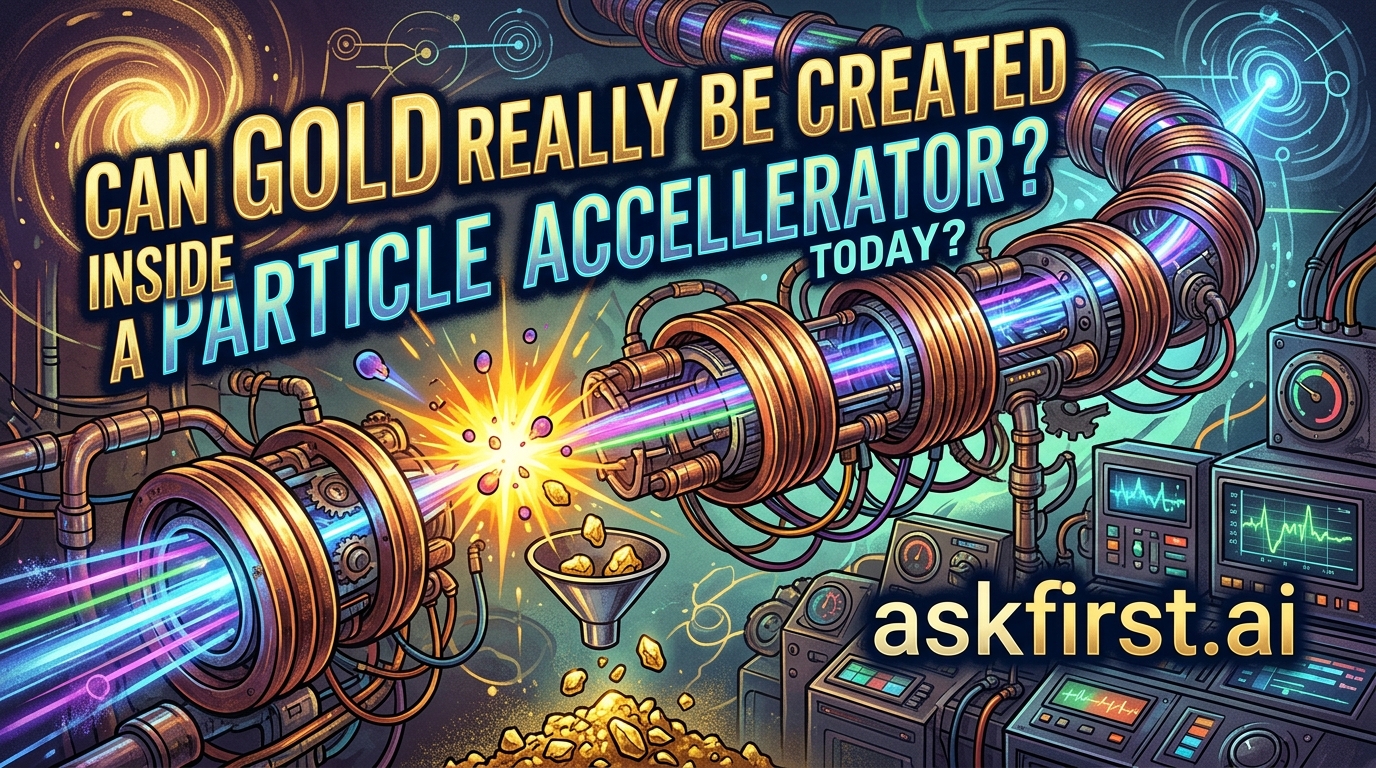
The transformation of base metals into gold, known as alchemy, has captivated human imagination for millennia. While medieval alchemists sought the mythical Philosopher's Stone to achieve this feat, the arrival of modern particle physics has fundamentally altered the reality of nuclear transmutation. In short, the answer is yes: gold can be created inside a particle accelerator, but the practical and economic implications are far different from what the ancient practitioners envisioned.
The Mechanism of Transmutation
At the core of this process is the fundamental structure of the atom. Gold is a chemical element defined by its atomic number: 79. This means that every atom of gold contains exactly 79 protons in its nucleus. To create gold from other elements, one must manipulate the nucleus to change the number of protons to match this specific value. This can be achieved through nuclear reactions inside a particle accelerator or a nuclear reactor.
For instance, by bombarding elements like mercury (atomic number 80) with high-energy neutrons or charged particles, it is physically possible to knock a proton out of the nucleus, resulting in an atom with 79 protons. Theoretically, this is gold. Scientists such as Glenn Seaborg successfully demonstrated this by transmuting bismuth into gold in 1980. However, these processes come with severe limitations that make them unsuitable for commercial mining.
The Energy and Cost Barrier
While the science is sound, the economic reality is devastating to the idea of artificial gold production. The energy required to operate a particle accelerator—essentially a massive machine designed to push subatomic particles to near light-speed—is enormous. When calculating the cost of the electricity used to run these facilities, the wear and tear on equipment, and the time required to perform the transmutation, the final price per gram of synthetic gold exceeds the current market value of natural gold by trillions of dollars.
Furthermore, the gold produced in such experiments is often unstable. Transmutation often results in radioactive isotopes of gold that are not only useless for jewelry or investment but are potentially hazardous to handle. These isotopes have short half-lives, meaning they decay back into other elements over time, making them ephemeral remnants of a high-energy experiment rather than a permanent store of wealth.
Understanding Isotopic Stability
Nature provides us with gold that is stable, primarily in the form of Gold-197. When scientists manipulate atoms, they often create isotopes that are too 'heavy' or 'light.' These unstable nuclei undergo radioactive decay, releasing radiation as they attempt to reach a state of equilibrium. Therefore, the gold created in a laboratory setting is rarely the 'pure' gold found in your jewelry box. It is a fleeting, radioactive shadow of the real thing, demanding complex purification processes that add yet another layer of impossible cost to the project.
Why Particle Accelerators Exist
If we cannot make a profit from it, why do we build these machines? Particle accelerators like the Large Hadron Collider (LHC) are built for fundamental discovery, not mass production. They are used to investigate the building blocks of the universe, such as the Higgs Boson or the nature of dark matter. The transmutation of gold is merely a proof-of-concept for nuclear physics, showing that humanity understands the structure of the atom well enough to influence it, rather than a blueprint for industrial manufacturing.
The Myth of Cheap Riches
It is common for science fiction stories to suggest that advanced civilizations could solve all resource scarcity by simply rearranging atomic structures. While this is scientifically possible, it ignores the laws of thermodynamics. According to the Second Law of Thermodynamics, any process of transforming matter and energy involves an increase in entropy, which necessitates significant energy input. The universe, in effect, 'charges' us for the energy used to rearrange its components. Since natural gold was forged in the hearts of dying stars (supernovae) over eons, paying for that process through human-made technology is inherently less efficient than simply mining the crust of the Earth.
Conclusion
In summary, the ability to create gold in a particle accelerator is a triumph of scientific capability, proving that the dream of the ancient alchemist was physically correct—but economically catastrophic. While we have mastered the art of atomic manipulation, we remain bound by the physical laws that make gold production a futile pursuit for wealth. Gold will remain a product of geological history, forged in cosmic crucibles, rather than a product of our modern laboratory bench.