The Evolutionary Psychology of Social Cringe
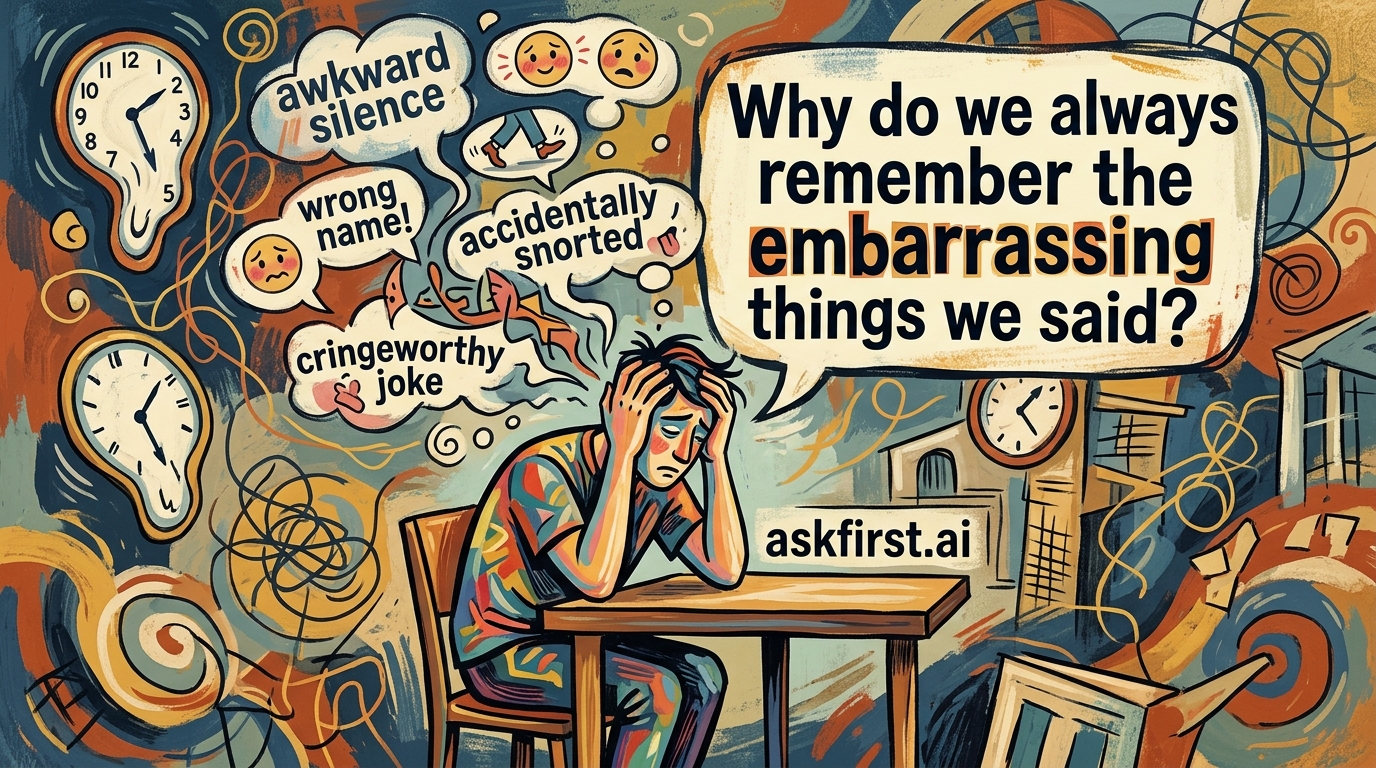
Human memory functions in a highly selective manner, prioritizing information that directly impacts social standing and survival. When an individual experiences a moment of acute embarrassment, the brain triggers a heightened state of alertness. This phenomenon is often rooted in the spotlight effect, a psychological concept where individuals believe others are noticing their actions and appearance far more than they actually are. Because human ancestors lived in tightly-knit groups where social rejection could equate to exile or death, the brain developed an intense mechanism to monitor social blunders.
The Negative Bias and Memory Retention
The brain possesses a negativity bias, which is the psychological principle stating that negative experiences are recorded more vividly and persist longer than positive ones. Embarrassment serves as a painful social lesson. By replaying the moment of shame—the stumbling words or the social faux pas—the brain attempts to conduct a 'post-mortem' of the event to ensure the mistake is never repeated. This process is known as rumination, which serves a corrective, albeit uncomfortable, function. It is effectively a simulation of how to avoid future social exclusion.
Neurobiological Mechanisms: The Role of the Amygdala
When a person recalls an embarrassing moment, the amygdala, the brain's emotional center, becomes highly activated. This activation creates a strong neural pathway associated with that specific memory. Research indicates that social pain activates many of the same brain regions as physical pain, such as the anterior cingulate cortex. Consequently, the brain 'archives' these memories with higher emotional 'weight' or 'salience'. This high emotional arousal ensures that the event is etched into long-term memory with exceptional detail, making it far more accessible than mundane, neutral information.
The Self-Correction Mechanism: Social Learning
Embarrassment acts as a potent pedagogical tool. Psychologists suggest that the discomfort of cringing at one’s past self is actually a sign of growth and social intelligence. If one did not experience embarrassment, it would imply a failure to understand social norms or a lack of concern for how one is perceived by others. The 'cringe' is therefore a reflection of the evolving self-concept. As individuals mature, they gain new insights and develop better social skills, which leads to the retroactive recognition that previous behaviors were not ideal. This is often referred to as the 'perspective gap'.
Practical Strategies to Manage Rumination
While this mechanism is evolutionary, chronic rumination can be taxing. To handle these intrusive thoughts, consider the following strategies:
- Cognitive Reappraisal: Shift the focus from 'Why did I say that?' to 'What did I learn from this situation?' Transforming a judgment into an observation reduces emotional intensity.
- Practicing Self-Compassion: Recognize that everyone, without exception, experiences these moments. Acknowledge that the 'spotlight' on one's errors is largely internal; others have likely long forgotten the incident.
- Reality Testing: Explicitly ask oneself: 'Does this specific memory have an impact on my life today?' Often, the answer is no, which helps to de-escalate the emotional response.
The Cultural Context of Shame
Social expectations vary across cultures, but the biological response to public error remains largely universal. While some cultures view social slips with humor and lightness, others associate them with higher stakes regarding honor. Regardless of cultural upbringing, the human drive to maintain a 'prosocial' persona remains the primary anchor for why these memories refuse to fade. It is essential to remember that these memories are not marks of failure, but markers of a functioning social conscience. By understanding that these intrusive thoughts are merely an evolutionary safety net designed to keep one in the good graces of others, individuals can transition from feeling embarrassed to feeling human. The cringe is not a sign that something is wrong with the mind; it is evidence that the mind is highly attuned to the intricacies of human connection.