The Paradox of Social Presence
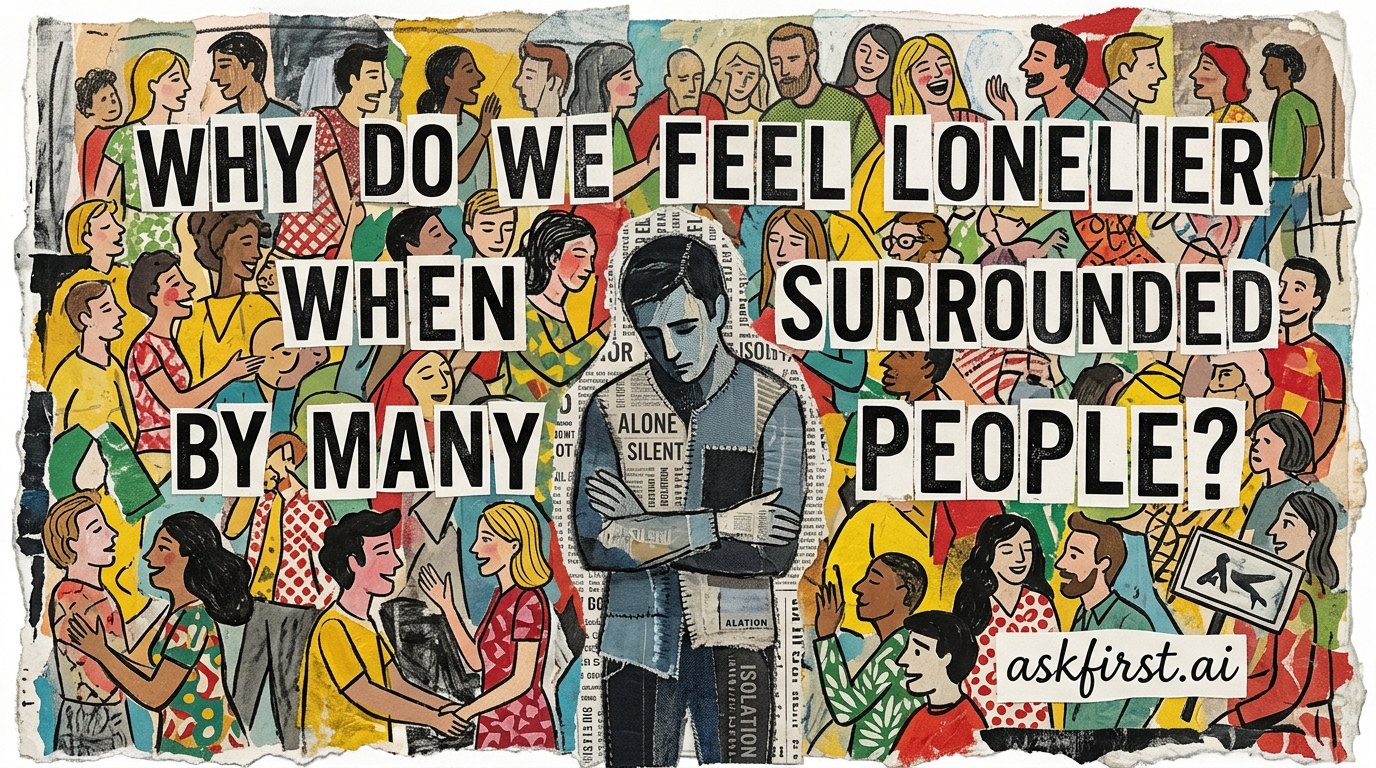
It is a profound psychological mystery that individuals often experience their most acute feelings of isolation while physically surrounded by crowds. This phenomenon, often referred to as 'social loneliness,' highlights the fundamental distinction between the simple presence of others and the quality of human connection. The feeling does not stem from a lack of people, but from a perceived gap between the social interactions we desire and the social reality we experience in a given moment.
The Evolutionary Perspective
From an evolutionary standpoint, the human brain is hardwired for deep, meaningful connections. Our ancestors relied on small, tightly knit tribes for survival, where every member was intimately known. When surrounded by strangers in a modern, impersonal urban setting, the brain fails to receive the biological signals of safety and belonging that it evolved to crave. The sensory overload of a crowd can actually trigger a defensive mechanism, causing an individual to withdraw internally, thus reinforcing the sense of being an 'outsider' despite the physical proximity of others.
The Mismatch Theory
Psychologists often point to the 'Mismatch Theory.' This theory suggests that our psychological hardware remains rooted in ancestral environments, while our social software has been forced to adapt to high-density, low-intimacy living conditions. When a person is in a crowd of strangers, the brain detects an environment rich in social stimuli but poor in social connection. This results in a cognitive dissonance: the brain sees people but feels the lack of a 'tribe,' signaling loneliness as a warning that one's essential need for belonging is unmet.
The Role of Comparison and Social Media
In the digital age, being surrounded by others often involves observing the projected happiness of others. According to Social Comparison Theory, when we are in a crowd—or viewing the crowd of life through social media—we tend to compare our internal emotional state with the external, curated displays of those around us. If we feel invisible or disconnected while others appear to be chatting or laughing, that gap creates a powerful sense of exclusion. We are essentially measuring our 'insides' against everyone else's 'outsides.'
The Importance of Emotional Reciprocity
Loneliness is primarily a failure of emotional reciprocity. You can be in a room of fifty people and feel entirely alone if there is no shared emotional resonance. Genuine connection requires:
- Authentic Vulnerability: Being able to express true thoughts and feelings.
- Mutual Interest: Both parties actively engaging in the mental world of the other.
- Consistency: Repeated interactions that build trust and history.
Without these elements, social interaction is merely superficial. Being in a crowd without these bridges creates a 'stifling' effect, where the lack of depth becomes more apparent compared to the vast quantity of social potential present. It is the contrast between the possibility of connection and the reality of indifference that creates the sharpest pangs of isolation.
How to Mitigate the Paradox
Understanding the mechanics of this feeling is the first step toward resolution. To combat this state, one might consider the following evidence-based approaches:
- Shift Focus to Quality: Prioritize one-on-one interactions over large-group settings. Deep conversation with one person often alleviates loneliness better than superficial interaction with ten.
- Practice Active Participation: Move from passive observation of a crowd to active engagement. A small, polite interaction with a cashier or a fellow traveler can break the spell of anonymity.
- Cultivate Shared Interests: Join groups based on hobbies or passions. Shared activities provide a natural, non-forced basis for the 'reciprocity' that the brain finds so nourishing.
- Mindfulness of Environment: Recognize that feelings of loneliness in crowds are a natural, signal-based response, not a reflection of personal worth. Acknowledging this helps detach the self from the negative emotion.
Conclusion
The feeling of loneliness in a crowd is a testimony to the complexity of the human spirit. It serves as a reminder that we are not designed for mere coexistence, but for deep, interconnected lives. By moving past the surface-level engagement of modern life, individuals can transform environments of isolation into spaces of meaningful encounter, proving that the solution to loneliness is not just the presence of people, but the depth of our commitment to knowing them.