The Psychology of Nocturnal Rumination
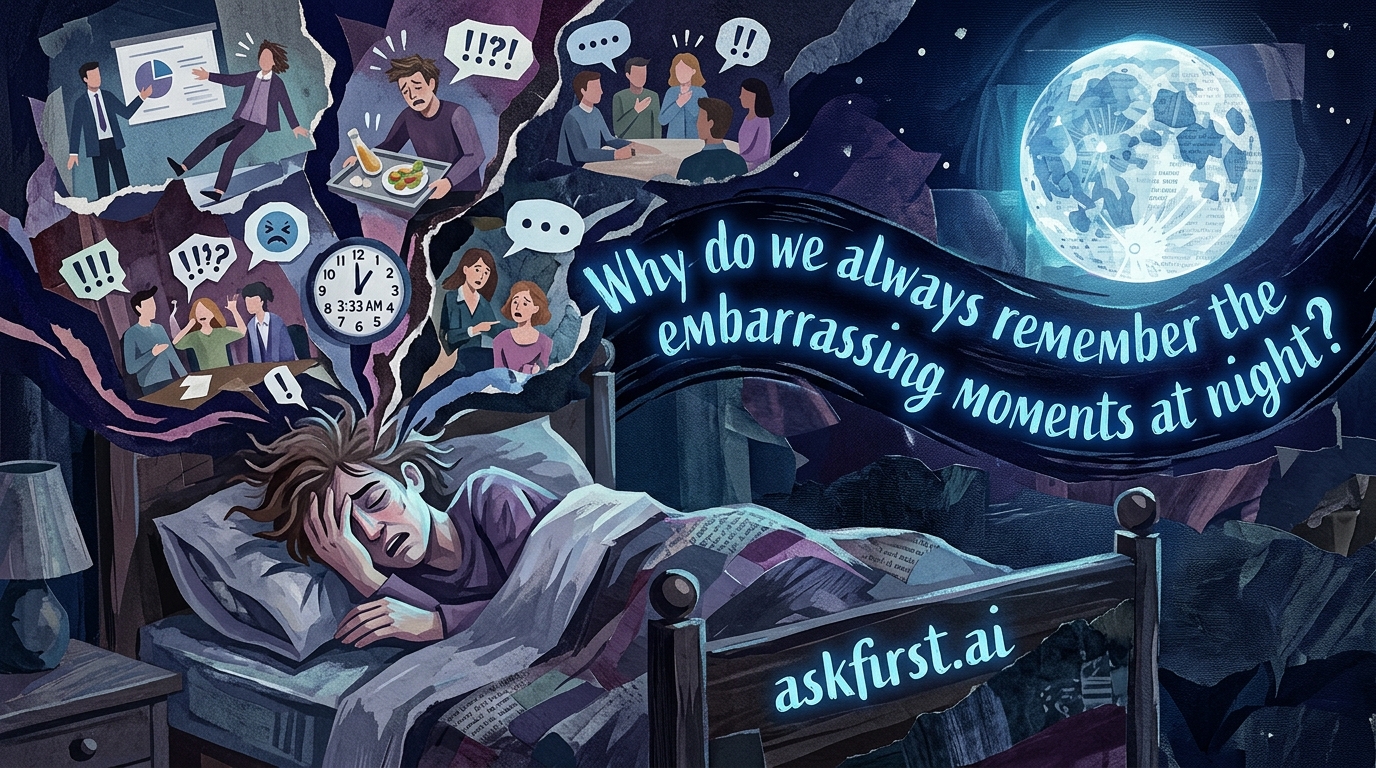
It is a universal human experience: the lights go out, the room falls silent, and suddenly, the brain decides to play a high-definition highlight reel of every social blunder committed in the last decade. This phenomenon is known as nocturnal rumination. The brain, often described as a prediction engine, undergoes a significant state change during the transition from wakefulness to sleep, creating the perfect conditions for these unwanted intrusive memories to surface.
The Science of Cognitive De-cluttering and The Zeigarnik Effect
Psychologists often attribute this tendency to the Zeigarnik Effect, which posits that the brain remembers interrupted or incomplete tasks better than completed ones. When a social interaction ends poorly or feels "unfinished" due to embarrassment, the mind treats it as an unresolved file. During the day, the brain is preoccupied with executive functions and sensory input. At night, sensory deprivation occurs. Without the external stimulation of a busy day, the brain's internal network—the Default Mode Network (DMN)—activates. This network is responsible for self-referential thought, autobiographical memory, and imagining the future. Because there is no new data coming in, the DMN defaults to reviewing unresolved emotional files, often highlighting "errors" in social judgment to ensure future survival.
Why Embarrassment Remains Sticky
Evolutionary psychology provides a compelling perspective on why these memories feel so vivid. Humans are fundamentally social creatures; historically, exclusion from a group was synonymous with a threat to survival. Consequently, the brain is hardwired to be hypersensitive to social status and reputation. Embarrassment serves as a social feedback mechanism. By keeping these memories highly accessible, the brain effectively performs a 'system update' on social behavior, attempting to ensure the same mistake is never repeated. The intense emotional weight attached to these memories is the brain's way of marking the information as 'mission-critical'.
- Emotional Tagging: The amygdala, which processes emotion, plays a key role in memory consolidation. High-arousal events, whether positive or negative, are chemically prioritized.
- The Spotlight Effect: Many people suffer from a cognitive bias called the Spotlight Effect, where individuals overestimate how much others notice their flaws. At night, the brain lacks the reality-checking mechanism of external social feedback, allowing this bias to run unchecked.
The Role of Cortisol and Circadian Rhythms
Physiologically, the body’s hormonal balance shifts significantly at night. While cortisol—the stress hormone—is typically lowest during the early sleep period, the fatigue caused by a long day compromises the prefrontal cortex. The prefrontal cortex acts as the 'rational manager' of the brain, regulating emotional responses. When fatigue sets in, the 'manager' goes offline, leaving the more impulsive and emotionally volatile parts of the brain to operate without inhibition. This makes it much harder to dismiss intrusive thoughts with logic or perspective.
Strategies for Managing Late-Night Thoughts
Understanding that these thoughts are not reflections of reality, but rather byproducts of brain architecture, is the first step toward mitigation. Experts recommend several strategies:
- Cognitive Distancing: Label the thought as 'just a brain glitch' rather than an objective truth. Recognizing that the brain is simply processing data can strip the thought of its emotional power.
- Write It Down: Taking a moment to write down the thought transfers the information from the active, looping memory to a static, external form. This can help the brain 'check off' the task as completed.
- Mindfulness and Anchoring: Utilize sensory grounding techniques. Focus on the texture of the bedding or the rhythm of breathing. By diverting the DMN’s focus to immediate sensory input, you can deactivate the loop.
- Practice Self-Compassion: Research consistently shows that self-kindness reduces the intensity of ruminative cycles. Treat the memory as you would a friend’s mistake; it is likely that no one else remembers the event with the same clarity or judgment that you do.
Conclusion: The Brain's Misguided Protection
Ultimately, remembering embarrassing moments at night is not a sign of personality failure or excessive dwelling. It is a biological quirk—the result of a highly evolved brain attempting to keep an individual safe within a social framework. By acknowledging that this is a predictable, physiological process, one can learn to navigate these nocturnal mental reruns with greater patience and less anxiety. The night might be quiet, but the brain remains an active, protective, and sometimes over-zealous guardian of our social standing.