The Genesis of a Planet: Unraveling the Formation of Earth
The formation of Earth is a cosmic narrative spanning 4.54 billion years, a process defined by the violent, chaotic, and beautiful mechanics of the early solar system. Understanding how our planet coalesced from a cloud of dust and gas into the life-sustaining sphere we inhabit today requires looking at the interplay of gravity, thermodynamics, and high-energy collisions. This process, known as planetary accretion, is the foundational story of geology and planetary science.
The Solar Nebula: The Cradle of Planets
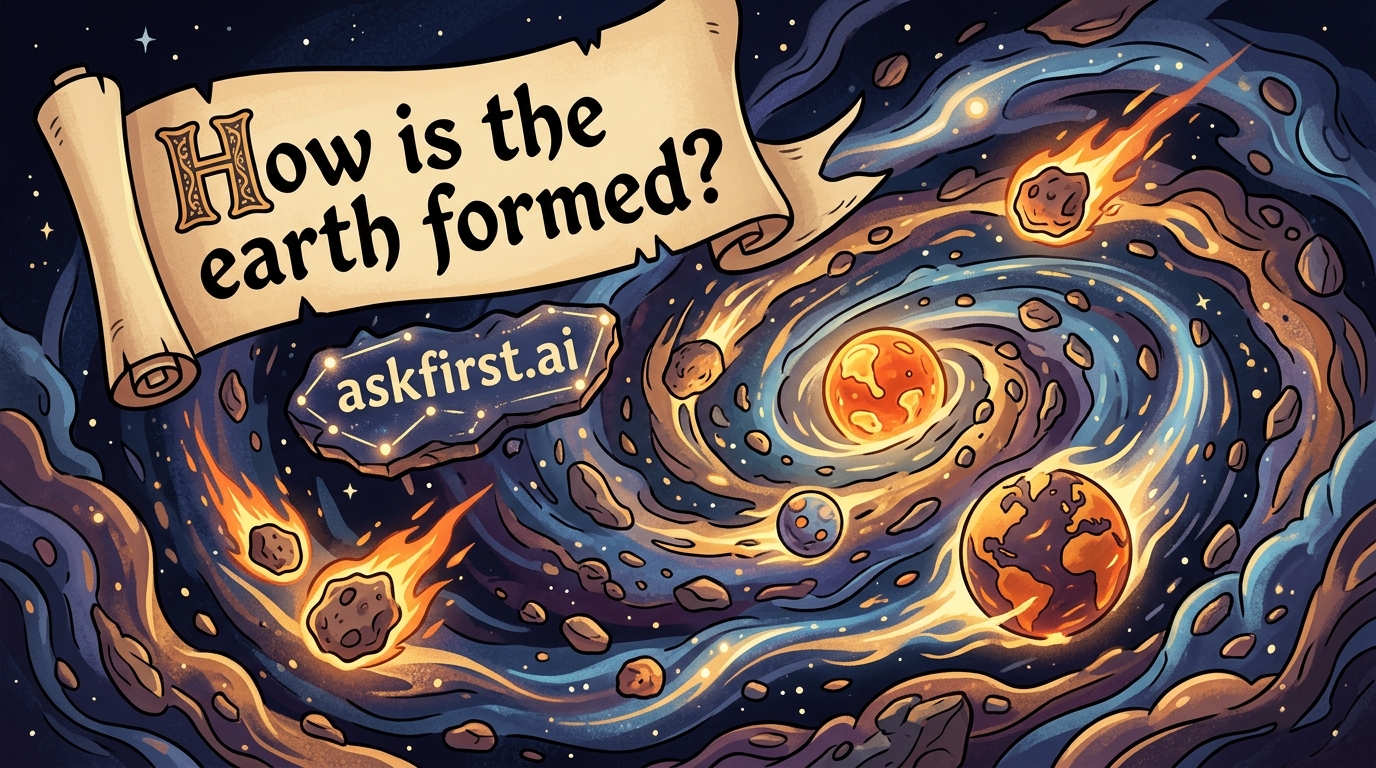
Approximately 4.6 billion years ago, a vast molecular cloud—a cold, dense region of interstellar gas and dust—began to collapse, likely triggered by the shockwave of a nearby supernova. As this cloud contracted under its own gravity, it flattened into a rotating protoplanetary disk known as the solar nebula.
According to the Nebular Hypothesis, first proposed in the 18th century by thinkers like Immanuel Kant and Pierre-Simon Laplace, the center of this disk grew increasingly dense and hot, eventually igniting to become our Sun. The material remaining in the outer disk began to clump together. Through a process called accretion, microscopic dust particles collided and stuck together due to electrostatic forces, gradually forming "planetesimals"—rocky bodies ranging from a few kilometers to hundreds of kilometers in diameter.
The Violent Era of Accretion
As these planetesimals grew, their gravitational pull increased, allowing them to attract more material. This era was characterized by constant, high-energy collisions. Earth formed in the "inner" part of the solar nebula, where temperatures were too high for volatile substances like water and methane to condense, resulting in a planet composed primarily of rock and metal.
During this stage, Earth was a molten, chaotic ball of magma. The heat generated by the constant bombardment of planetesimals, combined with the decay of short-lived radioactive isotopes like Aluminum-26 (as documented in The Formation of the Solar System by astronomer Michael Woolfson), kept the planet in a liquid state. This molten phase was crucial because it allowed for planetary differentiation. Heavier elements, primarily iron and nickel, sank toward the center of the planet due to gravity, forming the dense metallic core. Lighter silicate materials rose to the surface to form the mantle and the primordial crust.
The Great Impact: The Birth of the Moon
One of the most defining moments in Earth’s history occurred roughly 4.5 billion years ago, shortly after the planet’s formation. The Giant Impact Hypothesis posits that a Mars-sized protoplanet, often named Theia, collided with the young Earth.
The energy released by this impact was cataclysmic, liquefying the entire planet's surface and ejecting a massive amount of debris into orbit. Over time, this debris coalesced to form the Moon. Evidence for this theory, such as the isotopic similarity between Earth rocks and lunar samples brought back by the Apollo missions (notably analyzed in Lunar Sourcebook by Heiken, Vaniman, and French), confirms that the Moon is essentially a piece of the early Earth’s mantle. This impact also likely tilted Earth on its axis, giving us our seasons, and accelerated the planet's rotation.
Cooling, Differentiation, and the Atmosphere
As the bombardment slowed, Earth began to cool. The steam trapped within the molten interior began to escape through volcanic outgassing, creating the planet's secondary atmosphere. This early atmosphere, rich in water vapor, carbon dioxide, and nitrogen, eventually cooled enough for water to condense, leading to the formation of the first oceans.
The Hadean Eon—the earliest period of Earth's history—was a time of crustal hardening. As the surface cooled, the first igneous rocks formed. Geologists, such as those studying the Acasta Gneiss in Canada’s Northwest Territories (some of the oldest known crustal rocks at approximately 4.03 billion years old), have pieced together this timeline by analyzing zircon crystals. These microscopic crystals act as "time capsules," preserving the chemical conditions of the early Earth and proving that liquid water existed on the surface much earlier than previously thought.
Conclusion: A Dynamic Legacy
The formation of Earth was not a singular event but a prolonged, complex sequence of gravitational assembly, thermal differentiation, and massive kinetic impacts. From the swirling dust of a solar nebula to the stabilization of a molten sphere and the eventual cooling of its surface, Earth’s development provided the necessary physical and chemical conditions for life.
We live on a planet that is the result of billions of years of cosmic recycling. By studying the geological record, from the metallic core to the ancient zircons in the crust, we gain an appreciation for the precarious and precise circumstances that allowed Earth to transform from a hellish, molten rock into the blue, habitable cradle of life we call home. The story of our planet is one of continuous evolution, a testament to the enduring power of physics in the vast expanse of the universe.