The Neural Marvel of the Cephalopod
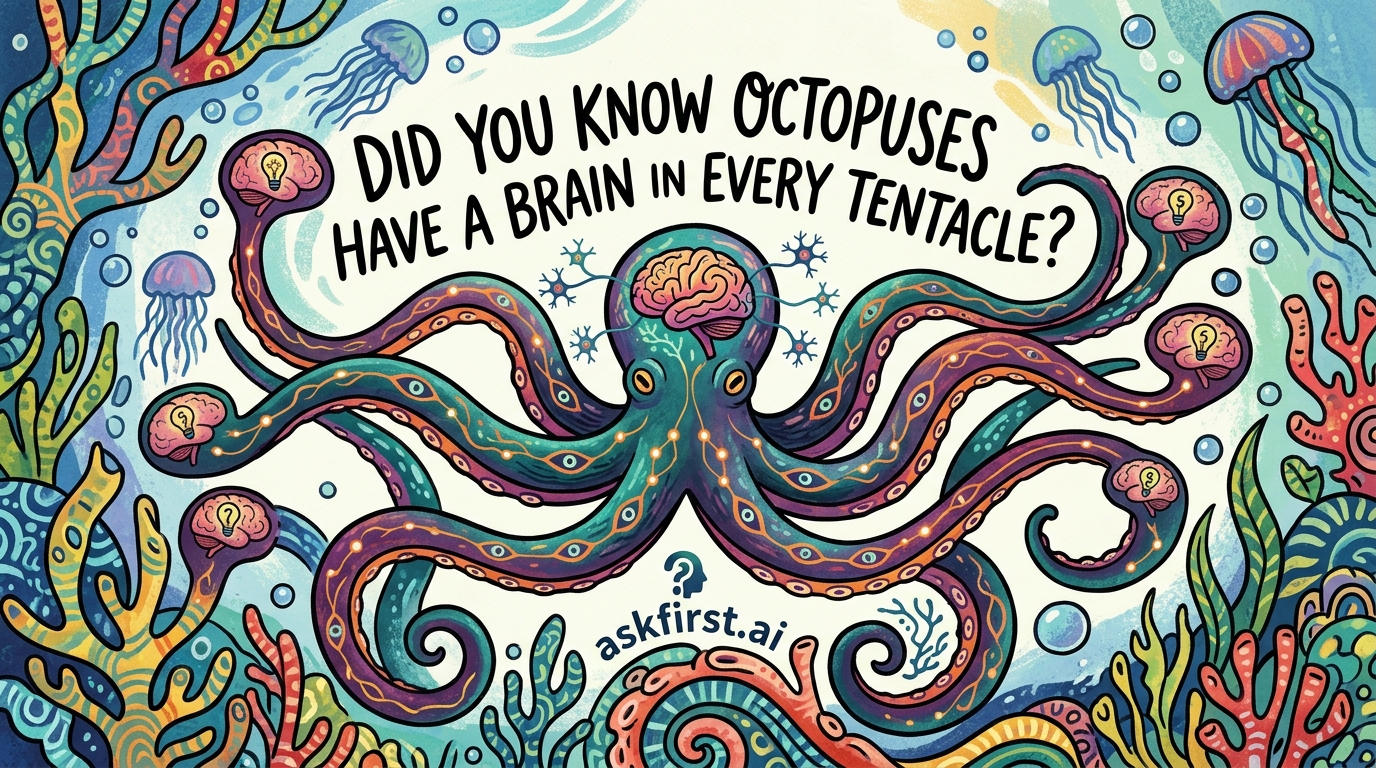
When exploring the depths of marine biology, few creatures spark as much wonder as the octopus. Often regarded as the closest thing to an extraterrestrial intelligence on Earth, the octopus possesses a nervous system that defies conventional biological logic. To answer the inquiry: yes, the notion that octopuses have a brain in every tentacle is a highly accurate characterization of their decentralized nervous system. Specifically, approximately two-thirds of an octopus's neurons are located in its arms rather than its central brain.
Decentralized Intelligence: How It Works
In most vertebrates, the brain acts as a central command station, sending electrical signals through a spinal cord to control movement. In contrast, the octopus employs a distributed control strategy. The central brain, located within the head, manages complex decision-making and sensory integration. However, the arms operate with a high degree of autonomy. Each arm possesses its own 'mini-brain' or neural ganglion, which functions as a peripheral processing center.
- Autonomous Movement: An octopus arm can perceive environmental cues, such as textures and chemicals, without input from the central brain.
- Reflexive Action: When an arm touches an object, it can trigger localized muscular responses—like exploring crevices or grasping items—instantly.
- Sensory Processing: With hundreds of thousands of neurons dedicated to suction cups, the arms effectively 'taste' and 'feel' the seafloor independently.
This architecture allows the animal to process massive amounts of sensory input simultaneously. If the central brain had to coordinate every single muscle fiber and suction cup movement, the cognitive load would be immense. Instead, the central brain issues 'high-level' commands—such as 'go explore that rocky outcrop'—and the arms negotiate the specific mechanics of navigating that terrain on their own.
The Evolutionary Advantage
This unique biological structure is a masterclass in evolutionary adaptation. Octopuses live in complex, three-dimensional environments filled with potential predators and prey. By offloading sensory processing to the arms, the animal gains significant speed and coordination benefits. It can investigate multiple holes simultaneously, manipulate shells to find crabs, and camouflage different parts of its body at the same time. This would be functionally impossible for a human, whose central nervous system would reach a bottleneck trying to process that level of independent limb activity.
Investigating the Science
Scientific study of these creatures—most notably by researchers such as Dr. Peter Godfrey-Smith and teams at institutions like the Marine Biological Laboratory—has demonstrated that even when an arm is detached, it continues to react to external stimuli. These arms show a form of primitive learning, reinforcing the idea that intelligence is not merely a product of the central skull. This decentralized system is a testament to the fact that 'intelligence' does not have to be concentrated in a single location to be highly effective.
Comparisons with Human Biology
To better understand this, consider the human nervous system. We rely heavily on a centralized hub. If the brain loses its connection to a limb, the limb becomes paralyzed. An octopus, however, treats its arms as semi-independent appendages. While the central brain maintains overall control and suppresses conflicting movements, the arms exhibit a 'brain-like' capacity for local processing. This fascinating divergence highlights the adaptability of life on Earth; while vertebrates went the route of centralized control, cephalopods thrived by diversifying their neural architecture.
The Future of Biological Inspiration
This phenomenon has profound implications for fields beyond biology. Robotics engineers and AI researchers study octopuses to design 'soft robotics.' Creating robots that can move through confined spaces by sensing the environment locally—rather than relying on a central, heavy CPU—is a direct application of the octopus's blueprint. The decentralized brain model offers a sustainable and efficient pathway for creating machines that can navigate unpredictable, complex environments.
Final Thoughts
The intelligence of the octopus is a humbling reminder of the diversity of cognitive evolution. Whether it is solving puzzles, navigating mazes, or displaying remarkable mimicry, the octopus functions as a living laboratory for neural complexity. The fact that its 'arms possess minds of their own' ensures that it remains one of the most agile, capable, and enigmatic predators in the ocean. This decentralized network is not just a biological quirk; it is a fundamental pillar of what makes the octopus a master of its aquatic realm.