The Cognitive Weight of Concealment
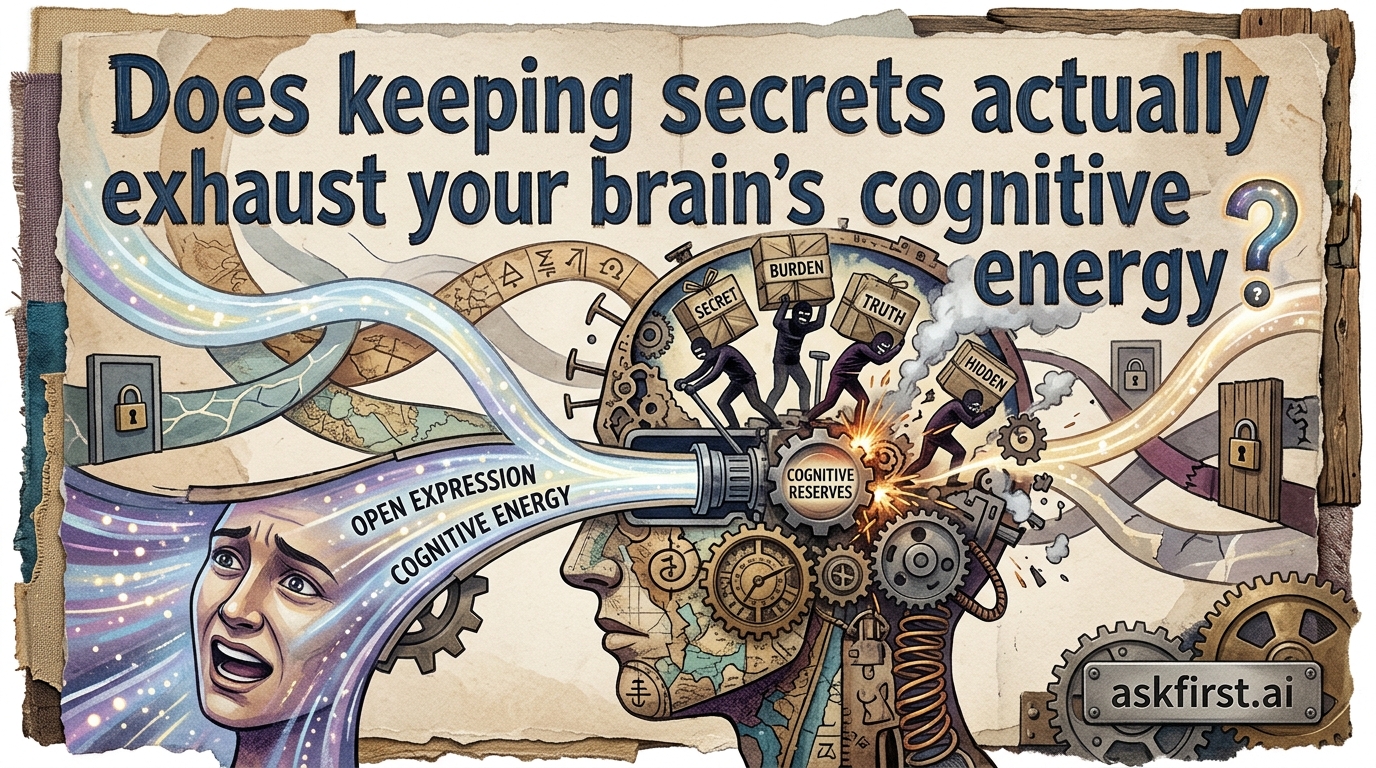
Human beings are social creatures, yet a significant portion of the human experience involves the deliberate concealment of information. From hiding a surprise birthday gift to shielding a professional ambition, secrets are universal. However, modern cognitive science suggests that keeping secrets is not merely a social act; it is a labor-intensive neurological process. When a person possesses information that must be withheld from others, the brain is forced into a state of persistent vigilance. This phenomenon, often termed 'concealment tax,' represents a genuine drain on cognitive resources, leading to measurable psychological and physiological exhaustion.
The Mechanism of Executive Functioning
At the heart of this exhaustion lies the prefrontal cortex, the area of the brain responsible for executive functions such as impulse control, planning, and focus. When a secret is held, the brain must perform a complex series of operations to avoid disclosure. This involves continuous monitoring of the environment to detect social cues that might lead to a slip of the tongue.
- Active Inhibition: The brain must constantly suppress the urge to communicate the hidden information.
- Social Simulation: The brain proactively creates scenarios to anticipate questions that might threaten the integrity of the secret.
- Self-Correction: After every social interaction, the mind audits the conversation to ensure no vital information was inadvertently revealed.
Because these functions share the same neurological circuitry required for complex reasoning and problem-solving, the cognitive load dedicated to secret-keeping inevitably reduces the efficiency of other mental tasks. Research published in the Journal of Personality and Social Psychology has indicated that individuals harboring secrets often perform more poorly on tests of physical stamina and mathematical problem-solving because their executive 'battery' is already heavily taxed by the act of concealment.
The Physiological Toll: Beyond the Mind
It is a fallacy to assume that mental effort is confined to the brain. Cognitive exertion triggers the sympathetic nervous system, the body's 'fight or flight' response. Studies have shown that when individuals attempt to hide information under social pressure, they exhibit increased blood pressure and elevated levels of cortisol, the body’s primary stress hormone.
Over long periods, the chronic activation of this stress response can lead to a phenomenon known as 'cognitive fatigue.' This is not mere tiredness but a biological state where the brain’s ability to process new information slows down. When the brain is busy managing the 'background task' of a secret, it experiences a drop in attentional capacity, making the person more prone to irritability, memory lapses, and a lack of creative clarity. This explains why people often feel 'heavier' or more lethargic while carrying a significant burden of secrecy.
The Paradox of Disclosure
Interestingly, the psychological relief experienced after finally sharing a secret—what is colloquially known as 'getting it off one's chest'—provides evidence for the energy-draining theory. Once a secret is revealed, the constant monitoring and inhibition cycles are terminated. This leads to a sudden influx of available cognitive resources. People often describe feeling 'lighter' because they are no longer dedicating metabolic energy to the maintenance of a social facade.
However, it is important to note that not all secrets carry the same weight. Research distinguishes between 'trivial secrets' and 'deep-seated personal secrets.' While hiding a small annoyance might require minimal effort, hiding core aspects of one’s identity or life history requires a massive, sustained effort that continuously gnaws at cognitive bandwidth.
Strategies for Mitigation
Understanding that secret-keeping consumes limited cognitive resources leads to a practical strategy: mindful disclosure. While not all information is meant to be public, learning to categorize information can help. If a piece of information is causing constant internal agitation, it acts as a 'background app' consuming mental processing power.
- Reflective Journaling: Writing down a secret can act as an external 'hard drive,' offloading the memory from the immediate, active-processing memory systems.
- Contextual Boundaries: Establishing clear rules about who needs to know what can reduce the 'vigilance' aspect of secret-keeping.
- Acceptance: Acknowledging the mental weight of a secret often reduces the anxiety associated with it, which in turn lowers the cognitive cost.
In conclusion, the brain is an energy-intensive organ that operates under strict resource constraints. By demanding that the brain play a perpetual game of hide-and-seek with social data, secret-keeping directly competes with the faculties needed for high-level thinking and sustained emotional well-being. Recognizing this reality serves as a powerful reminder of the value of transparency and the high biological cost of silence.