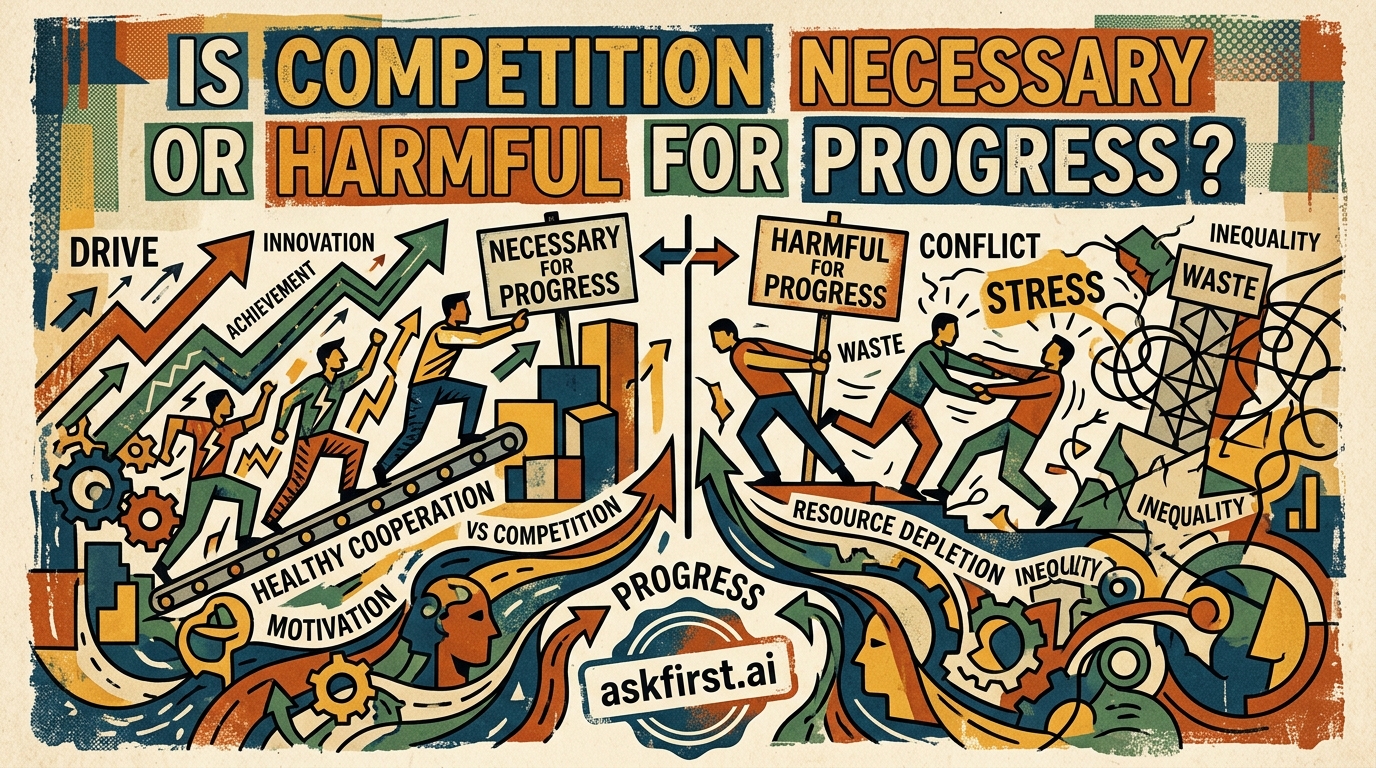
The Paradox of Competition: Catalyst for Evolution or Barrier to Progress?
The debate surrounding competition is as old as civilization itself. Whether observing the biological imperatives of Darwinian natural selection or the cutthroat dynamics of the global marketplace, one must grapple with a fundamental question: Is competition the engine of human advancement, or is it a destructive force that stifles true cooperation and innovation? The answer is not binary; rather, it is a complex intersection of incentives, psychological thresholds, and structural frameworks. To understand progress, one must view competition not as a goal in itself, but as a mechanism that, when properly calibrated, transforms potential energy into realized achievement.
The Evolutionary and Economic Case for Competition
At its core, competition acts as a filter for inefficiency. In his seminal work, The Wealth of Nations (1776), Adam Smith articulated the concept of the "invisible hand," arguing that individuals pursuing their own self-interest—often in direct competition with others—inadvertently promote the welfare of society. By competing for resources, market share, or prestige, agents are forced to lower costs, improve quality, and innovate.
Consider the "Space Race" of the mid-20th century. The intense geopolitical rivalry between the United States and the Soviet Union acted as a massive accelerant for technological progress. Without the existential pressure to outpace the adversary, the development of aerospace engineering, satellite telecommunications, and materials science would likely have been delayed by decades. In this context, competition provided the necessary urgency to overcome engineering bottlenecks that would have been ignored in a collaborative, yet complacent, environment.
Furthermore, in biological terms, as detailed in Richard Dawkins’ The Selfish Gene (1976), competition is the primary driver of adaptation. Organisms that fail to compete effectively for sustenance and reproduction do not pass on their traits. This "survival of the fittest" ensures that the species constantly refines its capabilities, leading to the complex biodiversity we witness today.
The Hidden Costs: When Competition Becomes Harmful
While competition drives speed and efficiency, it can also induce significant systemic harm. When competition is stripped of ethical boundaries or long-term vision, it often leads to the "tragedy of the commons." This concept, famously explored by Garrett Hardin in his 1968 essay published in Science, illustrates how individual actors, competing for a shared resource, will inevitably exhaust it to the detriment of all.
In modern corporate environments, excessive internal competition—often fostered by "stack ranking" performance reviews—can create a toxic culture. When employees are pitted against one another for limited bonuses or promotions, the incentive to share knowledge vanishes. This hoarding of information creates organizational "silos," which stagnate company-wide innovation.
Moreover, hyper-competition often leads to "short-termism." Corporations focused solely on quarterly earnings reports to beat competitors will often neglect foundational Research and Development (R&D) that takes years to bear fruit. As noted by Clayton Christensen in The Innovator’s Dilemma (1997), companies that are obsessed with defending their current market position against existing competitors often fail to see the "disruptive innovations" emerging from the periphery, eventually leading to their obsolescence.
The Synthesis: Competition as a Tool, Not a Religion
The most progressive systems—whether in biology, economics, or organizational management—are those that balance competition with high-trust cooperation. This is often referred to as "coopetition."
A concrete example of this is the open-source software movement. Developers compete fiercely to build the most robust, secure, and feature-rich code, yet they do so on a foundation of shared, public knowledge. By competing to contribute to the best version of the software, they collectively build a product that no single entity could have created alone. This illustrates that competition is most effective when it occurs on top of a collaborative infrastructure rather than in place of it.
Psychologically, competition can be a powerful motivator, but it requires a "growth mindset," a term coined by psychologist Carol Dweck in her book Mindset: The New Psychology of Success (2006). When individuals view competition as a way to measure and improve their own performance against an external benchmark rather than a way to diminish others, it becomes a source of inspiration. Conversely, when competition is tied strictly to ego and zero-sum outcomes, it breeds anxiety, burnout, and unethical behavior.
Conclusion: The Architecture of Future Progress
Is competition necessary or harmful? It is both. It is a potent, high-octane fuel that can power the engine of progress toward incredible heights, but it is also highly corrosive if allowed to leak into the delicate machinery of human collaboration.
The path forward lies in designing systems that harness the energy of competition while preventing it from becoming a zero-sum war. We must foster environments where individuals and institutions compete to solve the most difficult problems, rather than competing to consolidate power or extract short-term rent. Progress is not merely the result of being "better" than the person next to you; it is the result of using that drive to push the boundaries of what is possible for everyone. By tempering competition with a commitment to shared progress, we ensure that the race we are running is one that leads to a sustainable and prosperous future.