The Illusion of Temporal Perception
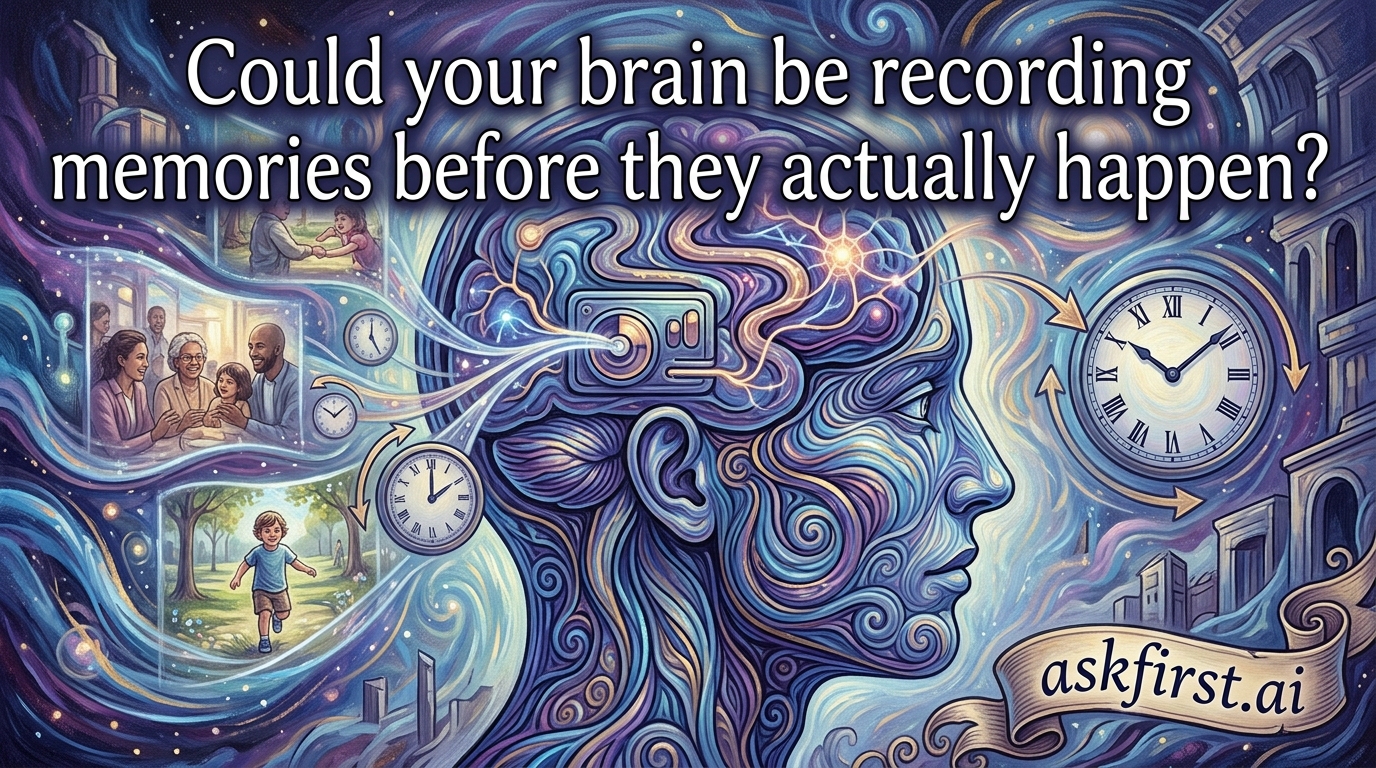
Human perception is often viewed as a linear, chronological process. We experience the world through a sequence of moments, storing them as discrete memories that form a coherent narrative of our lives. However, the phenomenon of precognitive cognition and the quirks of neural timing challenge this intuition. Could the brain essentially be 'editing' the flow of time, creating a sense of anticipation that borders on memory? This investigation delves into the intersection of neurobiology and temporal consciousness.
Neuro-Chronometric Delays and Processing Latency
Scientific study of neural pathways indicates that there is a significant lag between a physical event and the brain's conscious awareness of it. It takes approximately 80 to 100 milliseconds for sensory information to reach the brain and be synthesized into a conscious 'now.' To compensate for this processing speed, the human brain engages in proactive temporal construction. It effectively predicts the state of the world to bridge the sensory gap. This means that at any given moment, a substantial portion of what is perceived is a calculated extrapolation—a predictive simulation of what is likely occurring, rather than a direct, raw recording of reality.
The Role of Predictive Coding in Memory
Modern neuroscience, particularly the Predictive Processing framework championed by researchers like Karl Friston, suggests that the brain is not a passive receiver of data but an active inference machine. It generates internal models of the environment to anticipate sensory input. When these predictions align with reality, the brain stores them as 'predicted experiences.'
- Schema Formation: The brain uses existing schemas to prepare for anticipated outcomes.
- Simulated Anticipation: By firing neurons in patterns associated with future events, the brain creates a 'pre-memory' that feels remarkably similar to a genuine recollection once the actual event unfolds.
This process is highly efficient, allowing humans to react to threats or opportunities before the full sensory picture has been processed. When the reality catches up with the simulation, the brain creates a sense of continuity, often indistinguishable from memory.
The Deja Vu Mechanism
Deja vu provides a relatable look into these neural glitches. Often explained as a sensory 'mismatch,' it occurs when information hits the brain through two different pathways at slightly different times. The brain interprets the secondary, slower transmission as a memory of a primary, already-experienced event. This is not necessarily an instance of seeing the future, but rather an instance of the brain failing to sequence its input correctly, leading to the subjective feeling that a 'memory' was formed before the full experience was concluded.
Quantized Time and Neural Oscillations
There is ongoing debate regarding whether neural processing happens in discrete chunks or a continuous stream. Research into gamma-band oscillations suggests that the brain samples information in brief frames—similar to the shutter speed of a camera. If these sampling frames fluctuate, the brain may experience internal 'reordering.'
- Temporal Elasticity: High-stress situations often trigger a 'fight or flight' response that accelerates mental sampling.
- The Subjective Snapshot: During these high-arousal moments, the density of information storage increases, which can create the illusion that one has lived through an event multiple times or remembered it before it reached a logical conclusion.
Ethical and Psychological Implications
Understanding that our brains are essentially 'predictive engines' shifts our perspective on memory reliability. Memory is not a camera roll; it is a creative reconstruction. If the brain is constantly predicting the next second, the distinction between a 'prediction' and a 'memory' becomes a matter of neural threshold rather than chronological certainty.
Conclusion
While science does not support the concept of clairvoyance or mystical time travel, the biological reality is arguably just as fascinating. The human brain is a time-transcending machine that works relentlessly to simulate, predict, and integrate information. By generating predictive models, we effectively live in a state of 'anticipatory memory.' We are not just recording history; we are inventing it in real-time, based on the patterns of the past and the expectations of the next millisecond. The sense that you have experienced something before might simply be your brain’s way of showing you its work, revealing the complex, invisible architecture of human consciousness.