The Dawn of Captured Time
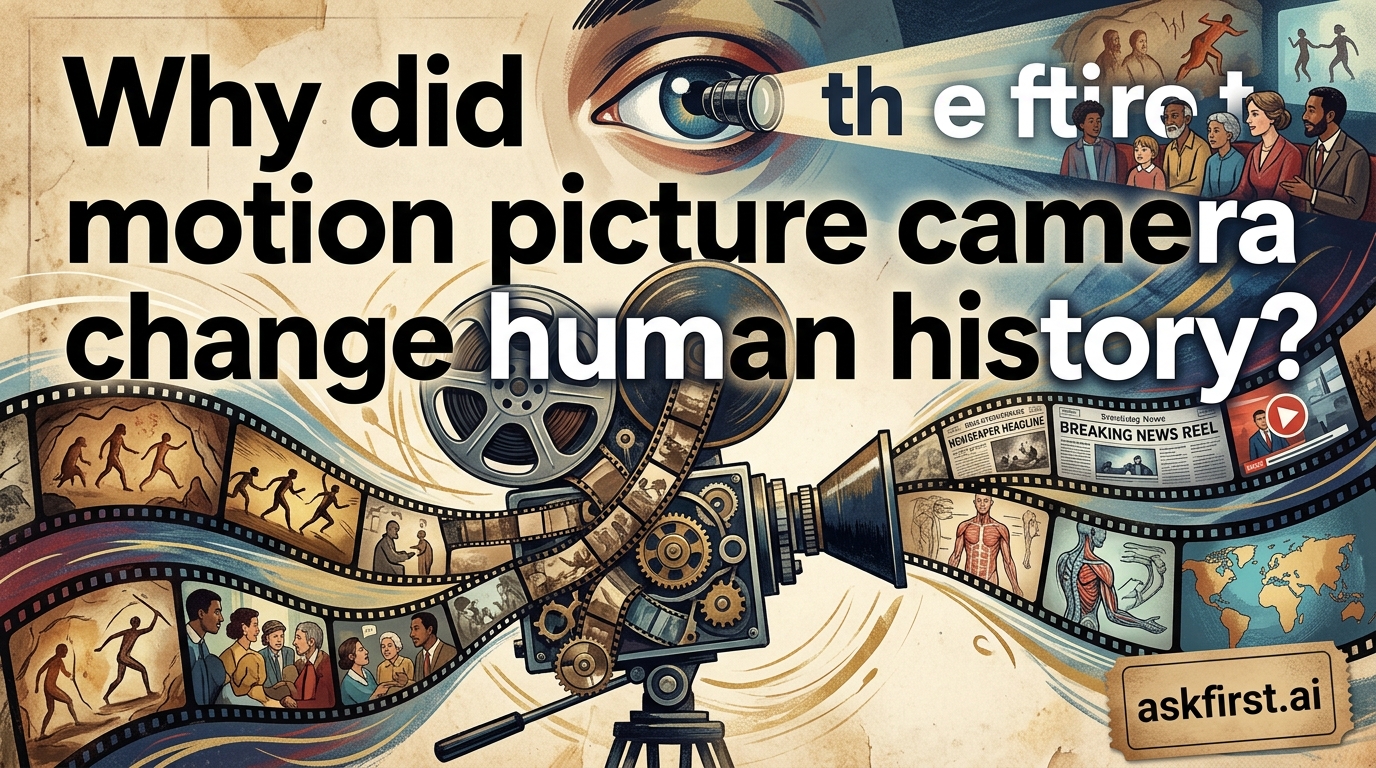
The invention of the first motion picture camera serves as one of the most profound turning points in the narrative of human civilization. Before this technological marvel emerged, human memory was anchored solely to static images, written records, and oral traditions—all of which were filtered through the subjective lens of the creator. The ability to mechanically capture motion, light, and duration fundamentally altered how humanity perceives reality, archives its history, and communicates across generational divides.
Breaking the Limits of Human Perception
At its core, the motion picture camera did something that philosophers and scientists had dreamed of for centuries: it turned time into a tangible, reproducible object. Before the Kinetoscope and the Cinématographe, life was experienced as a continuous, fleeting stream of sensory input. Once the camera arrived, society gained the ability to 'freeze' and 'replay' the fabric of life. This shifted the human experience from a transient existence to one that could be archived.
- Democratization of Experience: It allowed individuals in one corner of the globe to witness the rituals, landscapes, and daily struggles of people thousands of miles away, fostering global empathy.
- Scientific Advancement: Scientists could now study micro-movements, biological patterns, and mechanical processes that were too fast for the naked eye to process, fundamentally changing the fields of physics and medicine.
The Birth of Visual Language
Beyond mere documentation, the camera birthed an entirely new form of human communication: cinema. This technology didn't just record; it allowed for the construction of narratives. By manipulating the sequence of frames, editors and directors discovered that they could manipulate human emotion. This gave rise to the 'language of film'—a universal syntax of close-ups, wide shots, and montage sequences that transcend spoken language barriers. This was the first time in history that a collective cultural consciousness could be shaped by a shared visual experience.
Challenging the Myth of Objective Truth
Perhaps the most transformative aspect of this innovation was the sudden, complex relationship between 'the truth' and the visual record. While early audiences treated the footage as indisputable fact, society eventually learned that the camera could lie. Through framing, editing, and lighting, reality could be manufactured. This realization catalyzed the development of critical media literacy, forcing humanity to question the authenticity of what it sees. This skepticism has become a cornerstone of modern intellectual thought.
A Legacy of Infinite Retention
Historians now categorize human history into two distinct eras: the 'Pre-Cinematic' and the 'Cinematic.' The former remains mysterious, relying on inference and physical remains, while the latter offers a vivid, visceral window into the past. We possess the ability to look back at the beginning of the twentieth century and see the movement, hear the cadence of speech, and observe the fashions and mannerisms of ancestors as if they were present.
The Ever-Present Impact
This technology has evolved into the digital medium we carry in our pockets today. Every time a person captures a video of a significant life event or a profound social shift, they are continuing the revolution started by the Lumière brothers. The motion picture camera did more than capture light; it granted humanity a kind of immortality. It ensured that no era would ever truly be forgotten, and it provided a mirror in which the human race could constantly examine, critique, and celebrate its own evolution.
Conclusion: The Everlasting Mirror
In summary, the motion picture camera is the bedrock of modern visual culture. It transformed society from a collection of isolated, local communities into a globally interconnected species. By capturing the kinetic energy of human life, it provided the tools necessary to analyze, understand, and preserve our collective journey. As we look toward the future, the influence of this device remains undiminished; it continues to act as the primary vessel for human creativity, truth-seeking, and historical memory. The world did not just observe the invention of a camera; it witnessed the birth of a new way of being.