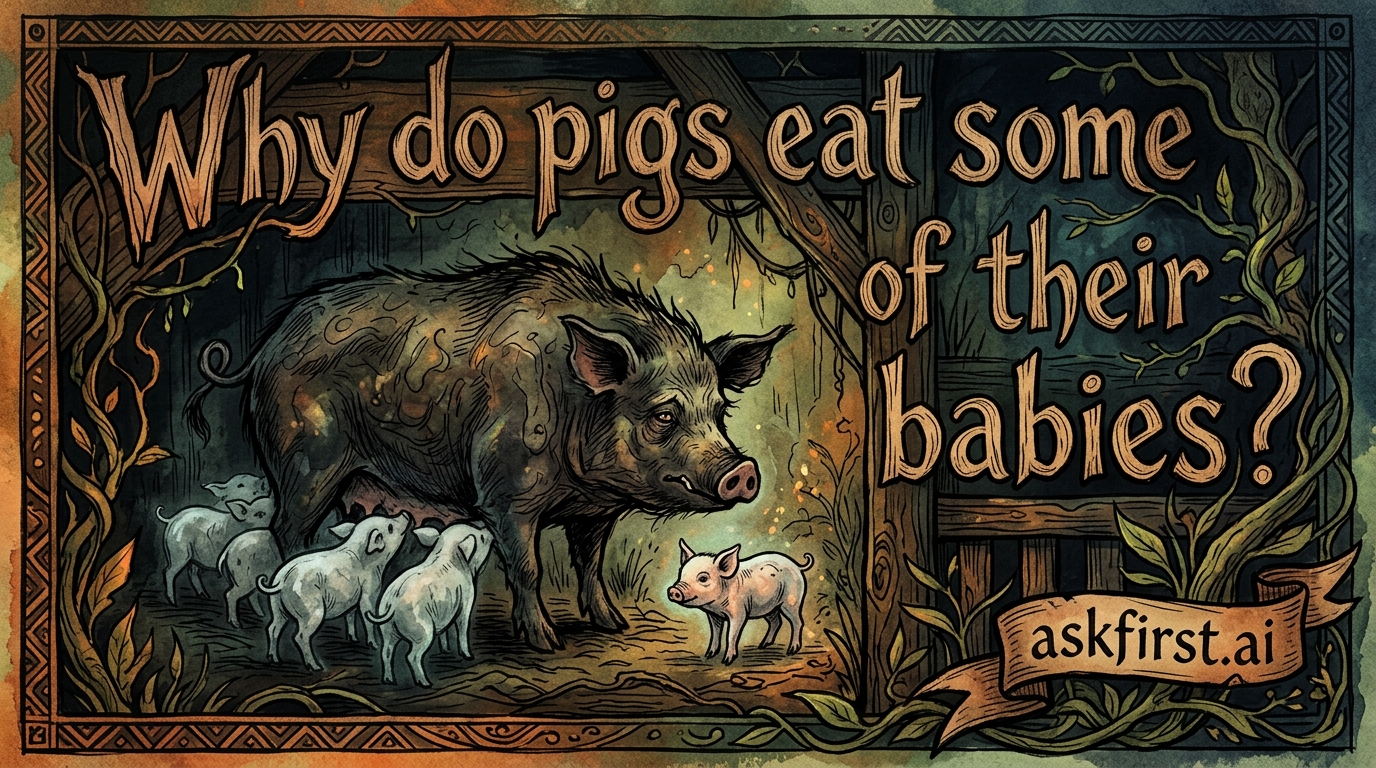
The Biological and Behavioral Drivers of Maternal Filial Cannibalism in Swine
The phenomenon of maternal filial cannibalism—where a sow consumes one or more of her piglets shortly after birth—is a distressing yet biologically documented behavior in Sus scrofa domesticus. While it contradicts the deep-seated evolutionary drive to propagate one's genetic lineage, it is rarely an act of "malice." Instead, it is typically an extreme physiological or psychological response to environmental stressors, health complications, or hormonal imbalances. Understanding why this occurs requires a deep dive into porcine ethology, veterinary science, and modern husbandry practices.
1. The Stress-Induced "Fight or Flight" Response
In commercial and small-scale farming alike, the farrowing (birthing) environment is a critical period. When a sow is placed in a confined space, such as a farrowing crate, her cortisol levels can spike significantly. According to Temple Grandin, a professor of animal science at Colorado State University and author of Animals in Translation, pigs are highly sensitive to environmental stressors. If a sow feels threatened, insecure, or unable to control her surroundings, her maternal instincts can be overridden by a primal "panic" response.
When a sow is in a state of extreme agitation, she may perceive the movement of her own piglets as a threat or a source of pain. If she is experiencing a difficult labor (dystocia), the pain may cause her to lash out. In some cases, the sow accidentally kills a piglet during a thrashing episode; once the piglet is dead and blood is present, the sow’s scavenging instinct—pigs are natural omnivores—may lead her to consume the carcass. This is often not an act of predation, but rather an act of cleaning or scavenging that spirals into cannibalism.
2. Nutritional Deficiencies and Metabolic Imbalance
Nutrition plays a foundational role in maternal behavior. If a sow is suffering from a severe deficiency in essential minerals or proteins, her body may trigger a desperate search for supplemental nutrients. Research outlined in The Ethology of Domestic Animals by Per Jensen suggests that sows lacking in sodium, phosphorus, or certain amino acids may exhibit pica—the consumption of non-food items or, in extreme cases, animal matter.
If the sow’s diet during late gestation is inadequate, she may lack the metabolic reserves necessary to sustain lactation. In nature, a sow that cannot adequately feed her litter might consume a portion of it to regain the energy required to support the remaining offspring. While this sounds brutal, from an evolutionary standpoint, it is a "sunk cost" calculation: it is better to sacrifice one offspring to ensure the survival of the others than to have the entire litter perish due to maternal starvation.
3. The Role of Hormones and Maternal Priming
The hormonal cascade surrounding parturition is delicate. Oxytocin, the "bonding hormone," is essential for milk letdown and the establishment of maternal care. If a sow experiences a hormonal disruption—often caused by high stress or illness—she may fail to recognize her piglets as her own.
This is particularly common in primiparous sows (those giving birth for the first time). Without the "maternal priming" that comes from previous experience, a first-time mother may be overwhelmed by the sensory input of the birth process. If she does not recognize the piglets as her progeny, she treats them as foreign objects or prey items. This failure of recognition is why experienced farmers often keep a close watch on gilts during their first farrowing.
4. Pain and Physical Trauma
A common, yet often overlooked, cause of piglet cannibalism is the pain associated with nursing. If a sow has developed mastitis (an infection of the mammary glands) or if her teats are cracked and bleeding, the piglets’ attempts to nurse can be intensely painful. When a piglet latches on, the sow experiences a sharp, stinging sensation. If this occurs repeatedly, the sow may develop an aggressive aversion to her offspring. She may bite at the piglets to stop them from nursing, and once the biting begins, the transition to full-blown cannibalism is a short, tragic step.
5. Environmental Factors and Herd Density
The physical environment is perhaps the most manageable factor in preventing this behavior. Overcrowding and noise pollution are major contributors. In The Pig: A Natural History by Richard Lutwyche, the author notes that pigs are highly social animals that require a degree of seclusion during the farrowing process. If a sow is kept in a high-traffic area where she feels exposed to other pigs or humans, her anxiety levels remain elevated. Providing a quiet, dimly lit, and temperature-controlled environment is the standard recommendation by the American Association of Swine Veterinarians (AASV) to mitigate the risk of cannibalistic behavior.
Conclusion
Maternal cannibalism in pigs is a multifaceted issue rooted in the intersection of biology, environment, and physical health. It is rarely a result of a "vicious" nature. Instead, it is an indicator that the sow is suffering from extreme stress, nutritional inadequacy, or physical pain. By ensuring proper prenatal nutrition, minimizing environmental stressors, and monitoring the health of the sow’s mammary glands, farmers can significantly reduce the likelihood of this behavior. Understanding these triggers allows for more humane animal management, shifting the focus from blame to proactive care and environmental optimization.